How Many Players Are on a Youth Soccer Team? Formats by Age
 Reviewed by Roman PivarnikUEFA Pro Licence · Technical Director, Slovak FA
Under U.S. Soccer's national standards, a youth soccer team plays 4v4 with no goalkeeper through U8, 7v7 at U9 and U10, 9v9 at U11 and U12, and full 11v11 starting at U13. Those numbers aren't arbitrary, and they aren't up to your club — since August 2017 they've been mandatory for every U.S. Soccer member organization, including US Youth Soccer, US Club Soccer, and AYSO.
The number on the field is only half the answer, though. The number on the roster is a separate rule, the field shrinks and grows with the format, and a few things you'd expect to see in a soccer match — offside, punts, headers — either don't exist or work differently depending on how many players are out there. Here's the complete picture, straight from the standards themselves.
How many players are on a youth soccer team at each age?
This is the chart most parents are looking for. Every row comes from U.S. Soccer's Player Development Initiatives, the document that sets small-sided standards for players 12 and younger.
| Age group | Format | On the field | Goalkeeper? | Ball size | Max roster |
|---|---|---|---|---|---|
| U6, U7, U8 | 4v4 | 4 per team | No | 3 | No formal roster |
| U9, U10 | 7v7 | 6 field players + 1 GK | Yes | 4 | 12 |
| U11, U12 | 9v9 | 8 field players + 1 GK | Yes | 4 | 16 |
| U13 and above | 11v11 | 10 field players + 1 GK | Yes | 5 | Set by the league |
Two things surprise people here. First, the roster caps are much tighter than most clubs assume — a 7v7 team is supposed to carry no more than 12 players, and a 9v9 team no more than 16. Second, the small-sided standards stop at U12. Once players reach U13 and move to 11v11, roster size, game counts, and field dimensions go back to whatever the league or state association sets.
If you're still working out which age group your child falls into in the first place, our guide to youth soccer age groups breaks down the U-number system in detail.
Small-sided games give each player more touches, but only on game day. These 10 drills need nothing but a ball and add the touches practice cannot. FlickTec builds a new personalized home session every day. Free 7-day trial.
Why doesn't youth soccer just play 11v11?
Because a 7-year-old on a full-size field touches the ball almost never.
U.S. Soccer's stated reasoning is blunt: "Kids under the age of 12 don't win World Cups so we should not treat them like adults or professional players." The small-sided formats exist to develop improved skills with the ball, faster decisions and better awareness, and genuine partnerships between teammates — outcomes that require a player to actually be involved in the game rather than standing forty yards from the action.
Fewer players on a smaller field means more touches, more one-v-one moments, and more decisions per minute for every child on the roster. That's also why the standards mandate that every player should play a minimum of 50% of the time in each game at both 7v7 and 9v9. The format is engineered around participation.
The same logic drives training design, which is why small-sided games are the backbone of good practice sessions at every level, not just game day.
What does 4v4 look like at U6 to U8?
4v4 is deliberately barely a "game" at all. The standards say formal games aren't needed, and neither are formal rosters — clubs are encouraged to run in-house programs where kids train and play as a fluid pool rather than as fixed teams. When a game is played, having about six players per side maximizes participation.
The specifics:
- Field: 25–35 yards long, 15–25 yards wide
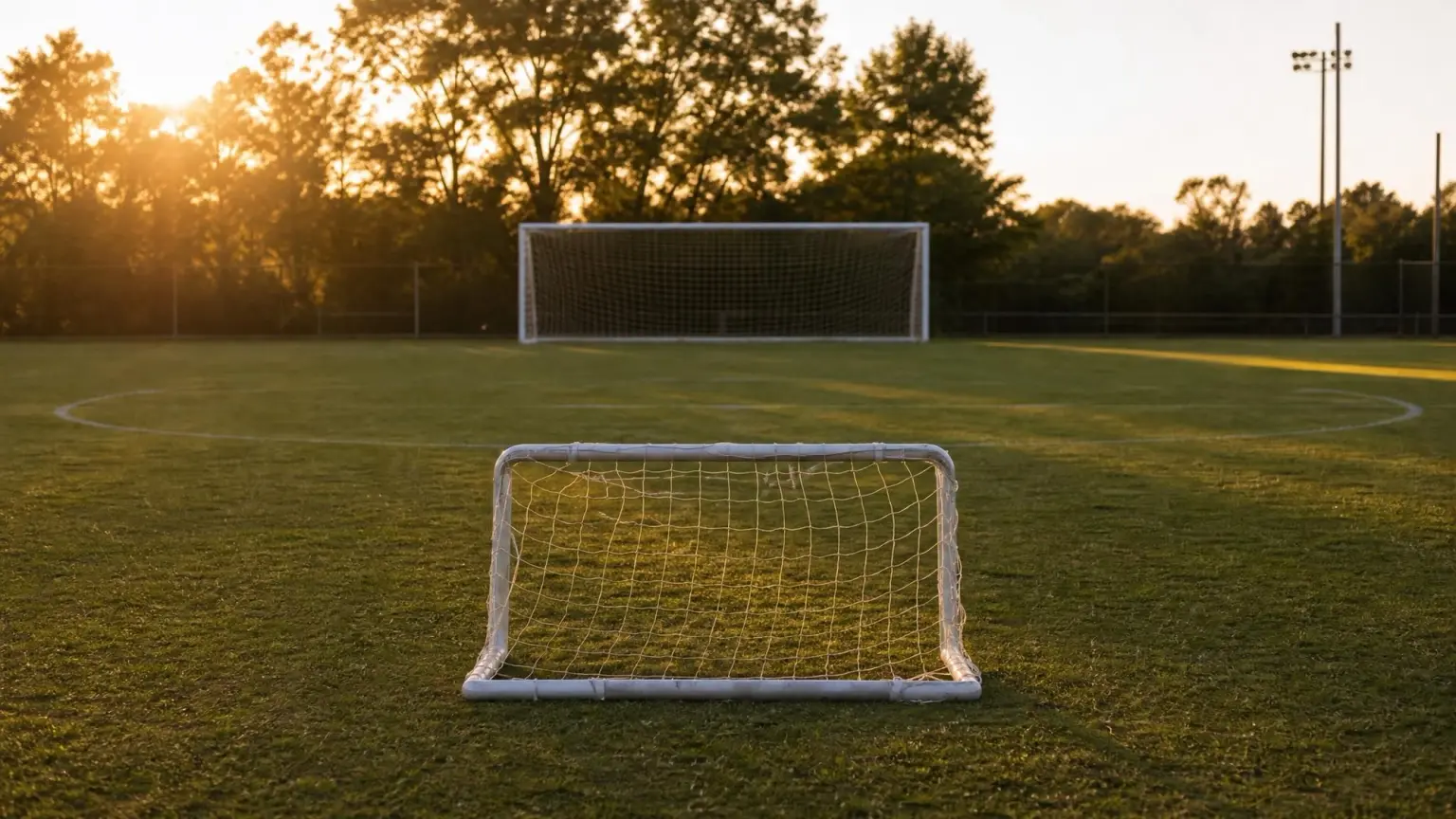
- Goals: no larger than 4 feet high by 6 feet wide
- Game time: four 10-minute quarters, with 5-minute breaks between them
- No goalkeepers, no penalty kicks, no offside
- All free kicks are indirect, and opponents stand 10 feet from the ball on restarts
- Shin guards are required; corner flags aren't needed
- No registered referees. Coaches manage the game from the touchline
- Deliberate heading is not allowed. A deliberate header gives the other team an indirect free kick
The standards also say results and standings should not be recorded, travel should be limited, and players at this age should not be in tournaments, showcases, or festivals at all.
What changes at 7v7 (U9 and U10)?
Three big things arrive at once: a goalkeeper, the offside rule, and the build-out line.
The build-out line is the rule most new soccer parents find baffling. It's a line across the field on each side, positioned equidistant between the penalty area line and the halfway line. It does two jobs:
- It creates space to play out of the back. When the goalkeeper catches the ball in play, or on any goal kick, the entire opposing team must retreat behind the build-out line until the ball is back in play. Once the ball is played, they can cross it and the game resumes normally.
- It marks where offside applies. Players cannot be penalized for offside between the halfway line and the build-out line. They can be penalized between the build-out line and the goal line. For how offside itself works — the two-part test, and how it expands as players age up — see our full guide to the offside rule in youth soccer.
There's a related rule that catches goalkeepers out constantly: punts and drop kicks are not allowed in 7v7. Once the opposition is behind the build-out line, the keeper may pass, throw, or roll the ball into play — nothing else. A punt or drop kick hands the opposing team an indirect free kick. If you're coaching this age group, our guide to coaching goalkeepers at the youth level covers how to teach distribution inside these constraints.
The rest of the 7v7 picture:
- Field: 55–65 yards by 35–45 yards
- Goals: no larger than 6.5 feet by 18.5 feet, though a 6.5 x 12 foot goal is recommended depending on the players' age and ability
- Game time: two 25-minute halves, 10-minute halftime, no added time
- Ball: size 4
- A game cannot start or continue with fewer than 5 players on a team
- Substitutions are unlimited, at any stoppage — though whether a substituted player can come back on, and exactly when a sub is allowed, changes by level, which we break down in our guide to youth soccer substitution rules
- Deliberate heading is not allowed
- Players should play no more than 20 games per calendar year, and never more than one game in a day
- Players should get a minimum of 2 rest days per week during the season
That 20-game ceiling and the two-rest-day minimum are the two rules clubs break most often, and they're the ones with the clearest link to burnout and overuse injury.
What changes at 9v9 (U11 and U12)?
9v9 is the last stop before the full game, and it's where soccer starts to look like soccer.
- Field: 70–80 yards by 45–55 yards
- Goals: no larger than 7 feet by 21 feet, with 6.5 x 18.5 feet recommended
- Game time: two 30-minute halves, 10-minute halftime
- Ball: size 4
- A game cannot start or continue with fewer than 6 players on a team
- No build-out line. Offside now works exactly as it does in the adult game, across the whole attacking half
- Players should play no more than 30 games per calendar year
- Roster capped at 16
Heading is the one genuinely confusing rule at this level. Deliberate heading is not allowed in U11 games — a deliberate header concedes an indirect free kick. It is currently allowed in U12 games without limitation, though U.S. Soccer explicitly empowers its member organizations to limit or ban heading at U12 if they choose. In practice this means the U12 heading rule genuinely varies by league, so ask your club rather than assuming.
With a bigger field, a real offside line, and eight outfield players, this is also the age where positional roles start to mean something. Our guide to soccer positions for youth players is a useful primer if your child is suddenly being asked to play "the eight." It's also where coaches start picking a real team shape — our guide to youth soccer formations by age covers the best 7v7, 9v9, and 11v11 setups.
Is U12 soccer 9v9 or 11v11?
Under the U.S. Soccer standard, U12 is 9v9. The small-sided mandate covers players 12 and younger, which makes U13 the first age group that plays full 11v11 on a full-size field with a size 5 ball.
Leagues do vary in practice, and some competitive clubs move players to 11v11 earlier than the standard suggests. If your U12 team is playing 11v11, that's a league decision, not the national standard. Either way, the jump is a real developmental cliff — twice the field, twice the running, and a tactical picture that's genuinely harder to read. Making it deliberately is worth the effort, and we've written a full guide to transitioning players from small-sided to 11v11.
What size ball and field go with each format?
Ball size tracks the format exactly: size 3 for 4v4, size 4 for both 7v7 and 9v9, and size 5 from U13 onward. A common mistake is buying a size 5 ball for a 10-year-old because it's what the older kids use — at U10 the correct ball is a size 4, and using the wrong one makes striking and receiving meaningfully harder. Our soccer ball size guide by age covers the sizing in depth.
| Format | Field (yards) | Max goal (feet) | Game length |
|---|---|---|---|
| 4v4 | 25–35 × 15–25 | 4 × 6 | 4 × 10-min quarters |
| 7v7 | 55–65 × 35–45 | 6.5 × 18.5 | 2 × 25-min halves |
| 9v9 | 70–80 × 45–55 | 7 × 21 | 2 × 30-min halves |
| 11v11 | Full size | 8 × 24 | Varies by age group |
Note that the field figures are ranges — clubs pick a size within them — while the goal figures are hard maximums.
For the full breakdown — every field size and marking from the 4v4 micro-pitch to a regulation 11v11 field, plus the penalty area, goal box, and build-out line — see our dedicated guide to how big a youth soccer field is at each age.
And if that game-length column raises more questions than it answers — halftime, overtime, and the exact half lengths from U13 all the way to U19 — we've broken down how long youth soccer games last at every age in its own guide.
What this means for your child's development
The formats are designed so that the game itself teaches. But a 7v7 roster of 12 means your child is on the field roughly half the time, in two 25-minute halves, maybe once a week. That's not many minutes with the ball, and it's exactly why the standards recommend a training-to-game ratio of two to three training sessions for every game played.
Most of a young player's touches have to come outside the match. That's the gap FlickTec is built to fill — short, structured individual sessions that add ball time between team practices without adding another car ride.
Frequently Asked Questions
How many players are on a youth soccer team?
It depends on the age group. Under U.S. Soccer's standards, U6 through U8 play 4v4 with no goalkeeper, U9 and U10 play 7v7 (six field players plus a goalkeeper), U11 and U12 play 9v9 (eight field players plus a goalkeeper), and U13 and older play the full 11v11. Roster limits are separate: no more than 12 players at 7v7 and no more than 16 at 9v9.
Is U12 soccer 9v9 or 11v11?
U12 is 9v9 under the U.S. Soccer standard, because the small-sided standards apply to all players 12 and younger. U13 is the first age group that plays 11v11. Some leagues move to 11v11 earlier, so check with your club.
How many players are on a U10 soccer team?
A U10 team plays 7v7 — six field players and one goalkeeper. The roster should include no more than 12 players, and every player should get at least 50% of the playing time in each game.
What is the build-out line in youth soccer?
The build-out line is used in 7v7 at U9 and U10. It sits equidistant between the penalty area line and the halfway line. When the goalkeeper has the ball in hand or takes a goal kick, the opposing team must retreat behind it until the ball is in play, which lets the team build possession out of the back without pressure. It also marks the boundary for offside: offside can only be called between the build-out line and the goal line.
Can kids head the ball in youth soccer?
Deliberate heading is not allowed in 4v4, in 7v7, or in U11 games, and a deliberate header results in an indirect free kick for the opposing team. Heading is currently allowed at U12 without limitation, but U.S. Soccer allows its member organizations to limit or ban it at that level, so rules vary by league. Teaching heading technique with lightweight balls, such as foam balls or balloons, away from any opposition, is permitted at all ages.
The formats look like a technicality until you watch a U9 game on a full-size field with eleven players a side. Half the team never touches the ball, the goalkeeper punts it back and forth, and nobody learns anything. The small-sided standards exist because the shape of the game determines what a child gets to practice. Knowing which format your child should be playing — and how many teammates should be on that roster — is a reasonable thing for a parent to check.