All 11 Soccer Positions Explained: Names, Numbers & Roles
 Reviewed by Roman PivarnikUEFA Pro Licence · Technical Director, Slovak FA
Every soccer team has 11 players on the field, and each one plays a specific position with a unique job. Understanding soccer positions helps young players find where they fit, helps parents follow the game, and helps coaches build balanced teams. The four main groups are goalkeeper, defenders, midfielders, and forwards, but each group contains several specialized roles.
What are all 11 positions in soccer?
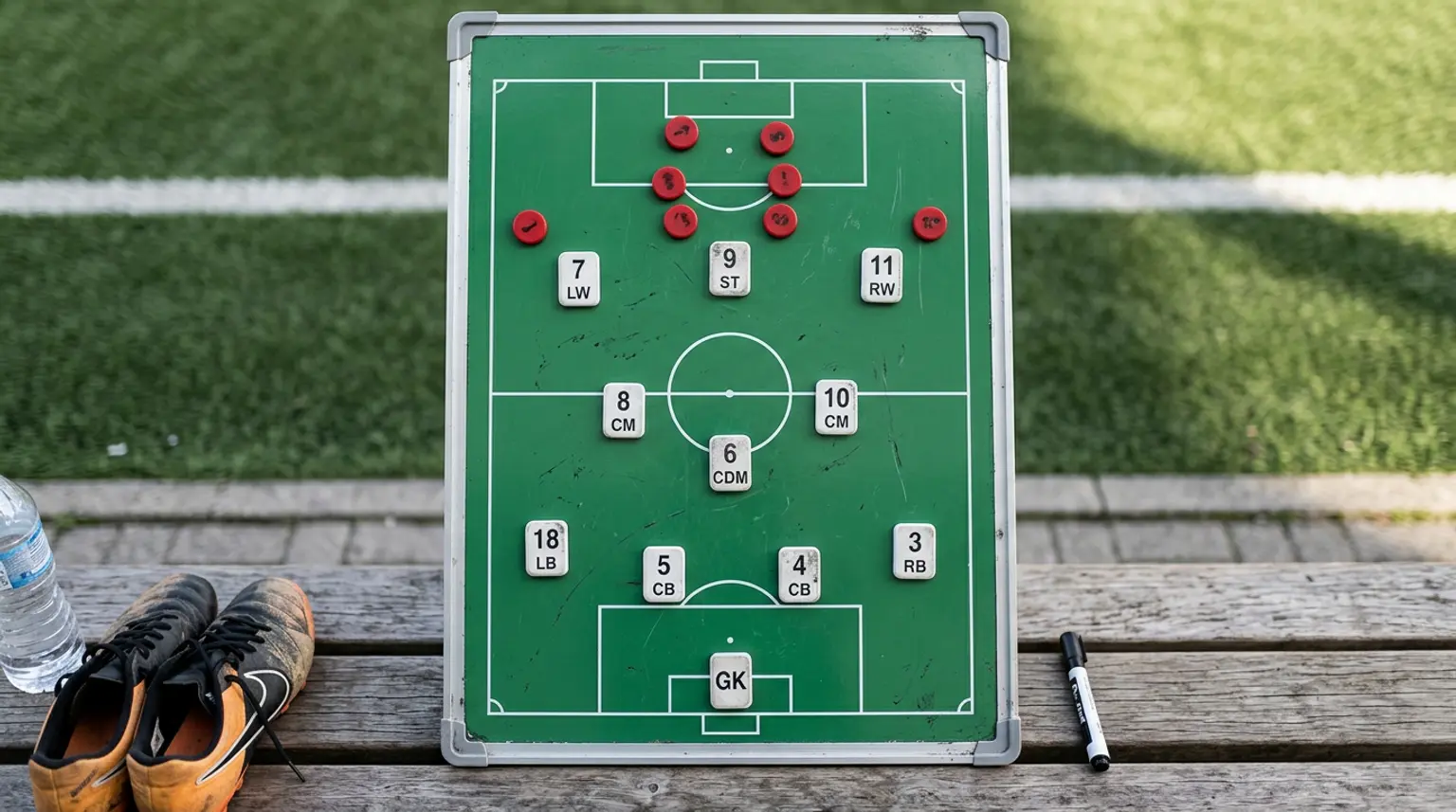
In a standard 11v11 lineup, the eleven positions are: goalkeeper, right back, left back, two center backs, defensive midfielder, central midfielder, attacking midfielder, right winger, left winger, and striker. Each also carries a traditional shirt number that coaches still use as shorthand for the role:
| # | Position | Abbreviation | Group |
|---|---|---|---|
| 1 | Goalkeeper | GK | Goalkeeper |
| 2 | Right Back | RB | Defense |
| 3 | Left Back | LB | Defense |
| 4 | Center Back | CB | Defense |
| 5 | Center Back | CB | Defense |
| 6 | Defensive Midfielder | CDM | Midfield |
| 7 | Right Winger | RW | Attack |
| 8 | Central Midfielder | CM | Midfield |
| 9 | Striker / Center Forward | ST / CF | Attack |
| 10 | Attacking Midfielder | CAM | Midfield |
| 11 | Left Winger | LW | Attack |
The exact mix changes with the formation — a 4-4-2 trades the attacking midfielder and one winger for a second striker and wide midfielders — but these eleven roles are the vocabulary of the sport. When a coach says "we need a 6" or "she's a natural 9," this numbering is what they mean. The rest of this guide walks through what each role actually does.
Every position needs a different toolkit. Position-specific training shows what strikers, midfielders and defenders should practice. FlickTec builds each day's home session around your player's position. Free 7-day trial.
What are the four main position groups in soccer?
Soccer positions fall into four categories: goalkeeper, defense, midfield, and attack. The goalkeeper is the only player who can use their hands inside the penalty area. Defenders protect the goal and stop the opposition. Midfielders control the middle of the pitch, linking defense to attack. Forwards are responsible for scoring goals.
Within these four groups, there are typically 10 outfield positions that coaches arrange into formations like 4-3-3, 4-4-2, or 4-2-3-1. The numbers represent how many players are in each line from defense to attack. A 4-3-3 formation, for example, uses four defenders, three midfielders, and three forwards.
What does a goalkeeper do?
The goalkeeper (GK) is the last line of defense. Their main job is to stop the ball from entering the net, but modern goalkeepers do much more. They organize the defense, start attacks with distribution, and act as a sweeper behind the back line. Learn more about coaching goalkeepers to understand the unique demands of this critical position.
Key skills for youth goalkeepers: shot stopping, positioning, communication, distribution with feet and hands, and bravery in one-on-one situations.
At the youth level, goalkeepers often rotate so every player gets experience in the role. Specialization usually begins around U12 to U14.
What do defenders do in soccer?
Defenders play in front of the goalkeeper and focus on preventing the opposition from scoring. There are several types of defenders.
Center Back (CB)
Center backs are the core of the defense. They typically play in pairs and are responsible for marking opposing strikers, winning aerial duels, and clearing danger. Center backs need to be strong, good in the air, and able to read the game.
Right Back (RB) and Left Back (LB)
Full backs play on the sides of the defense. In modern soccer, they do much more than just defend. They overlap with wingers, deliver crosses into the box, and track back to cover their flank. Full backs need speed, stamina, and the ability to both defend and attack.
Sweeper (SW)
The sweeper sits behind the main defensive line and cleans up any balls that get through. This role is less common in modern soccer but still appears in some youth systems as a way to teach defensive reading and positioning.
| Defensive Position | Primary Job | Key Skills |
|---|---|---|
| Center Back | Block shots, win headers, mark strikers | Strength, aerial ability, positioning |
| Right Back | Defend right flank, support attack | Speed, crossing, tackling |
| Left Back | Defend left flank, support attack | Speed, crossing, tackling |
| Sweeper | Clean up behind defense | Reading the game, passing, composure |
What do midfielders do in soccer?
Midfielders are the engine of the team. They connect defense to attack, control possession, and dictate the tempo of the game. There are several types of midfielders.
Defensive Midfielder (CDM)
The defensive midfielder sits in front of the back line and shields the defense. They break up opposition attacks, win the ball back, and distribute it to teammates. Think of them as the team's anchor. They need excellent positioning, tackling ability, and simple, effective passing.
Central Midfielder (CM)
Central midfielders are the most versatile players on the pitch. They contribute in both defense and attack, moving box to box throughout the game. They need good passing range, vision, stamina, and the ability to arrive late into the box for goals.
Attacking Midfielder (CAM)
The attacking midfielder, sometimes called the "number 10," plays behind the strikers and creates chances. They are often the most creative player on the team, responsible for through balls, final passes, and shots from the edge of the box. Creativity, close control, and finishing ability are essential.
What do forwards do in soccer?
Forwards, also called attackers, are the players closest to the opposition goal. Their primary job is to score, but they also press the defense and create space for teammates.
Striker / Center Forward (ST/CF)
The striker is the main goal scorer. They play centrally and live on the shoulder of the last defender, looking for runs in behind or balls to feet. Strikers need composure in front of goal, good movement, and the ability to finish with both feet and their head.
Winger (LW/RW)
Wingers play wide on the left or right side of the attack. Their job is to beat defenders with pace and dribbling, deliver crosses, and cut inside to shoot. Wingers need pace, and mastering how to dribble past defenders is essential to their role. Wingers are typically the fastest players on the team and need excellent one-on-one skills.
| Attacking Position | Primary Job | Key Skills |
|---|---|---|
| Striker | Score goals, lead the line | Finishing, movement, composure |
| Left Winger | Beat defenders, cross or cut inside | Pace, dribbling, crossing |
| Right Winger | Beat defenders, cross or cut inside | Pace, dribbling, crossing |
| Attacking Midfielder | Create chances, link midfield to attack | Vision, passing, creativity |
How do youth players find their best position?
Finding the right position takes time, and most youth coaches encourage players to try multiple positions before specializing. Here are some general guidelines by age group.
Ages 6 to 9 (U7 to U10): Players should rotate through every position, including goalkeeper. The focus at this age is building comfort on the ball everywhere on the pitch, not locking players into roles.
Ages 10 to 12 (U11 to U13): Players start showing natural tendencies. Fast players may gravitate toward the wing. Strong, vocal players may enjoy center back. Coaches can begin guiding players toward positions that match their physical and technical strengths.
Ages 13 and up (U14+): Position specialization becomes more important as the game becomes more tactical. Players should still be comfortable in at least 2 to 3 positions, but primary roles become clearer. Position-specific training accelerates development when players have identified their best roles.
Still deciding where your child fits best? Our guide on what position your child should play in soccer breaks down how to read their strengths and temperament and match them to the right role.
Platforms like FlickTec help with this process by offering position-specific training. Players select their position and receive daily sessions tailored to the skills that position demands. This is based on methodology designed by Coach Roman Pivarnik, a UEFA Champions League coach with over 25 years of experience in professional player development.
Does every team use the same positions?
No. The specific positions used depend on the formation the coach selects. A 4-3-3 formation has wingers and a single striker. A 4-4-2 uses two strikers and wider midfielders instead of dedicated wingers. A 3-5-2 drops a defender and adds a midfielder.
What stays consistent is the four-group structure: goalkeeper, defenders, midfielders, and forwards. The number of players in each group changes based on the formation, but the underlying roles and responsibilities remain similar.
Frequently Asked Questions
What are the 11 positions in soccer?
Goalkeeper, right back, left back, two center backs, defensive midfielder, central midfielder, attacking midfielder, right winger, left winger, and striker. The exact mix varies by formation — a 4-4-2 swaps the attacking midfielder and one winger for a second striker and wide midfielders — but these eleven roles cover the standard game.
What do soccer position numbers mean?
Traditional numbering runs 1 through 11: 1 goalkeeper, 2 right back, 3 left back, 4 and 5 center backs, 6 defensive midfielder, 7 right winger, 8 central midfielder, 9 striker, 10 attacking midfielder, 11 left winger. Modern players wear any squad number, but coaches still use the traditional numbers as shorthand for roles — "playing as a 6" means playing defensive midfield.
What is the easiest soccer position for beginners?
Central midfield and outside defender are often the most beginner-friendly positions. Central midfielders get lots of touches and stay involved in the game. Outside defenders have a clear area to cover and can learn defensive principles without the pressure of being the last player. That said, youth players should try every position before deciding.
What is the hardest position in soccer?
Goalkeeper and central midfielder are often considered the most demanding positions. Goalkeeper requires a completely unique skill set and carries the pressure of every mistake potentially becoming a goal. Central midfield requires the most complete skill set: passing, defending, attacking, fitness, and game intelligence.
At what age should a youth player pick a position?
Most development experts recommend waiting until U13 or U14 before committing to a primary position. Before that, rotating through multiple positions builds a more complete player. Even after specializing, players benefit from occasional time in different roles to maintain versatility.
Can my child play a different position than their coach assigns?
Talk to the coach about your child's interests. Good youth coaches welcome this conversation and often have development reasons for placing a player in a specific position. Sometimes a player who wants to be a striker is developing defensive awareness at center back. Trust the process, but keep the communication open.
How does position-specific training work?
Position-specific training focuses on the skills most relevant to a player's role. A striker works on finishing and movement. A center back works on heading and positioning. Apps like FlickTec offer position-specific daily training sessions designed by professional coaches, so players can develop the exact skills their position demands from home.