The Offside Rule in Youth Soccer: A Simple Explanation (and When It Starts)
 Reviewed by Roman PivarnikUEFA Pro Licence · Technical Director, Slovak FA
Offside works the same in youth soccer as in the professional game — with one big difference: it doesn't exist yet for the youngest players. There's no offside in 4v4 (U6–U8). It's introduced at 7v7 (U9 and U10), but only near goal, beyond a marker called the build-out line. From 9v9 (U11 and U12) and full 11v11 (U13 and up), offside applies across the whole attacking half, exactly as it does for adults.
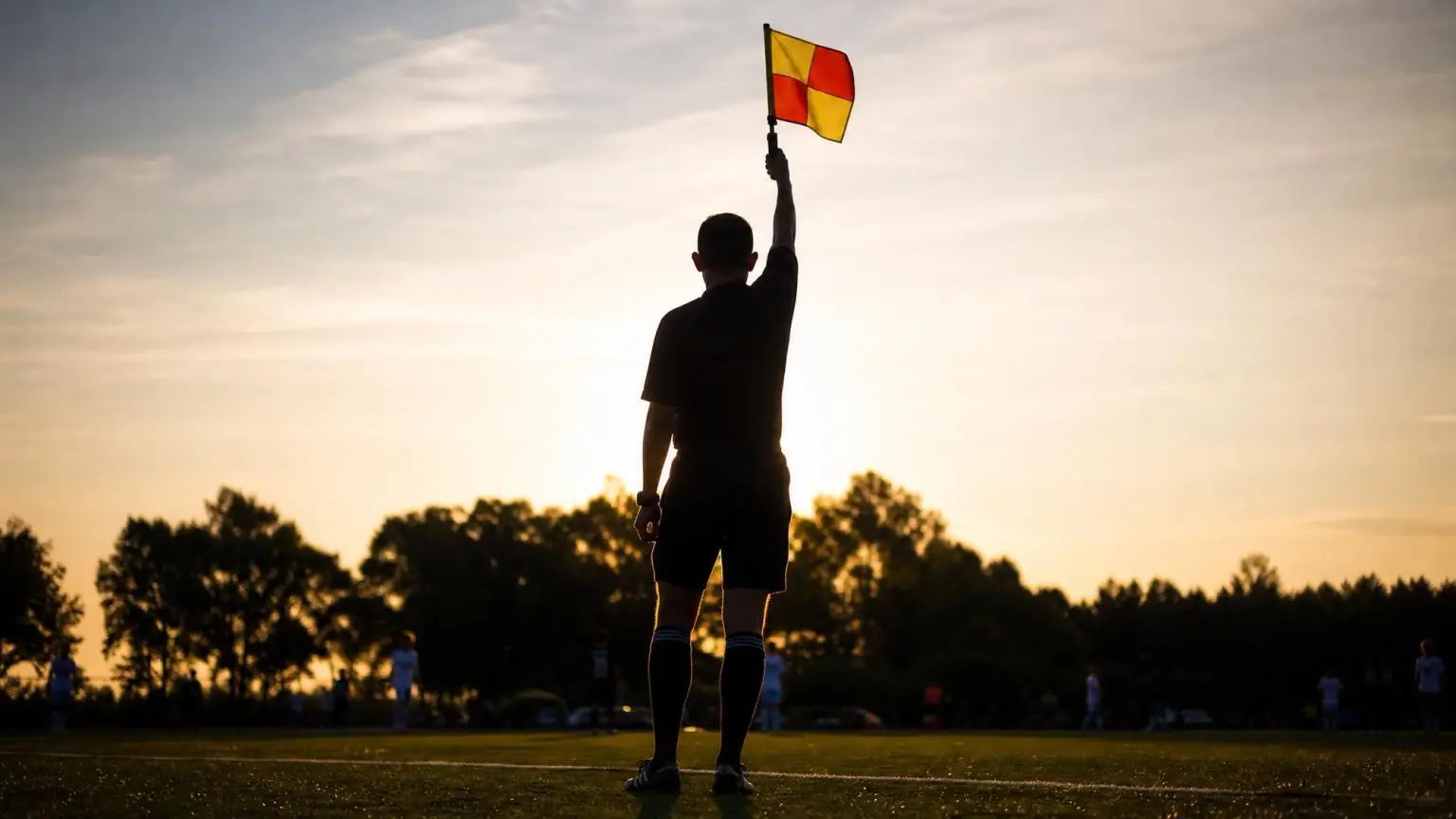
That's the short version of the most misunderstood call on a youth sideline. A parent sees a flag go up, a promising attack wiped out, and no idea why — or watches a nine-year-old sprint clean through and hears nothing at all. Below is what offside actually is, the two-part test referees apply, and precisely when it starts to matter as your child moves up the age groups.
What is offside in soccer, in plain English?
Offside is a positioning rule that stops attackers from camping near the opponent's goal waiting for a pass. For it to be called, two separate things both have to be true.
Under the IFAB Laws of the Game — the rulebook every league in the world is built on — a player is in an offside position if, at the moment a teammate plays or touches the ball, any part of the head, body or feet is in the opponents' half and is nearer to the opponents' goal line than both the ball and the second-last opponent. That second-last opponent is usually the last defender, because the goalkeeper is normally the very last. Hands and arms don't count — you can't be offside by an arm. (Arms get their own rule instead, and it's the one the sideline argues about most — see the handball rule explained.)
Three things people constantly get wrong:
- Being in an offside position is not an offence by itself. A player only commits an offside offence by becoming involved in active play — interfering with play by touching a ball a teammate passed, interfering with an opponent, or gaining an advantage from a rebound or deflection.
- It's judged the instant the ball is played, not when it's received. A player can be level with the defence when the pass is struck, then run onto it well behind the line, and still be perfectly onside. The timing is everything.
- Level is onside. A player exactly level with the second-last opponent — or with the last two opponents — is not in an offside position. Ties go to the attacker.
When an offside offence does happen, the restart is simple: the referee awards an indirect free kick where the offence occurred. No card, no foul — just a change of possession.
Beating the offside line is half timing, half beating your defender. These 1v1 moves cover the second half. FlickTec builds a new home session every day. Free 7-day trial.
When is there no offside?
Even where offside is fully in force, several situations are exempt. Under Law 11 there is no offside offence if a player receives the ball directly from a goal kick, a throw-in, or a corner kick. So a striker standing behind the last defender waiting on a throw-in is doing nothing wrong. (The throw itself has rules of its own that catch young players out — our guide to soccer throw-in rules covers what makes a throw legal and what happens on a foul throw.)
Stack that on top of the points above and offside is narrower than most sideline groans suggest. You can't be offside in your own half. You can't be offside just for standing in an offside position. And you can't be offside receiving the ball from an opponent's deliberate play — a defender's misplaced pass, for instance. The rule only bites in a specific, fairly narrow set of moments.
At what age does offside start in youth soccer?
Here's where youth soccer diverges from the adult game. Under U.S. Soccer's mandatory small-sided standards, offside is phased in alongside the game formats rather than being present from day one:
| Age group | Format | Offside? |
|---|---|---|
| U6, U7, U8 | 4v4 | None — offside is not called at all |
| U9, U10 | 7v7 | Yes, but only beyond the build-out line |
| U11, U12 | 9v9 | Full offside, across the whole attacking half |
| U13 and up | 11v11 | Full offside, across the whole attacking half |
"There will be no offside infraction before the U-9 age group," U.S. Soccer states plainly in its small-sided standards. In 4v4 there's no goalkeeper, no penalty kicks, and no offside — the format is stripped down purely for touches and decisions.
If the U-number labels are still fuzzy, our guide to youth soccer age groups breaks down which birth years land in each. And for the full picture of formats, rosters, and field sizes at every stage, see how many players are on a youth soccer team.
What is the build-out line, and how does it change offside?
The build-out line is the rule that trips up most new 7v7 parents, and it quietly does two jobs at once.
It's a line drawn across the field on each side, positioned midway between the top of the penalty area and the halfway line — U.S. Soccer defines it by that midpoint rather than by a fixed distance, so on a typical 7v7 field it ends up somewhere around 14–20 yards from the goal line. Its first job is to encourage playing out of the back: when the goalkeeper catches the ball in play or takes a goal kick, the entire opposing team must drop behind their build-out line until the ball is back in play, giving the young team space to pass out rather than boot it clear.
Its second job is offside. In 7v7, offside can only be called between the build-out line and the goal line — never from the halfway line. As one league sums it up, "offside will be called at the build-out line, not the center line." A U9 attacker can roam the entire middle of the field without ever being offside; the rule only switches on close to goal. Our full guide to the build-out line in soccer walks through the retreat rules, the punting ban, and the goal-kick details. (A related quirk that catches keepers out: goalkeepers can't punt or drop-kick in 7v7 — they have to throw or roll the ball out. Our guide to coaching youth goalkeepers covers distributing under those constraints.)
At 9v9 the training wheels come off: there's no build-out line, and offside applies across the whole attacking half exactly as it does in the 11v11 adult game. That's also the age where positional discipline starts to matter, because holding a line and reading one become part of the job — our primer on soccer positions for youth players is a good place to start if your child is suddenly being asked to play a specific role.
Why is offside delayed until U9?
Same reasoning behind restricting heading and shrinking the fields: the youngest formats are engineered around involvement, not realism. A U7 game with an offside line would have kids standing still, policing an imaginary boundary, instead of chasing the ball and making decisions. Removing offside at 4v4 keeps everyone active and around the ball, which is the whole point at that age.
By U9, players can actually grasp the idea of a defensive line and time a run against it — so offside arrives, but gently, confined to the zone beyond the build-out line where it teaches something useful. It's the same design philosophy behind the youth soccer heading rules by age: add complexity only when it aids development rather than getting in the way of it.
How do you explain offside to your child (or yourself)?
The one-sentence version that works on the car ride home: you can't get behind the last defender and wait there for a pass. You have to time your run so you're level with — or behind — the ball or that last defender at the moment your teammate kicks it. Then you can burst past.
A few cues that make it click:
- Watch the pass, not the finish. Freeze the instant the ball leaves the passer's foot — that's the only snapshot the referee is judging.
- Count the goalkeeper as one of the two defenders. That's why "second-to-last defender" almost always means the last outfield player.
- In 7v7, remember the free zone. There's a whole area — everything up to the build-out line — where offside simply doesn't apply. Understanding that changes how a young player moves.
Offside rewards timing over raw speed, and that's a sense built through reps and game understanding, not a single lecture. FlickTec's structured home sessions — built by a UEFA Pro Licence coach — focus on the ball mastery and movement that let a player attack the last line with confidence once the rule kicks in.
Frequently Asked Questions
At what age does offside start in youth soccer?
Offside is first enforced at the U9 age group, when players move to the 7v7 format. There is no offside in 4v4 (U6–U8). At 7v7 it applies only beyond the build-out line, and from 9v9 (U11–U12) and 11v11 (U13 and up) it applies across the entire attacking half.
Is there offside in 7v7 soccer?
Yes, but a limited version. In 7v7, a player can only be penalized for offside between the build-out line and the goal line — not between the halfway line and the build-out line. The build-out line, not the center line, is the offside boundary at this level.
What is offside in soccer in simple terms?
A player is offside if they're in the opponents' half and closer to the goal line than both the ball and the second-to-last defender at the moment a teammate plays the ball, and then get involved in the play. Being in that position isn't an offence by itself, and you are never offside receiving the ball directly from a throw-in, corner kick, or goal kick.
Why is there no offside in U8 soccer?
Small-sided formats for U6–U8 (4v4) are designed to maximize touches and decisions for every child. An offside rule would encourage kids to stand and wait rather than chase the ball, so U.S. Soccer's standards remove it entirely until U9.
What is the build-out line in youth soccer?
It's a line across each half of a 7v7 field, positioned midway between the top of the penalty area and the halfway line. It forces the opposing team to retreat when the goalkeeper has the ball — encouraging playing out of the back — and marks the boundary beyond which offside can be called.
Offside looks like the game's most arbitrary rule until you see the logic: it keeps attackers honest, and youth soccer introduces it exactly as fast as kids can handle it. Learn the two-part test, remember the build-out line if your child plays 7v7, and you'll never be the confused parent asking "wait, why was that offside?" again.