Youth Soccer Age Groups: What U8, U10, U13, U15 & U18 Mean
 Reviewed by Roman PivarnikUEFA Pro Licence · Technical Director, Slovak FA
Youth soccer age groups use the "U" system, where U stands for "Under." U8 means the player is under 8 years old. U10 means under 10. The system runs from U4/U6 at the youngest levels through U18 or U19 at the oldest youth levels. Starting with the 2026 to 2027 season, major US youth soccer organizations are transitioning from a January 1 to December 31 birth year system to an August 1 to July 31 system that aligns more closely with school grades.
Understanding age groups helps parents know what to expect at each stage: what format their child will play, what skills are age-appropriate, how much training is healthy, and what the development priorities should be. This guide covers every age group from the first kick to the last year of youth soccer.
Youth soccer age group chart: what each U number means
The number after the U is the age a player must be under on the age-group cutoff date. Here is the whole system at a glance:
| Age group | Means | Typical ages | Game format | Ball size |
|---|---|---|---|---|
| U6 | Under 6 | 4 to 5 | 3v3 or 4v4 | 3 |
| U8 | Under 8 | 6 to 7 | 4v4 | 3 |
| U10 | Under 10 | 8 to 9 | 7v7 | 4 |
| U12 | Under 12 | 10 to 11 | 9v9 | 4 |
| U14 | Under 14 | 12 to 13 | 11v11 | 5 |
| U16 | Under 16 | 14 to 15 | 11v11 | 5 |
| U19 | Under 19 | 16 to 18 | 11v11 | 5 |
So "what does U10 mean in soccer?" has a one-line answer: the player was 9 or younger when the season's age groups were set. Players can turn 10 during a U10 season and remain eligible — the cutoff date, not the birthday, decides the group. To find your child's exact group by birth year under the new cutoff, see our youth soccer birth year chart for 2026 to 2027.
Most U8 to U14 teams practice two or three times a week. These 10 no-equipment drills cover the other days. FlickTec builds a new home session every day for your player's age and position. Free 7-day trial.
How are youth soccer age groups determined?
The "U" number represents the age the player must be under at the start of the registration period. A player in the U10 age group must be 9 or younger when the season begins (under 10).
Current system (through 2025 to 2026 season): Age groups follow a January 1 to December 31 birth year calendar. All players born in the same calendar year play together.
New system (starting 2026 to 2027 season): US Youth Soccer, US Club Soccer, and AYSO are transitioning to an August 1 to July 31 cycle. This aligns soccer age groups with school grade levels so children play with their classmates. US Soccer provides an online age group calculator to help families determine their child's group under the new system. For the exact birth-year ranges under that new cutoff, see our youth soccer birth year chart for 2026 to 2027.
Important note for 2026: The 2025 to 2026 season continues under the old birth year system. The new system takes effect in fall 2026. Some players will shift age groups during the transition. Check with your club for specific guidance.
Changing the cutoff also changes who is oldest and youngest inside each band, and that shapes selection more than most families expect — our guide to the relative age effect in youth soccer covers what the research shows.
What does each age group look like?
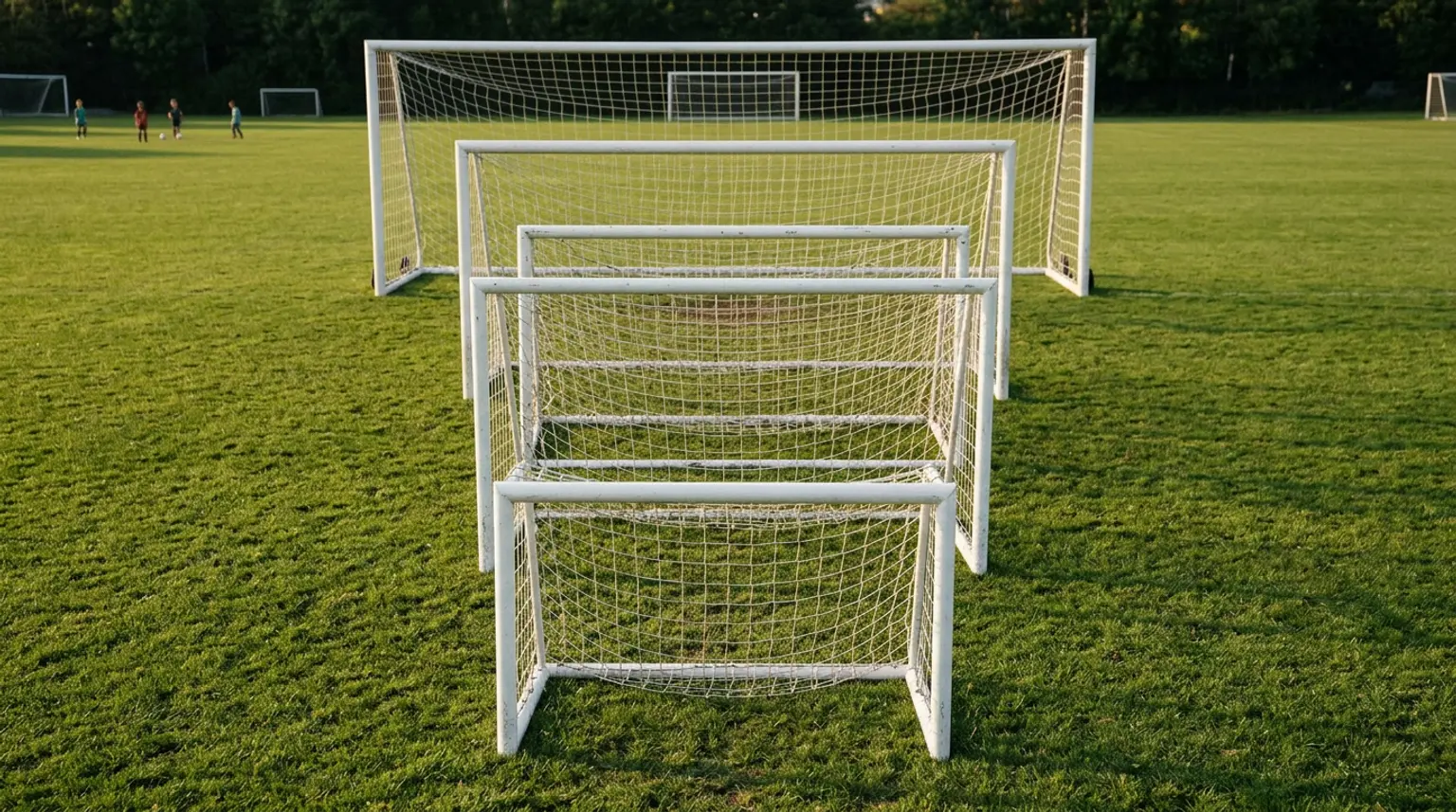
Each stage has its own game format, ball size, and development priorities. For the full reference on team sizes, roster caps, and field dimensions at every format — 4v4, 7v7, 9v9, and 11v11 — see our guide to how many players are on a youth soccer team.
U4 to U6 (Ages 3 to 5)
Format: 3v3 or 4v4 with no goalkeeper. Micro fields (approximately 25 by 15 yards).
What to expect: This is introductory soccer. Sessions are 20 to 30 minutes. Activities focus on movement, coordination, and having fun with a ball. There are no standings, no trophies, and minimal rules. Children at this age swarm the ball, kick in random directions, and occasionally pick up the ball with their hands. All of this is normal.
Development focus: Running, kicking, basic coordination, fun. Training for 6 year olds should feel like organized play.
Ball size: Size 3.
U7 to U8 (Ages 6 to 7)
Format: 4v4 with no goalkeeper. Small fields (approximately 35 by 25 yards).
What to expect: Players begin to understand the basic concept of the game: kick the ball toward the other team's goal. Some players start to pass, though most still dribble straight at the goal. Sessions are 30 to 45 minutes.
Development focus: Ball familiarity, basic dribbling, 1v1 confidence, fun. US Soccer's development framework emphasizes the FUNdamental stage. Training for 8 year olds should prioritize ball comfort and enjoyment.
Ball size: Size 3.
Home training: 10 to 15 minutes, 2 to 3 times per week. Toe taps, sole rolls, and simple dribbling. Should feel like play, not homework.
U9 to U10 (Ages 8 to 9)
Format: 7v7 with a goalkeeper. Medium fields (approximately 55 by 35 yards).
What to expect: The game starts to resemble recognizable soccer. Players begin to understand positions (though they should still rotate through them). Passing becomes more intentional. The 7v7 format provides a good balance of involvement for each player while introducing the goalkeeper position.
Development focus: This is the beginning of the golden age of learning. Ball mastery, first touch, passing with both feet, weak foot development, and introduction to positional concepts. Training for 10 year olds should emphasize technical skill development above all else.
Ball size: Size 4.
Home training: 15 to 20 minutes, 3 to 4 times per week. Structured sessions with ball mastery, wall passing, and dribbling patterns.
U11 to U12 (Ages 10 to 11)
Format: 9v9 progressing to 11v11. Larger fields. Offside rule introduced.
What to expect: The transition to larger formats begins. The field grows, the number of players increases, and the tactical complexity rises. Players start to develop genuine positional understanding. The gap between players who train individually and those who do not becomes clearly visible. These are also the ages where heading rules change: players 10 and under may not head the ball at all, while 11- and 12-year-olds may head in games but face practice limits.
Development focus: Technical refinement, passing under pressure, introduction to position-specific skills, continued ball mastery at speed, beginning of age-appropriate bodyweight strength work.
Ball size: Size 4.
Home training: 20 to 30 minutes, 4 to 5 times per week. Structured sessions including ball mastery, position-specific drills, and light strength work.
U13 to U14 (Ages 12 to 13)
Format: 11v11 on full-size or near-full-size fields.
What to expect: The full game. This is where childhood soccer starts to look like the adult version. The physical demands increase significantly. Tactical organization (formations, pressing, set pieces) becomes part of training. Tryouts become more selective. Some players begin to consider high school soccer and college pathways.
Development focus: Technical refinement under game-speed pressure, tactical understanding, position-specific development (30 to 40 percent of individual training), speed and agility training, structured strength and conditioning, and mental preparation for competitive play.
Ball size: Size 5.
Home training: 25 to 35 minutes, 4 to 5 times per week. Includes technical work, position-specific drills, strength training, and speed work.
U15 to U16 (Ages 14 to 15)
Format: 11v11 on full-size fields.
What to expect: Competition becomes serious. Club soccer involves regular league play and showcase tournaments. High school soccer begins for many players. Physical maturation continues to affect team dynamics, but the gap between early and late developers starts to narrow. Players who have trained consistently through the golden age now show their quality.
Development focus: Advanced tactical work, physical preparation, position mastery, mental toughness, introduction to video analysis. College recruiting exposure begins for players with college soccer aspirations.
Ball size: Size 5.
U17 to U19 (Ages 16 to 18)
Format: 11v11 on full-size fields.
What to expect: The final years of youth soccer. Players at this stage are either pursuing college soccer, considering semi-professional or professional pathways, or playing for the love of the game. Training is near-adult in intensity and complexity. Decision-making speed, tactical discipline, and physical performance are all expected to be at high levels.
Development focus: Performance optimization, game management, leadership, managing the balance between high school academics, club soccer, and college recruiting. Players should be self-directed in their individual training at this stage.
Ball size: Size 5.
How much should players train at each age group?
| Age Group | Team Sessions/Week | Home Training/Week | Session Length | Total Weekly Hours (Max) |
|---|---|---|---|---|
| U6 | 1 to 2 | 5 to 10 min, 2x | 20 to 30 min | 3 to 4 hrs |
| U8 | 2 | 10 to 15 min, 2 to 3x | 30 to 45 min | 4 to 6 hrs |
| U10 | 2 to 3 | 15 to 20 min, 3 to 4x | 45 to 60 min | 6 to 8 hrs |
| U12 | 3 | 20 to 30 min, 4 to 5x | 60 to 75 min | 8 to 10 hrs |
| U14 | 3 to 4 | 25 to 35 min, 4 to 5x | 75 to 90 min | 10 to 12 hrs |
| U16+ | 4 to 5 | 30+ min, 5x | 90 min | 12 to 14 hrs |
The guideline that total weekly training hours should not exceed the player's age provides a useful ceiling for avoiding overtraining.
What is the difference between recreational and competitive age groups?
The age group system is the same for both recreational and competitive soccer. The difference is in the level of play, coaching quality, time commitment, and cost.
Recreational: All players who register are placed on a team. Coaching is often by volunteers. Playing time is equal. Costs are low ($75 to $300/season).
Competitive (club): Players are selected through tryouts. Coaching is by licensed professionals. Playing time varies. Costs are higher ($1,500 to $5,000+/year). Leagues like ECNL, MLS NEXT, GA, and US Club Soccer operate competitive programs.
For a complete map of every competitive tier — from rec and travel through ECNL, Girls Academy, and MLS NEXT — see our guide to youth soccer levels explained.
Players can transition from recreational to competitive at any age, though the most common transition points are U10 to U12, when the player's interest, skill level, and family commitment align with the competitive pathway.
FlickTec is designed for players at every age group and level, with sessions starting at 5 minutes for younger players and scaling to full training sessions for U14 and beyond. The 500+ video exercises designed by Coach Roman Pivarnik (UEFA Pro Licence, former UEFA Champions League coach) cover all 8 skill areas with progressive difficulty that matches each development stage.
Frequently Asked Questions
What does the "U" stand for in youth soccer age groups?
U stands for "Under." U10 means the player is under 10 years old (9 or younger) at the start of the registration period. The system is used worldwide to group players of similar ages for fair and developmentally appropriate competition.
What does U10 mean in soccer?
U10 means under 10: the player was 9 or younger on the age-group cutoff date. U10 teams play 7v7 with a size 4 ball, and most players are 8 or 9 years old. Players can turn 10 during the season and remain eligible — the cutoff date decides the group, not the birthday.
What does U15 mean in soccer?
U15 means under 15: players were 14 or younger on the cutoff date. U15 teams play full 11v11 with a size 5 ball, and for many players it overlaps with the first year of high school soccer.
Does U14 mean 14 and under?
In soccer, U14 means under 14 — players were 13 or younger on the cutoff date, though many turn 14 during the season. The "14 and under" phrasing (written 14U) comes from baseball and softball; soccer counts from "under," so the U number is one year above the players' age at the cutoff.
Does U18 include 18-year-olds?
Not at the cutoff date. U18 means players were 17 or younger when age groups were set, so an 18-year-old at the cutoff belongs in U19 or adult soccer. Players who turn 18 during the U18 season remain eligible for that season.
What age group is U13?
U13 players were 12 or younger on the cutoff date — typically 11 and 12 year olds when the season starts. U13 is the first full 11v11 age group and the first to use a size 5 ball.
Does U12 play 9v9 or 11v11?
U12 plays 9v9 under US Soccer's Player Development Initiatives, on a field roughly 70 to 80 by 45 to 55 yards. Full 11v11 starts at U13, though some leagues begin transitioning players late in the U12 year.
Will the 2026 age group changes affect my child's team?
Possibly. The shift from January to December birth year groupings to August to July groupings means some players will shift to a different age group. Players born August through December may move to a younger group where they play with school classmates. Check with your club for specifics, and use US Soccer's online age group calculator to determine your child's group.
Can my child play up an age group?
Most organizations allow playing up (a U10 player playing on a U11 or U12 team) with club approval. Playing up can be beneficial for physically mature or technically advanced players who need more challenge. Playing down is generally not permitted. For what the rules actually allow, what changes on the field, and how to judge whether your child is ready, see our full guide to playing up an age group in youth soccer.
When should my child move from recreational to competitive soccer?
The most common transition age is 9 to 11. Signs that a child may be ready include: strong interest in improving, consistent home training habits, technical skills that exceed the recreational level, and the family's readiness for the time and financial commitment of competitive soccer.
Youth soccer starting age and specialization decisions should be guided by understanding what each age group demands. Age groups provide a framework for age-appropriate development. Each stage has its own priorities, and rushing through them rarely produces better outcomes than respecting the developmental timeline. Meet the player where they are. Build skills appropriate to their age. Trust the process.
For training that adapts to every age group and level, explore FlickTec for youth players aged 7 and up.