Youth Soccer Weather Rules: When Games Get Cancelled for Rain, Cold and Lightning
 Reviewed by Roman PivarnikUEFA Pro Licence · Technical Director, Slovak FA
Rain almost never cancels a youth soccer game. Thunder always does, and the clock that follows it restarts every single time you hear it again. Those two sentences cover most of what a parent standing on a wet sideline in October actually needs to know.
The rest is judgment, and the judgment is not yours — it belongs to the referee, on the day, at that field. Youth soccer weather rules are a mix of one hard national guideline (lightning), one set of published thresholds your league chooses for itself (cold), and one on-site inspection (the field). Knowing which of the three is in play tells you whether to unpack the chairs or start the car.
This is the month it starts to matter. Fall seasons run into shorter days, colder evenings and the first real thunderstorms since August, and the same family that spent September worrying about heat and hydration is now packing gloves.
Who actually decides if a youth soccer game is cancelled?
Two different people, at two different moments.
Before you leave the house, it is usually the league or the home club. They own the fields, and they close them — for standing water, for frost, for a facility-wide shutdown. That decision arrives by email or app, and it is the only one that saves you the drive.
Once everyone is at the field, it is the referee. Law 5 of the Laws of the Game is blunt about this: "Each match is controlled by a referee who has full authority to enforce the Laws of the Game in connection with the match." The Law goes further and names weather explicitly among the decisions that belong to the official — including the decision "that the condition of the field of play or its surrounds or that the weather conditions are such as to allow or not to allow a match to take place," and the decision "to abandon a match for whatever reason."
Coaches do not overrule that. Neither do parents, and neither does the fact that one team drove ninety minutes to be there.
It also helps to use the right word for what just happened, because they have different consequences for the standings:
| Term | What it means | What usually happens next |
|---|---|---|
| Postponed | Called off before kickoff | Rescheduled in full |
| Suspended | Stopped mid-game, intent to resume | Resumes after the delay, same day if possible |
| Abandoned | Stopped mid-game, not resumed | League rules decide: replay, or the score stands |
Your league handbook says which of those applies and at what point a partial game counts as complete. That is worth reading once in September rather than arguing about in November.
What is the 30-minute lightning rule in soccer?
This is the one part of youth soccer weather rules that is not a judgment call, and it is the one most worth knowing by heart.
The National Federation of State High School Associations sets the default policy that most US leagues and school associations follow. Its guidelines on lightning and thunder disturbances state it plainly: "When thunder is heard or lightning is seen, the leading edge of the thunderstorm is close enough to strike your location with lightning. Suspend play for at least 30 minutes and vacate the outdoor activity to the previously designated safer location immediately."
Then the part people get wrong: "Any subsequent thunder or lightning after the beginning of the 30-minute count will reset the clock and another 30-minute count should begin."
That is why a delay that felt like it should be fifteen minutes turns into ninety. Every rumble starts the half hour over.
The threshold is thunder itself, not distance. The National Weather Service explains why in its guidance on lightning safety and outdoor sports: a significant lightning threat "extends outward from the base of a thunderstorm cloud about 6 to 10 miles," and thunder "can usually be heard for a distance of about 10 miles." So if you can hear it, the storm is already close enough. The NWS also notes that about 30 people are killed by lightning in the US each year, and roughly two thirds of those deaths are tied to outdoor recreation.
Where to shelter — and where not to
The NFHS names a safer place as "a substantial building with plumbing and wiring where people live or work, such as a school, gymnasium or library," or, failing that, "a fully enclosed (not convertible or soft top) metal car or school bus."
The NWS is equally specific about what does not count: "small outdoor buildings including dugouts, rain shelters, sheds, etc., are NOT SAFE." Neither is a tree, a canopy, or the covered walkway between two buildings. Your car, windows up, is a better shelter than the pavilion by the concession stand.
One more detail worth passing to your club if nobody has: the NWS recommends the person watching the sky not be the coach or the referee, "because these people will be busy and can't adequately monitor conditions."
What about lightning apps?
They help, but they do not get the final word. The NFHS allows that validated detection devices or phone apps "could be used to assist in making a decision to suspend play if a lightning strike is noted to be within 10 miles," then adds: "you should never depend on the reliability of these devices and, thus, hearing thunder or seeing lightning should always take precedence over information from a mobile app or lightning-detection device."
Do youth soccer games get cancelled for rain?
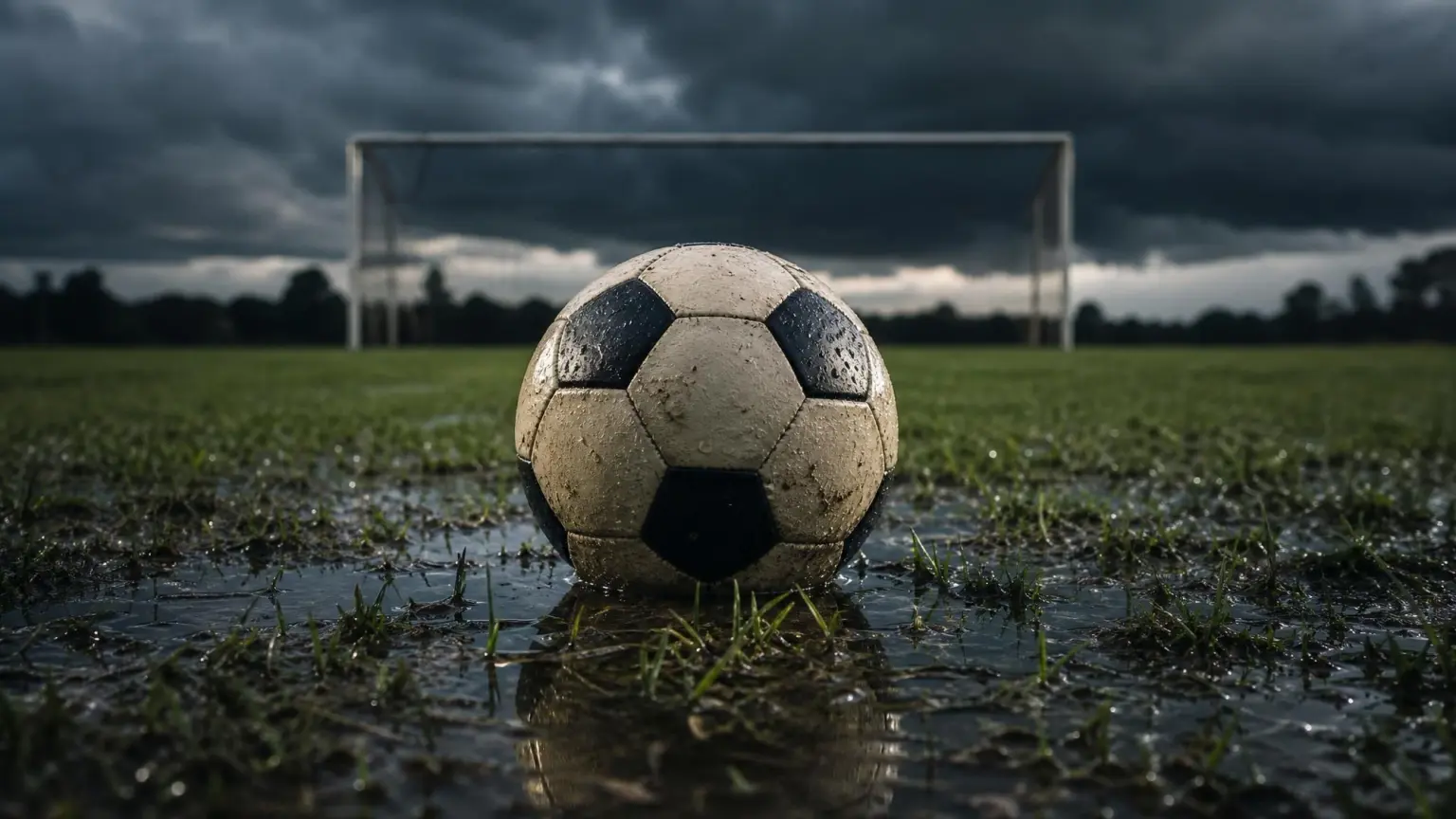
Usually not. Soccer is a wet-weather sport, and a steady October drizzle is a normal playing condition, not an emergency.
What stops a game is the field, not the sky. Standing water that holds the ball up, a surface churned to mud, a pitch soft enough that studs catch instead of slide — those are what a referee is looking at during the pre-match walk. A well-drained turf field will host a game in weather that would close the grass field next to it, which is why one team's game goes ahead and the other's does not.
The real risk to a young player in the rain is not the ninety minutes of play. It is the hour on either side of it. The National Athletic Trainers' Association position statement on environmental cold injuries puts a number on why: heat lost by direct contact with cold surfaces "is exacerbated by moisture, either in the environment (rain, snow, or water immersion) or in wet clothing," and conduction "can increase heat loss by up to 5 times with wet clothing."
A soaked 50°F afternoon with a breeze is harder on a ten-year-old than a dry 40°F one. The NATA guidance is simple and rarely followed on a Saturday sideline: "Remove wet clothing as soon as practical and replace with dry, clean items."
How cold is too cold for a youth soccer game?
There is no single national number, and anyone who quotes you one is quoting their own league.
What is standardised is the measurement. Leagues set their cold-weather thresholds in wind chill, not air temperature, and publish them in the same handbook as the heat policy. Find yours before the first cold weekend.
A few things the NWS says about wind chill that change how you read that number:
- Wind chill is only defined at or below 50°F, with wind above 3 mph. Outside that range the figure does not apply.
- Sun matters a lot. "Bright sunshine may increase the wind chill temperature by 10°F to 18°F." A sunny 35°F kickoff and an overcast one are not the same afternoon.
- Frostbite needs actual freezing air. The NWS is explicit: "you can only get frostbite if the actual air temperature, not the wind chill temperature, near your skin is below freezing." Above freezing, the risk is hypothermia instead — not frostbite.
- The chart was not built for children. In the NWS's own words, the wind chill tests "were conducted on adult subjects… Use the existing chart as a starting point and be even more cautious with children."
That last point is the one that matters most for U8s standing still at the back post. The NATA adds the practical version: toes, fingers, ears and skin should be covered once wind chill reaches the range where frostbite becomes possible in 30 minutes or less.
What should a child wear for a cold, wet soccer game?
The NATA recommends a three-layer system, and it translates neatly onto a youth player:
| Layer | Job (per NATA) | On a U12 |
|---|---|---|
| Base | Allows sweat to evaporate with minimal absorption | Thin long-sleeve technical top, under the kit |
| Middle | Insulation | Light fleece or training top — removable |
| Outer | Wind and water resistant, still breathes | Rain shell or club jacket |
Details that decide how the afternoon goes:
- The kit goes over the base layer, not instead of it. Most leagues allow this; check yours for colour rules on undershirts.
- Pack a second pair of socks and change them at halftime if the first pair is soaked. Wet feet are the fastest way to a miserable second half.
- Cover the extremities. Gloves and a headband or hat — the NATA names toes, fingers and ears specifically.
- Subs cool down fast. A jacket goes on the moment a player comes off, not once they start shivering.
- Keep drinking. Cold suppresses thirst: the NATA notes players "should be encouraged to hydrate even if they are not thirsty, as evidence suggests the normal thirst mechanism is blunted with cold exposure."
- Warm up longer. A cold body needs more runway — worth extending the usual pre-game warm-up routine by a few minutes.
If you are building the bag from scratch, our youth soccer equipment checklist covers the rest of the season kit.
What are the warning signs a child is too cold?
Learn these, because a child will not reliably tell you.
The NATA classifies mild hypothermia at a core temperature of 98.6°F to 95°F, with vigorous shivering, impaired fine motor control, lethargy, cold extremities and pallor — the player is typically still conscious and talking. Moderate hypothermia sits at 94°F to 90°F, and is marked by cessation of shivering, slurred speech, impaired mental function and depressed respiration and pulse.
Read those two rows together, because the sequence is counterintuitive: shivering stopping is not a sign that a child has warmed up. In the NATA's own table, vigorous shivering belongs to the mild stage and shivering stopping belongs to the moderate one. A child who was shivering, has gone quiet, and is fumbling their zipper comes off the field and into a warm car.
One more thing to file away: cold, dry air is a known trigger for exercise-induced bronchoconstriction, a narrowing of the airways that the NATA notes can affect anyone, "from a small child at play to an elite athlete," with or without a diagnosis of asthma. A child who coughs hard for twenty minutes after cold games is worth mentioning to your pediatrician.
When the weather wins
Some weekends it just does. That is the point in the season when families start looking at winter leagues — and indoor soccer is a genuinely different sport, with walls in play and a running clock, worth understanding before you sign up.
It is also the point where home training stops being an optional extra and starts being the only training. A rained-out Saturday and a dark Tuesday are two sessions gone in one week. Short, structured work in a garage or hallway — the kind of daily session a platform like FlickTec is built around — keeps touches from disappearing entirely between November and March.
Frequently Asked Questions
How long do you have to wait after lightning to resume a soccer game?
At least 30 minutes after the last thunder heard or lightning seen, per NFHS guidelines. Critically, the count restarts from zero every time thunder is heard again, so a delay can easily run past an hour. Play resumes only after a clean 30 minutes with no thunder and no lightning.
Do soccer games get cancelled for rain?
Rarely. Rain by itself is a normal playing condition. Games are called when the field becomes unplayable — standing water holding the ball up, or a surface soft enough to be a slipping and injury risk. That call is made by the referee at the field, or earlier by the league if it closes the facility.
How cold is too cold for youth soccer?
There is no national threshold — each league sets its own, published in its inclement weather policy, and measured in wind chill rather than air temperature. Wind chill is only defined at or below 50°F. The National Weather Service notes its wind chill chart was tested on adults and advises being "even more cautious with children."
Who decides whether a youth soccer game is cancelled?
Before kickoff, the league or home club, usually over a field closure. Once everyone is at the field, the referee: Law 5 of the Laws of the Game gives the official full authority over whether field or weather conditions allow a match to take place, and over abandoning one already underway.
Is it safe to shelter in a dugout during a thunderstorm?
No. The National Weather Service states that "small outdoor buildings including dugouts, rain shelters, sheds, etc., are NOT SAFE." Safe options are a substantial building with wiring and plumbing, or a fully enclosed hard-topped vehicle with the windows closed. A tree is among the most dangerous places to stand.
What should my child wear to a cold, wet soccer game?
Three layers: a thin base layer that moves sweat away, an insulating middle layer, and a wind- and water-resistant outer shell that still breathes. Add gloves and ear cover, pack a spare pair of socks for halftime, and get a jacket on any player the moment they come off the field.