Indoor Soccer Rules: What's Different From Outdoor Soccer and Futsal
 Reviewed by Roman PivarnikUEFA Pro Licence · Technical Director, Slovak FA
Indoor soccer is a different sport wearing the same jersey. The walls are in play, there is no offside, teams are usually six a side, halves run around 22 to 25 minutes on a clock that never stops, and a foul can send your child to a penalty box for two minutes like hockey. Almost none of that comes from the rulebook they played under all fall.
This is the month it starts to matter. Outdoor seasons wind down through October and November, winter leagues open registration now, and a lot of families sign up for something they have never actually watched. Here is what changes when your child steps onto the boards — and how indoor differs from futsal, which is a third set of rules again.
What is indoor soccer?
The official US Indoor rulebook defines the sport by the only feature that really matters:
Indoor Soccer: That form of soccer whose play is bounded by a physical structure (e.g., wall, board, or combination thereof) within the field of play.
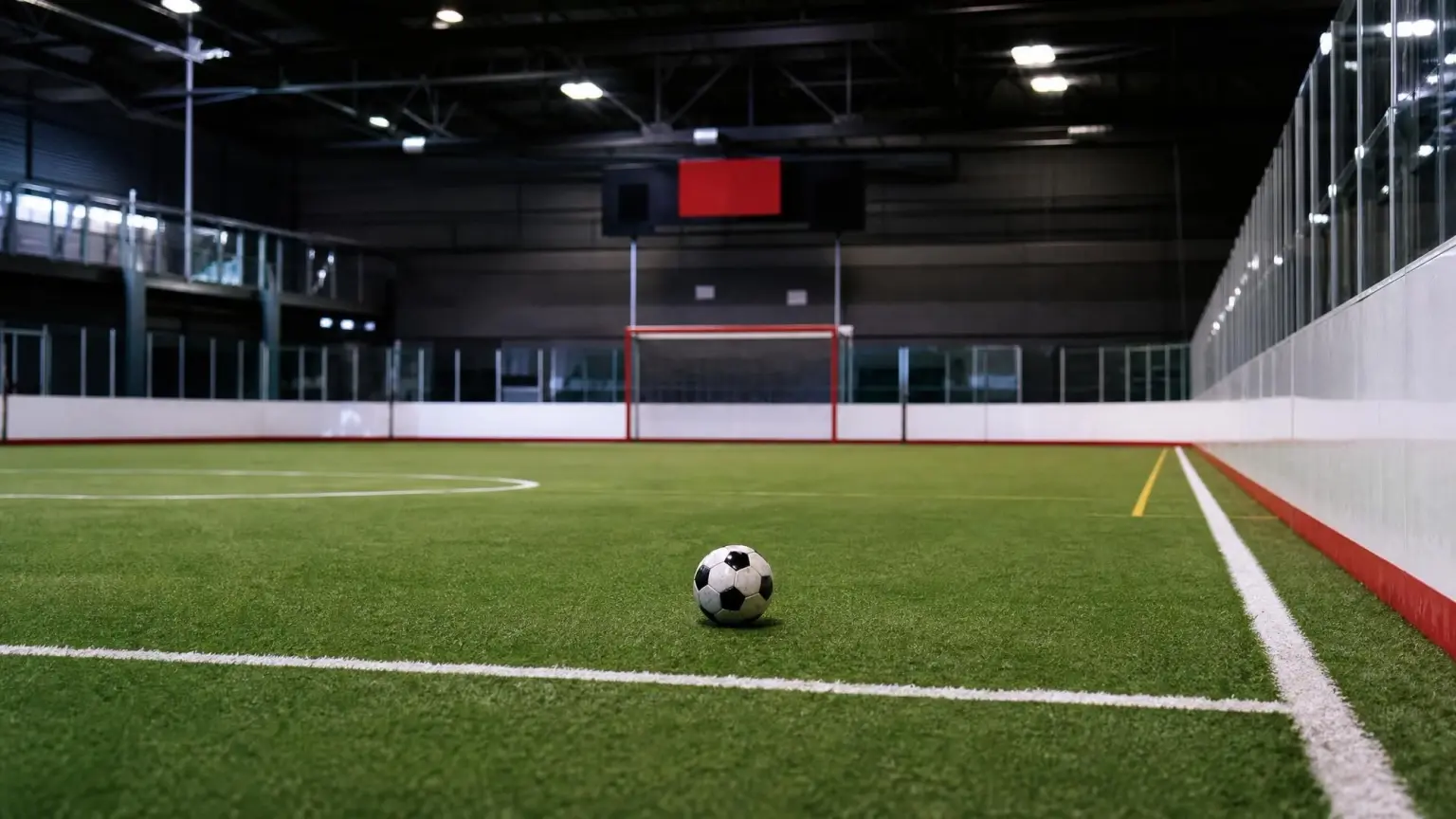
The wall is the sport. A ball played off the boards stays live, so the game has no natural pauses, no throw-ins to reset, and nowhere to hide a weak first touch. The rulebook allows fields between 140 and 210 feet long and 60 to 90 feet wide, with 180 by 75 feet as the standard, enclosed by a perimeter wall of 4 to 12 feet. Goals are a stubby 12 feet wide by 6½ feet high, set flush into that wall.
That is smaller than any outdoor field your child has played on, including the small-sided ones — our guide to youth soccer field dimensions by age has the outdoor numbers to compare against.
How many players are on an indoor soccer team?
Six is the usual answer — five outfield players plus a goalkeeper — but the national rulebook writes it as a range rather than a fixed number:
| Age group | Players on the field (US Indoor) |
|---|---|
| U12 and below | No fewer than 5, no more than 7 |
| Above U12, and coed | No fewer than 4, no more than 6 |
Facilities then pick a number inside that band, and they do not all pick the same one. High Velocity Sports in Michigan, to take one published example, runs 5v5 for U8 and younger, 7v7 for U9–U10 and 6v6 for U11 and up. Substitutions are unlimited and made on the fly, hockey style, without stopping play — which is the real reason indoor rosters stay small.
The ball changes too. US Indoor specifies a size 4 indoor ball for U12 and below and a size 5 above that, while plenty of facilities run size 3 for the youngest groups. Indoor balls are usually felt-covered or lower-bounce, not the ball in your garage; our soccer ball size by age guide covers the outdoor equivalents.
How long is an indoor soccer game?
A regulation US Indoor game is two 22-minute halves, which the rulebook allows facilities to extend to 28 minutes. The clock runs continuously and only stops for an unusual delay the referee calls. Halftime is two minutes. In a tournament or playoff, a tie goes to a 10-minute sudden-death overtime and then a tiebreaker.
Local variation is again the rule rather than the exception — the High Velocity rulebook above uses two 25-minute halves for U9 and older, and four 12-minute quarters for U6–U8 on smaller fields. Either way, a running clock and a two-minute halftime mean an indoor slot is under an hour door to door rather than the half-day a Saturday outdoor game turns into. That is much of the appeal in January.
Is there offside in indoor soccer?
No. The US Indoor rulebook contains no offside law at all — not in the rules, not in the fouls, not in the definitions. A striker can stand on the goalkeeper's toes all game and it is legal.
This catches out well-coached defenders more than anyone. There is no line to hold, no stepping up, no trap. Defending indoor is about pressure and covering the back post, not about geometry. If your child has spent the fall learning the offside rule, expect a few confused weeks while they unlearn it for the winter.
What is a three-line violation?
The one genuinely new rule most families meet. In place of offside, indoor borrows a restriction from hockey:
A "Three-Line Violation" occurs when a player propels the ball in the air across the two Red Lines and the Halfway Line toward the opponent's Goal without touching the Perimeter Wall or another player or a Referee on the field of play.
In plain terms: you cannot boot the ball the length of the building in the air. Clear it along the ground, bounce it off the wall, or get a touch from anyone in between and it is fine. The restart is a free kick for the other team from the offending team's restart mark.
There is a companion rule too. A superstructure violation is called when the ball hits any part of the building above the field — rafters, lights, ceiling netting — and play restarts from the nearer mark.
Blue cards, the penalty box, and power plays
Most indoor facilities use a three-card system, and the extra card is the one nobody expects. Under US Indoor:
| Card | Time penalty |
|---|---|
| Blue (optional third card) | 2 minutes |
| Yellow | 2 minutes |
| Red — card accumulation | 2 minutes, plus ejection |
| Red — anything else | 5 minutes, plus ejection |
Every one of those is served sitting in a penalty area, and the team plays a player short for the duration. Get scored on while short-handed and the penalty is wiped out and your player is released — a genuine hockey-style power play.
This changes how a foul feels. Outdoor, a yellow card is a warning that mostly matters later in the season, and the full picture of what each card means and what follows plays out over weeks. Indoor, a caution costs your team two minutes and probably a goal, tonight. It also makes "boarding" — propelling an opponent into the perimeter wall, whether or not it was intentional — one of the most heavily punished acts in the sport.
Can you slide tackle in indoor soccer?
No, and this is the single most important line in the rulebook for a parent to read before the first game. Slide tackling appears on the US Indoor list of offences with no qualifier attached — no "careless, reckless or excessive force" test of the kind that governs it outdoors. It is simply a foul, and the definitions section is broad about what counts:
Slide-Tackle: Leaving one's feet to propel one or both feet, legs, or other body part in the direction of an opponent with or without the ball.
With or without the ball. A vicious one — into one or both legs from the side or behind — is a straight red. On an unforgiving surface with walls three feet away, that severity is not hard to justify. A defender who slides indoors on Tuesday and outdoors on Saturday needs both versions, so it is worth reading our guide to when a slide tackle is legal outdoors alongside this one.
Goalkeepers keep a familiar restriction: no handling a deliberate pass back from a teammate, and no controlling the ball with hand or foot inside their arc for more than five seconds.
Indoor soccer vs futsal: what's the difference?
They get used interchangeably at registration time and they are not the same game. Futsal is FIFA-governed with its own Futsal Laws of the Game; walled indoor soccer is not.
| Walled indoor soccer | Futsal | |
|---|---|---|
| Surface | Turf, enclosed by boards | Flat hard court, usually wood |
| Players | Usually 6 a side (5 + GK) | 5 a side (4 + GK) |
| Walls | In play | None — the ball goes out |
| Ball out of play | Only if it clears the wall — then a kick-in | Every touchline — kick-in within 4 seconds |
| Ball | Size 4 (U12 and below) or 5, indoor | Size 4, low-bounce by specification |
| Clock | Runs continuously | Stops whenever the ball is out |
| Halves | 22–25 minutes | 20 minutes of actual playing time |
| Offside | None | None |
| Fouls | Cards and time penalties | Accumulated fouls |
Two of those rows deserve a sentence more. The futsal ball is low-bounce by rule, not by marketing: FIFA specifies it "must not bounce lower than 50cm or higher than 65cm on the first rebound when dropped from a height of 2m." And futsal punishes persistent fouling by counting rather than carding — FIFA's own summary explains that once a team commits its sixth accumulated foul in a half, the opposition gets a free kick with no wall allowed, from a second penalty mark ten metres out.
If you are weighing the two for this winter, our piece on futsal versus soccer and whether your child should play both is the decision version of this comparison.
Why your facility's rules are the ones that count
Read the national rulebook closely and you notice how much it deliberately leaves open. Facilities are split between goal kicks and goalkeeper throw-ins on defensive restarts. The blue card is optional. Penalty kicks and shootouts are both accepted. Halves are 22 minutes "which may be extended to 28 minutes, depending on administrative policy."
So two arenas twenty minutes apart genuinely play different games, and the league you registered with is the authority — not the internet, and not the parent next to you who played somewhere else. Three things worth checking before week one:
- Team size and ball size for your child's age group, which vary more indoors than out.
- Footwear. Indoor footwear is required; facilities differ on whether turf shoes and cleats are allowed on their surface.
- Whether the facility uses the blue card, because a two-minute penalty for dissent surprises a lot of first-timers.
Shin guards, for the record, are compulsory everywhere — indoor and futsal alike. And because a winter season is short and fast, keeping a little ball work going at home through it — the kind of thing a training app like FlickTec is built to structure — tends to matter more than which league you picked.
Frequently Asked Questions
Is there offside in indoor soccer?
No. The US Indoor rulebook has no offside law, and there is no offside in futsal either. Attackers can position themselves anywhere, including directly in front of the goalkeeper, which is why defending indoors is about pressure and cover rather than holding a line.
How many players are on an indoor soccer team?
Usually six — five outfield players and a goalkeeper. The US Indoor rulebook sets it as a range: no fewer than 5 and no more than 7 on the field for U12 and below, and no fewer than 4 and no more than 6 above U12 and for coed. Individual facilities choose a number inside that band, so check your league.
How long is an indoor soccer game?
A regulation US Indoor game is two 22-minute halves with a two-minute halftime, and the rulebook lets facilities extend halves to 28 minutes. The clock runs continuously rather than stopping for restarts, so a game slot is typically under an hour. Many facilities use 25-minute halves for older age groups and quarters for the youngest.
Can you slide tackle in indoor soccer?
No. Slide tackling is listed as an offence in the US Indoor rules with no careless-or-reckless qualifier, and the definition covers leaving your feet toward an opponent "with or without the ball." A tackle from the side or behind into an opponent's legs is a red card. Goalkeepers at some facilities may slide feet-first to make a save inside their own area — check your league's rule.
What is the difference between indoor soccer and futsal?
Walled indoor soccer is played on turf inside boards that keep the ball live, usually six a side, with a running clock and hockey-style time penalties. Futsal is FIFA-governed, played five a side on a flat hard court with no walls, a low-bounce ball, a stopped clock, 20-minute halves, and accumulated fouls instead of a penalty box.
Indoor is not a watered-down version of the outdoor season, and it is not a substitute for it either. It is a faster, tighter, more physical game with its own rulebook, and the families who enjoy it most are the ones who learned that before the first whistle rather than during it. Read your facility's rules once, in September, and the winter mostly takes care of itself.