Soccer Referee Signals Explained: Every Hand and Flag Signal
 Reviewed by Roman PivarnikUEFA Pro Licence · Technical Director, Slovak FA
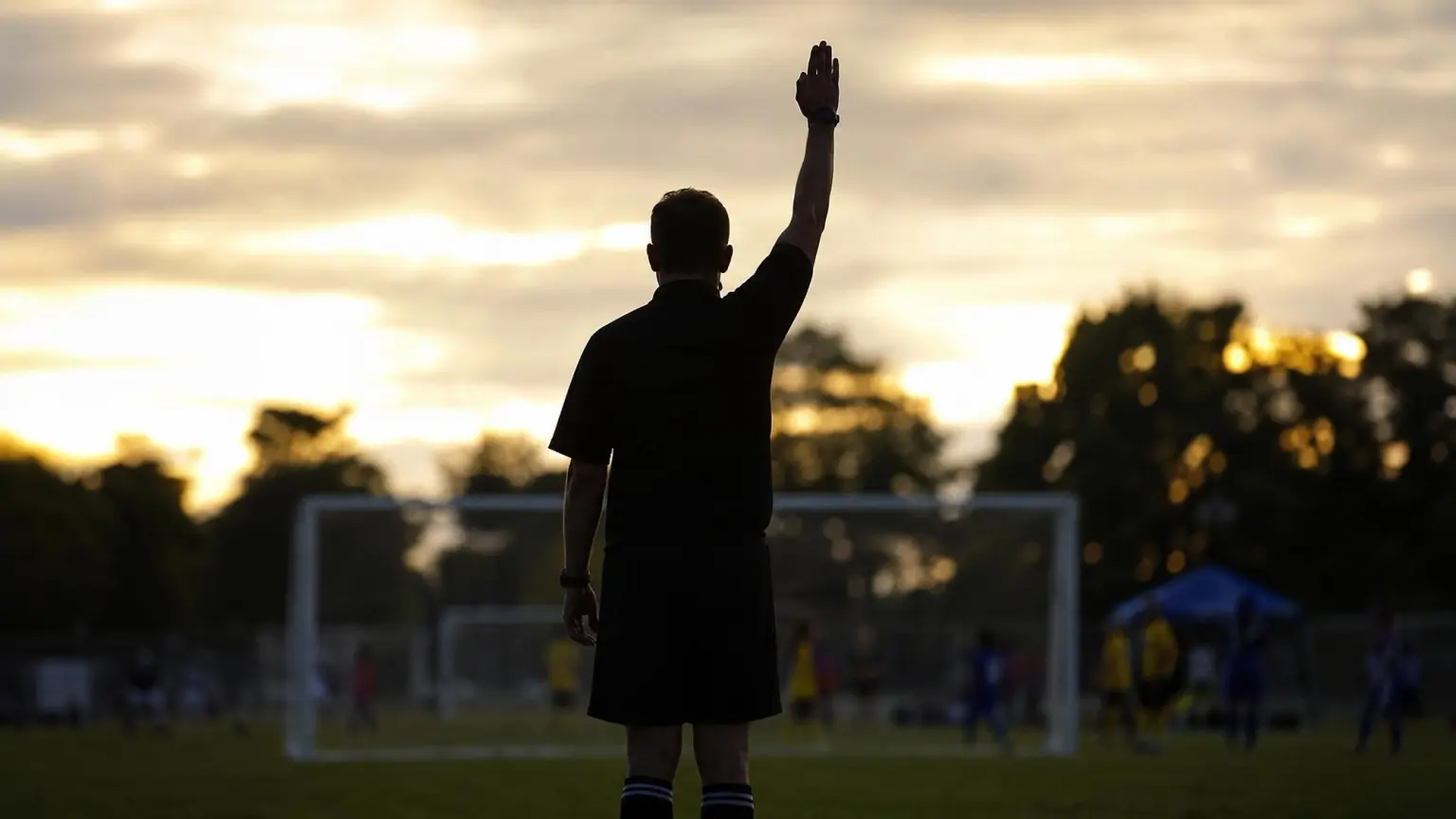
Soccer referee signals are how one official tells 22 players and every parent on the touchline what just happened without saying a word. The core set is small. One arm straight up means an indirect free kick. An arm pointed toward a goal means a direct free kick. Both arms swept forward means advantage — play on. A point at the penalty mark means a penalty. A card held overhead means a caution or a sending-off. The assistant referee adds a second layer with the flag: offside, throw-in direction, corner kick, goal kick. Almost everything else you think you are seeing is the referee talking to a player, not signalling a decision.
Youth soccer is where most parents learn to read these signals, and it is the worst possible classroom. There is often one referee instead of three, the flag is being held by somebody's dad, and decisions arrive faster than anyone can explain them.
Here is the full set, what each one obliges the players to do next, and the youth-specific quirks that make a Saturday morning game look nothing like a televised one.
What do the referee's hand signals mean?
Something surprising first: the Laws of the Game do not describe the signals in words at all. Law 5 devotes exactly one line to them — "Refer to graphics for approved referee signals" — and then shows a page of drawings. That is why wording varies between guides. The gestures themselves are standardised; the sentences describing them are not.
| Signal | What the referee does | What it means |
|---|---|---|
| Indirect free kick | One arm held straight up above the head | A goal cannot be scored directly — the ball must touch another player first |
| Direct free kick | Arm straight out, pointing toward the goal the kicking team is attacking | A goal can be scored straight from the kick |
| Advantage | Both arms raised in parallel up to shoulder height, pushed forward | There was an offence, but play continues because the fouled team is better off |
| Penalty kick | Points at the penalty mark | Direct free kick offence by the defence inside their own penalty area |
| Caution | Yellow card held overhead, arm fully extended | Formal warning; the player stays on |
| Sending-off | Red card held overhead, arm fully extended | The player leaves and cannot be replaced |
| Corner kick | Points at the corner arc, arm angled about 45 degrees down | Ball out over the goal line, last touched by the defending team |
| Goal kick | Points toward the goal area | Ball out over the goal line, last touched by the attacking team |
Two of these carry more information than the rest.
The raised arm is the one to watch. It stays up until the kick has been taken and the ball touches another player, goes out of play, or it is clear no goal can be scored. If a shot goes straight in while that arm is still vertical, it does not count. Our guide to the difference between a direct and indirect free kick covers which offences produce each one.
The advantage signal is a promise with a deadline. The referee is not waving the foul away permanently. Under Law 5 the referee "penalises the offence/orders a retake if the anticipated advantage does not ensue at that time or within a few seconds." So a referee can sweep both arms forward, watch the attack break down two seconds later, and still bring it back for the original foul. That is not the referee changing their mind. That is the Law working exactly as written.
There is no separate signal for a goal, and none for a normal foul beyond pointing the direction. A referee who points and says nothing has given you a direct free kick.
Why doesn't the referee blow the whistle for everything?
Because the Laws tell them not to. The IFAB's guidance on the whistle splits it in two.
The whistle is needed to start each half and restart after a goal, to stop play for a free kick or penalty kick, and to restart free kicks where the ten-yard distance is being enforced, penalty kicks, and play after a caution, sending-off, injury or substitution.
The whistle is explicitly not needed to "stop play for a clear: goal kick, corner kick, throw-in or goal" or to restart from most free kicks, goal kicks, corner kicks, throw-ins and dropped balls. The reason is blunt: "A whistle which is used too frequently/unnecessarily will have less impact when it is needed."
This is the single biggest source of sideline confusion in youth games. The ball goes out, the referee points and says nothing, and half the parents assume the referee missed it. They did not. A silent point is the correct mechanic for an obvious ball out of play.
The flip side matters too. When a referee is holding a free kick for the wall to retreat, they must clearly tell the kicker to wait for the whistle. A kick taken before that whistle gets retaken — and the player who took it can be cautioned.
What do assistant referee flag signals mean?
The assistant referee is not there to make decisions. Under the Laws they indicate — when the whole ball leaves the field and which team gets the restart, when a player in an offside position may be penalised, when a substitution is requested, and at penalty kicks whether the goalkeeper came off the line early. The referee still decides.
| Flag position | Meaning |
|---|---|
| Flag pointed up the touchline at about 45 degrees above horizontal | Throw-in, in the direction the flag points |
| Flag held horizontal, pointing toward the goal area | Goal kick |
| Flag angled about 45 degrees down toward the nearest corner | Corner kick |
| Flag straight up, held still | Offside, or an offence the referee needs to see |
| Flag held horizontally overhead with both hands | Substitution requested |
The mechanics are deliberately slow. A good assistant stops running, faces the field, makes eye contact with the referee and raises the flag with unhurried motion — then keeps it up until the referee acknowledges it or the defending team clearly has the ball. An assistant sprinting along with the flag half up is not signalling anything yet.
Assistants also step onto the field at free kicks near their touchline to help walk the ten yards. That is in their job description, not freelancing.
How does the assistant show where an offside happened?
This is the signal almost nobody on the sideline can read, and it is the most useful one to learn.
The assistant raises the flag straight up first. Once the referee whistles, the flag drops to one of three angles, and that angle tells the referee which third of the width of the field the offence happened in:
- 45 degrees above horizontal — far third, the side away from the assistant
- Horizontal — middle third
- 45 degrees below horizontal — near third, the assistant's own touchline
The restart comes from where the offside player was standing, not from where the pass was played, so the referee needs that information to place the ball. Our explainer on how offside works in youth soccer covers when it starts being called at all — under the US small-sided standards there is no offside before U9, which means at 7v7 you will never see this signal.
What changes when there's only one referee?
Most youth games below the older competitive age groups run with a single official and no certified assistants. Two things follow.
Club linesmen are not assistant referees. They are volunteers — usually a parent from each team — and their authority is deliberately tiny. US Youth Soccer's guidance to new referees is to "ask them to only indicate when the ball has completely crossed over the touchline or goal line, and not the direction the throw or whether it is a goal kick or corner kick." A club linesman raises the flag straight up for a ball out of play. That is the whole job. They do not signal direction, they do not flag offside, and they do not call fouls. If a club linesman starts pointing which way the throw goes, they have gone outside their role, and the referee is right to ignore it.
The referee cannot see everything. One official covering a full field will miss touches on the far touchline. That is a structural limitation of a one-referee game, not bias. The throw-in going the wrong way is usually a sightline problem, and the throw-in rules are hard enough to judge from twenty yards even with a clear view.
Substitutions run differently too. With no assistant to hold the flag overhead, subs wait at the halfway line for the referee to wave them on directly. Which stoppages allow it varies by league — youth substitution rules cover the common formats. The reason so many youth games run this way at all is that there are not enough certified officials to field a three-person crew — and the entry requirements are lower than most parents assume, which we cover in how to become a youth soccer referee.
Signals that don't exist
A short list, because these cause real arguments:
- There is no signal for "I saw it and I'm not calling it." Referees frequently see contact and judge it fair. Silence is a decision.
- There is no card-in-the-pocket warning signal. A referee talking to a player with no card in hand has given a warning, not a caution. Nothing goes on the record.
- There is no signal that distinguishes a handball from any other direct free kick. The referee points, and that is it. What counts as a handball offence is decided in the referee's head, not announced with a gesture.
- Pointing at the spot where a foul happened is not a penalty. A penalty is a point at the penalty mark specifically. Referees indicate restart spots outside the box constantly.
Reading a youth game from the sideline
Three habits make almost everything legible in real time.
Watch the arms before the ball. Vertical arm, both arms forward, or a straight point toward a goal — those three cover the large majority of stoppages, and each tells you what should happen next.
Assume silence is intentional. No whistle on a ball crossing the line is the correct mechanic, not a missed call.
Judge the flag by whether it is still. A raised, motionless flag is a signal. Anything else is a volunteer trying to keep up with play.
Frequently Asked Questions
What does it mean when the referee raises one arm straight up?
It signals an indirect free kick — a kick that cannot be scored directly. The arm stays up until the ball has been kicked and touches another player, goes out of play, or it becomes clear no goal can be scored. If the ball goes straight into the goal while the arm is still raised, no goal is awarded and the defending team gets a goal kick.
What is the advantage signal in soccer?
Both arms raised in parallel to shoulder height and pushed forward in the direction of play. It means the referee saw an offence but is letting play continue because the fouled team benefits. It is not permanent: if the expected advantage does not materialise within a few seconds, the referee can come back and penalise the original offence.
Why doesn't the referee blow the whistle when the ball goes out?
Because the Laws advise against it. The whistle is not needed to stop play for a clear goal kick, corner kick, throw-in or goal, since overusing it reduces its impact when it genuinely matters. A referee pointing without whistling has made a decision, not missed one.
What do the assistant referee's flag angles mean for offside?
After the referee stops play, the assistant lowers the flag to show which third of the field's width the offence occurred in: about 45 degrees above horizontal for the far third, horizontal for the middle third, and about 45 degrees below horizontal for the near third. The restart is taken from where the offside player was, so the referee needs that location.
Can a parent volunteer with a flag call offside?
No. Club linesmen assist a solo referee by indicating only that the ball has completely crossed the touchline or goal line. They do not signal the direction of the throw, whether it is a corner or a goal kick, offside, or fouls. Those all remain the referee's decisions.
None of these signals are secret, and none of them are improvised. Learn the three arm positions and the four flag positions and most of what looks like chaos on a youth field resolves into a referee doing precisely what the Laws ask. The sideline arguments that survive that are almost always about judgement, which no signal was ever going to settle.