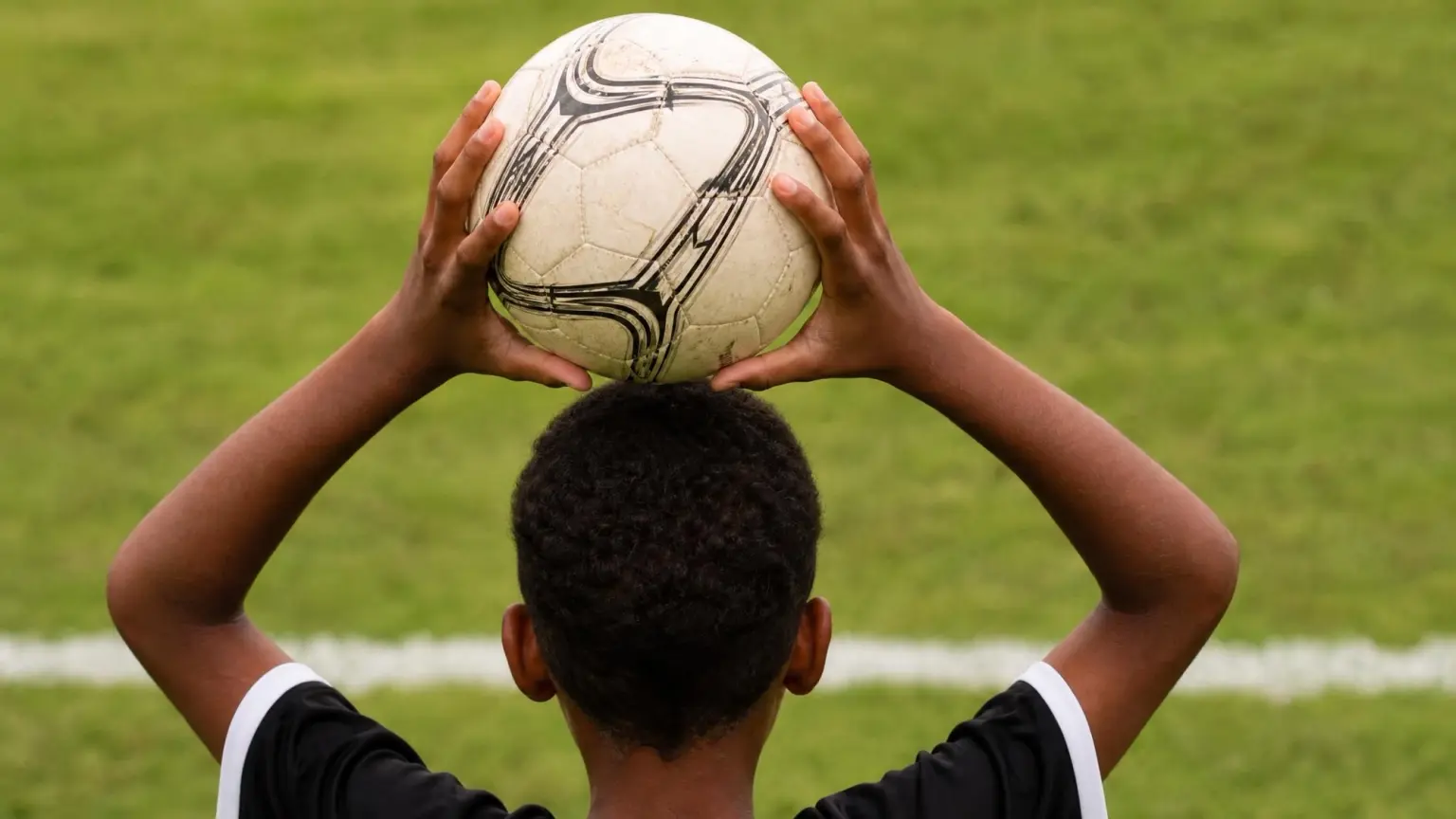
Soccer Throw-In Rules: What Makes a Throw Legal (and What's a Foul Throw)
 Reviewed by Roman PivarnikUEFA Pro Licence · Technical Director, Slovak FA
A throw-in is legal when, at the moment the ball leaves the thrower's hands, they are facing the field of play, have part of each foot on the touchline or on the ground outside it, and throw the ball with both hands from behind and over the head — from the point where it went out. Miss any one of those and it's a foul throw, and the throw-in is handed to the other team. You cannot score directly from a throw-in, and there is no offside from one.
The throw-in is the most common restart in soccer and the one young players get wrong most often. It's also the rule sidelines police hardest: a nine-year-old lifts a back foot, someone shouts "foul throw!", and the referee waves play on anyway.
Here is exactly what the law requires, the things people call foul throws that aren't, and how the rule is deliberately softened for the youngest age groups.
What are the rules for a throw-in in soccer?
A throw-in is awarded to the opponents of the player who last touched the ball when the whole of the ball passes over the touchline, on the ground or in the air. Any player on that team can take it.
Under the IFAB Laws of the Game, at the moment of delivering the ball the thrower must:
- stand facing the field of play
- have part of each foot on the touchline or on the ground outside the touchline
- throw the ball with both hands from behind and over the head from the point where it left the field of play
Three details follow from that wording, and they settle most sideline arguments before they start:
- The ball is in play when it enters the field of play — not the instant it leaves the hands.
- If the ball touches the ground before entering the field, the throw-in is retaken by the same team from the same position. That one is a do-over, not a turnover.
- All opponents must stand at least 2 m (2 yds) from the point on the touchline where the throw-in is to be taken.
Notice what the law does not say. There's no minimum distance, no restriction on direction, and nothing about how the player gets to the line.
What is a foul throw?
A foul throw is a throw-in that doesn't meet those conditions. The sanction is blunt and it surprises people: if the throw-in is not taken correctly, it is retaken by the opposing team. No free kick, no card — possession simply changes hands.
The foul throws you'll actually see in youth games:
| What happened | Why it's illegal |
|---|---|
| Front foot lands fully inside the field | Part of each foot must be on the line or outside it |
| Back foot lifts clear of the ground | Part of each foot must be touching the ground |
| One hand behind the ball, one on the side | The ball must be thrown with both hands |
| Ball released from in front of the forehead | It must come from behind and over the head |
| Throw taken ten yards up the line | It must be from the point where the ball left the field |
| Thrower turned side-on or away | They must be facing the field of play |
And a handful of things sidelines shout about that are perfectly legal:
- A run-up. Law 15 sets conditions at the moment of delivery only. A player can take three strides and throw, as long as the feet and hands are right when the ball is released.
- Heels off the ground. The law asks for part of each foot on the ground. Up on the toes is fine; a foot swinging free in the air is not.
- A two-yard throw to the nearest teammate. There is no minimum distance.
- Throwing backwards, or back towards your own goal. There is no direction requirement.
- An acrobatic or flip throw. Law 15 doesn't mention somersaults; it only sets conditions at the point of release. Some youth competitions ban them locally on safety grounds, so check your league's own modifications.
Can you score directly from a throw-in?
No. A goal cannot be scored directly from a throw-in, in either goal.
- Thrown straight into the opponents' goal → goal kick to the opponents.
- Thrown straight into the thrower's own goal → corner kick to the opponents.
Somebody else has to touch it first, and that somebody can't be the thrower. The player taking the throw must not touch the ball again until it has touched another player. Doing so hands the opposition an indirect free kick — or a direct free kick if they played it with a hand or arm, which is where the handball rule takes over.
Is there offside from a throw-in?
No. Law 11 states it plainly: there is no offside offence if a player receives the ball directly from a goal kick, a throw-in or a corner kick.
So a forward standing behind the last defender when a teammate takes a throw-in is doing nothing wrong at all. It is one of the few legal ways to get a runner in behind a defence, and good attacking teams use it. Our full guide to the offside rule in youth soccer covers how the offence works and at what age it first gets enforced.
Can you throw the ball to your own goalkeeper?
You can throw it to them. They just can't pick it up.
Under Law 12, a goalkeeper inside their own penalty area commits an indirect free kick offence if they touch the ball with the hand or arm after "receiving it directly from a throw-in taken by a team-mate." There is no card attached — just an indirect free kick to the other team from where the keeper handled it.
That means keepers have to take a teammate's throw-in with their feet, chest or head, under pressure, often with an attacker closing. It's a constraint worth drilling early rather than discovering in a game; our guide to coaching youth goalkeepers covers distribution and receiving under those limits.
How far away do defenders have to stand?
Two metres. All opponents must stand at least 2 m (2 yds) from the point on the touchline where the throw-in is to be taken.
A defender who stands inside that distance and unfairly distracts or impedes the thrower is cautioned for unsporting behaviour. In youth games a referee will almost always ask a player to back up first and reach for a card only if it keeps happening.
What is the new five-second countdown on throw-ins?
This one is genuinely new, so it's worth knowing before someone at the next game insists it isn't a thing. In February 2026 the IFAB announced that its anti-time-wasting countdown would be extended to throw-ins and goal kicks:
"If the referee considers that a throw-in or goal kick is taking too long or being deliberately delayed, a five-second visual countdown will be initiated."
The referee blows the whistle, signals clearly for the restart, and counts down from five with a raised hand. If the ball isn't in play at zero, the throw-in is awarded to the opposing team from the same position — and a delayed goal kick becomes a corner. The measures were confirmed for the FIFA World Cup 2026 and other competitions.
Whether it's being enforced at your child's field this season is a separate question. Youth leagues adopt Law changes on their own timelines, so if it matters to you, ask your club rather than assuming either way.
Do throw-in rules change for young kids?
In practice, yes — and the modification is intentional, not a referee going easy.
A throw-in is a genuinely difficult motor skill for a seven-year-old: both hands, both feet, behind and over the head, facing the right direction, all at the same moment. US Youth Soccer's Under-7/Under-8 playing recommendations say exactly that — "some U8 players do not yet have the eye-hand coordination to execute a throw-in to the letter of the law" — and set out how officials should respond:
"One 'do-over' per thrower should be the normal response if the throw-in is incorrect. The official of the match should explain to the child how to execute the throw-in correctly and accept anything reasonably close."
The same document lets coaches step onto the field "to assist the players in proper throw-ins, restarts and player injuries." These are recommendations rather than a national mandate, and leagues write their own modifications on top, so the handling varies from club to club. What's consistent is the direction of travel: by 7v7 (U9–U10) and above, expect Law 15 to be applied properly, with the ball going the other way on a foul throw.
If the U-numbers are still fuzzy, our youth soccer age groups guide maps them to birth years and game formats.
How do you teach a child a legal throw-in?
Almost every foul throw is a feet error, not a hands error — which is useful, because feet are the easier half to fix.
- Set the feet before you think about the ball. One foot back, both toes pointing at the field, weight on the back foot. Get that habit and most foul throws disappear.
- Drag the back toe. Teach a deliberate scrape of the back foot along the ground through the throw. It keeps part of that foot down without the player having to think about it.
- Both thumbs behind the ball. Thumbs and index fingers forming a rough W behind the ball forces two-handed delivery and stops the sideways sling.
- Start it behind the head, finish in front. The ball has to come from behind the head. A useful cue: touch the back of your neck with the ball, then throw.
- Stepping onto the field afterwards is fine. The requirements apply at release. Following through into the field is legal and actually helps power.
- Practise the short one. Kids default to hurling it as far as they can. The throw that keeps possession is usually the five-yard one to a teammate who's already turning.
Throw-ins are also a decision, not just a technique: where to look, when to go early, who to hit. That's built through repetition and game understanding rather than a single explanation on the drive home. FlickTec's structured home sessions — built by a UEFA Pro Licence coach — focus on the ball mastery and first touch that make a quick restart worth taking in the first place.
Frequently Asked Questions
Is it a foul throw if one foot comes off the ground?
Yes. At the moment of delivering the ball the thrower must have part of each foot on the touchline or on the ground outside it. Being up on the toes is fine — part of the foot is still down — but a foot lifted clear of the ground makes it a foul throw, and the throw-in goes to the opposing team.
Can you score directly from a throw-in?
No. A goal cannot be scored directly from a throw-in. If the ball goes straight into the opponents' goal the restart is a goal kick; if it goes straight into the thrower's own goal, the opponents get a corner kick. Another player has to touch the ball first, and it can't be the thrower.
Can a player be offside from a throw-in?
No. Law 11 says there is no offside offence if a player receives the ball directly from a goal kick, a throw-in or a corner kick. A teammate can stand behind the last defender and receive a throw-in legally.
What happens if a throw-in is taken incorrectly?
The throw-in is retaken by the opposing team. There's no free kick and no card — possession just switches. One exception works the other way: if the ball touches the ground before it enters the field of play, the same team retakes the throw from the same position.
Can the goalkeeper pick up a throw-in from a teammate?
No. If a goalkeeper inside their own penalty area handles the ball after receiving it directly from a teammate's throw-in, the opposing team is awarded an indirect free kick. There is no card for it. The keeper has to control the ball with their feet, chest or head instead.
How far away do defenders have to stand at a throw-in?
At least 2 m (2 yds) from the point on the touchline where the throw-in is taken. An opponent who stands closer and unfairly distracts or impedes the thrower should be cautioned for unsporting behaviour.