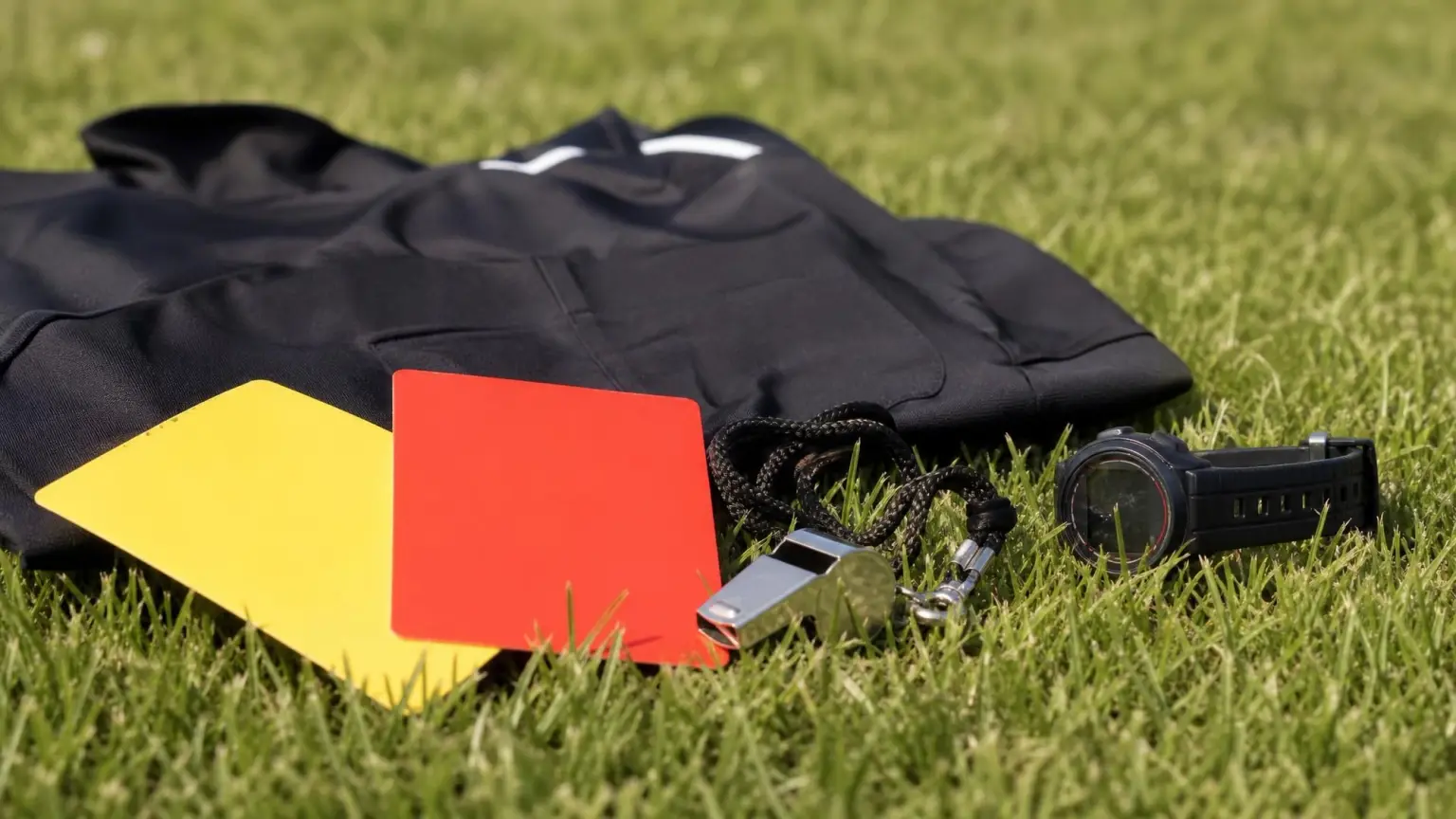
How to Become a Youth Soccer Referee: Requirements, Cost and Pay
 Reviewed by Roman PivarnikUEFA Pro Licence · Technical Director, Slovak FA
You can become a certified youth soccer referee at 13. The entry-level license is called Grassroots, it runs through your state referee committee rather than US Soccer directly, and it takes online modules plus one in-person field session — no fitness test, no playing experience, no practical evaluation. In California North the 2027 registration fee is $72.50; in Cal South a single referee working one U12 game is paid $78. The badge pays for itself in an afternoon.
If you have spent this fall watching a 14-year-old in a yellow shirt manage twenty-two players and forty parents on their own, you have already seen the shortage. US Soccer counts more than 130,000 active referees across 55 state associations, and every club director in the country will tell you it is not enough. Here is what the certification involves, what it costs, what it pays, and why October is a better month to start than most people assume.
What do you actually need to become a youth soccer referee?
Less than you would guess. Every state referee committee publishes its own requirement table against US Soccer's national policy, and the entry-level row is almost entirely blank. These are the first-time referee requirements as published by the California North Referee Association for the 2026 registration year:
| Requirement | What's needed |
|---|---|
| Age | 13 years of age or older |
| Previous game experience | None |
| Previous certification | None |
| Training | Online modules in the Learning Center, online Laws of the Game update, in-person field session |
| Safety and compliance | Safe & Healthy Playing Environments; background check and SafeSport training for officials 18 and older only |
| Fitness test | None |
| Practical evaluation | None |
Two rows matter more than the rest.
No playing experience is required. A parent who has never played can certify alongside their child, and so can a coach or a former player returning after twenty years.
The background check and SafeSport training apply only to officials 18 and older. Minors still complete the Safe & Healthy Playing Environments module, which is where the safeguarding material sits for them — the adult screening requirements are not a barrier for a 13-year-old, but the safeguarding education is not skipped either.
The figures above are Cal North's, and the fifty-five state committees set their own policies on top of the national standard, so start from US Soccer's state-by-state course finder rather than assuming.
How do you sign up for the grassroots course?
The sequence is much the same everywhere, because the coursework lives in one national system and only the field session is local. Cal North publishes the steps plainly:
- Create an account at the US Soccer Learning Center. For a minor, the referee's own email goes in as primary and the parent's as secondary.
- Choose Register for a Course, then Grassroots – First-Time Referees.
- Pick a course whose field session you can physically get to on the date listed. This decides your timeline, not the online work.
- Finish every online assignment before the field session, or you may be bumped to a later course.
- Attend the field session. Your badge is mailed to you afterwards.
Cal North runs courses in English and Spanish. The online portion covers the Laws of the Game and the safeguarding modules; the field session is where someone walks you through positioning, mechanics and the hand and flag signals you will be using on Saturday.
Why starting in October works in your favor
Referee licenses run by registration year, and the cutoff creates a quiet advantage for certifying in the fall. Under Cal North's published policy, entry-level courses finishing before late June register you for the current year — so you pay, then renew a few months later. Courses completed on or after July 1 register you for the following year instead, and those referees "will be able to referee the remaining season in addition to also being able to referee the next year before needing to renew their annual license."
Certify in October and one fee covers the back half of this season and all of next. Certify in April and you are renewing by winter. Check your own state committee's wording, but where this rule applies the fall course is simply better value.
What does it cost?
State committees set their own fees. Cal North's published 2027 schedule is a reasonable benchmark:
| License | Fee |
|---|---|
| New Grassroots Referee | $72.50 |
| Grassroots Referee recertification | $77.50 |
| Regional Referee upgrade | $100 |
A $10 late fee applies to 2027 registrations completed after 31 December 2026, and US Soccer may add a small transaction fee. Budget separately for a uniform, whistle, cards and a watch — the cost new referees most often forget.
How much do youth soccer referees get paid?
The honest answer is "it depends enormously", so here are two real published schedules at opposite ends of the range rather than an average that describes nobody.
Competitive club soccer. Cal South's Fall 2026 intercity fee schedule pays a three-referee crew $2.25 per minute of game time, prorated when fewer officials work:
| Age group | Game length | 3 referees (crew total) | 2 referees | 1 referee |
|---|---|---|---|---|
| U12, 9v9 | 60 min | $136 | $100 | $78 |
| U14, 11v11 | 70 min | $158 | $116 | $88 |
| U16, 11v11 | 80 min | $180 | $140 | $110 |
The two teams split the fee and pay it in cash before kick-off. One detail worth knowing before you show up: assistant referees not in proper uniform are treated as club linesmen and are not paid at all.
Recreational soccer. A municipal program pays a fraction of that. Waterford Parks and Recreation in Michigan publishes a rate card listing U8 at $14 per game, U10 center at $17, U12 center at $22 and U14 center at $27. That card was last revised in 2019, so treat it as an illustration of the gap rather than today's going rate — but the shape of the gap is real.
Both are per game, and games are short. Because fees scale with how long games actually run at each age, a referee working a U12 and a U14 back to back on one field does a little over two hours of work — and at Cal South rates, a single official covering both earns more in that morning than the whole annual registration fee.
What comes after Grassroots?
Grassroots is deliberately the only easy rung. Regional Referee, the step above, is where the requirements arrive all at once — Cal North lists 25 games as a referee and 15 as an assistant referee at adult amateur level, a license held in each of the two previous years, a FIFA sprint and interval fitness test, and three evaluations in the past twelve months averaging 8.0 or above.
Almost nobody needs that. The large majority of certified referees stay at Grassroots and work local youth games for years, which is exactly what clubs are short of.
For the few who do want the full pathway, US Soccer has just made it more explicit. In September 2026 it launched R90+, a 24-month program giving selected referees individualized coaching, match analysis, physical preparation and assignments at national events, starting in the South Region with roughly 60 referees before expanding. Kari Seitz, US Soccer's head of refereeing, framed it as a geography problem: "Our responsibility is to make sure geography does not determine who gets the opportunity to develop."
Is this a good idea for a 13-year-old?
Two honest things, in order.
Abuse from the sideline is the reason this job is hard to fill, and putting your own child in that position should be a deliberate decision rather than a casual one. US Soccer states a "zero-tolerance for referee abuse" commitment, and your state committee and league will have a reporting route — find out what it is before the first game, not after a bad one. Ask the assignor to start a young referee on small-sided games, and stand near the field for the first few.
The other half is that officiating teaches the game in a way playing it does not. A referee has to know where to be before the ball gets there, read what is about to happen, and say a decision out loud with people watching — the same skill set as reading the game as a player, learned from the one position that has to watch all twenty-two. Players who referee tend to come back understanding offside properly for the first time: not the rule as recited, but what the assistant referee is actually looking at.
It is also a job that pays in cash, takes two hours on a Saturday, and exists within walking distance of most American families. There are not many of those for a 14-year-old.
Frequently Asked Questions
How old do you have to be to referee youth soccer?
US Soccer's policy minimum for the entry-level Grassroots license is 13 years of age or older, as published in state referee committee requirement tables. State committees can add conditions on top of the national standard, so check your state's page for anything specific to where you live.
How much do youth soccer referees get paid per game?
It depends on the level far more than the age group. Cal South's Fall 2026 intercity schedule pays a three-referee crew $136 for a 60-minute U12 game and $180 for an 80-minute U16 game — $2.25 per minute of game time — and $78 for a single referee working that U12 game alone. A municipal recreational program in Michigan published rates of $17 for a U10 center referee and $27 for U14. Rec is the floor, competitive club the ceiling, and both are normal.
How long does it take to become a soccer referee?
The limiting factor is the field session, not the coursework. The online modules and Laws of the Game update are self-paced and must be finished before you attend, so your start date is whichever in-person session you can get to. Once you complete it, your badge is mailed and you can be assigned games.
Do you need a background check to referee youth soccer?
Only if you are 18 or older. Background screening and SafeSport training are required for officials 18 and above; referees under 18 complete the Safe & Healthy Playing Environments module instead. All three sit inside the same US Soccer Learning Center account.
Do you need to have played soccer to be a referee?
No. State requirement tables list previous game experience and previous certification as not applicable, and there is no fitness test or practical evaluation at Grassroots. Parents with no playing background routinely certify, often at the same course as their child.
One course, one field session, about seventy dollars, minimum age 13, no fitness test. Clubs are short of officials right now, and the fall registration window means a badge earned this month covers the rest of this season and all of the next. Find your state committee on US Soccer's course finder and look at what is scheduled near you — the hard part is picking a date, not passing anything.