FIFA Quality Marks Explained: How to Choose a Soccer Ball That Lasts
 Reviewed by Roman PivarnikUEFA Pro Licence · Technical Director, Slovak FA
A FIFA mark on a soccer ball is a lab result, not a marketing badge. There are three of them — FIFA QUALITY PRO, FIFA QUALITY and FIFA BASIC — and each means the ball passed the same battery of tests at a different level of strictness. The useful part for a youth parent is not which mark is on the box. It's the loss-of-pressure figure sitting behind it, because that is the one test that predicts whether the ball is still worth kicking in March.
Soccer balls are sold on feel and flight. The specification that actually decides whether a ball survives a youth season is buried in a FIFA testing manual almost nobody reads. Here is what the FIFA quality marks test, what the numbers are, and which of them matter when the ball is going to spend eight months in a garage and a driveway rather than a stadium.
What are the FIFA quality marks on a soccer ball?
In March 1995 the IFAB "decided to adopt compulsory testing and marking for footballs to be used in official matches." Today Law 2 requires that balls in "official competitions organised by FIFA or the confederations" carry one of the marks. National federation competitions can require them, but are not obliged to — which is why your child's league almost certainly doesn't.
The three marks, in FIFA's own words:
- FIFA QUALITY PRO — "the professional standard recommended for all top level matches." The emphasis of its test requirements "is on first-class performance, accuracy and safety."
- FIFA QUALITY — "the general level for training and broader use." Its requirements "emphasise the durability and safety of these products... more than for the FIFA Basic standard."
- FIFA BASIC — "designed to identify products that fulfil basic performance, accuracy, safety and durability criteria for football," aimed at organisations "with limited budgets."
FIFA Basic replaced the older International Match Standard, and IMS-marked balls "remain eligible for use until their certification expires." If you find an IMS ball in a clearance bin, that's what it is: the previous name for the entry tier.
The testing itself is outsourced. FIFA Quality Pro and FIFA Quality are certified by Empa, the Swiss Federal Laboratories for Materials Science and Technology. FIFA Basic is handled by Sports Labs Ltd. and PFI.
What do the FIFA ball tests actually measure?
Seven tests apply to outdoor footballs. None of them are subjective.
| Test | What happens in the lab | What it tells a parent |
|---|---|---|
| Circumference | The ball is measured across 4,500 points | It's the size it claims to be |
| Sphericity | Radius deviation, expressed as a percentage | It's actually round, so it rolls true |
| Rebound | Dropped from 2.00 m onto metal, ten times — plus a second run chilled to 5°C | It bounces consistently, including in cold weather |
| Water absorption | 250 compressions in 2 cm of water, at 25% of the ball's diameter, 40 per minute | It won't turn into a brick in the rain |
| Weighing value | Weighed to 0.01 g accuracy | It's the correct weight |
| Loss of pressure | Inflated, then re-measured after 72 hours | How fast it goes soft |
| Shape and size retention | Fired 2,000 times at 50 km/h into a stainless steel plate, then re-measured | Whether hard use deforms it |
That last one is the closest thing in the industry to a durability guarantee, and it is worth knowing exactly who gets it.
Which FIFA mark is best? The size 5 numbers side by side
Here are the published requirements for a size 5 outdoor ball, taken straight from the FIFA Quality Programme for Footballs testing manual:
| Test (size 5) | FIFA QUALITY PRO | FIFA QUALITY | FIFA BASIC |
|---|---|---|---|
| Circumference | 68.5–69.5 cm | 68.0–70.0 cm | 68.0–70.0 cm |
| Sphericity (max) | 1.5% | 1.8% | 1.8% |
| Rebound at 20°C | 135–155 cm | 125–155 cm | 125–155 cm |
| Rebound at 5°C | min. 125 cm | min. 115 cm | min. 115 cm |
| Water absorption (max) | 10% | 10% | 10% |
| Weight | 420–445 g | 410–450 g | 410–450 g |
| Loss of pressure (max) | 15% | 20% | 25% |
| Shape/size retention | max. 1.5 cm change, max. 1.5% sphericity, max. 0.1 bar | max. 1.5 cm change, max. 1.8% sphericity, max. 0.1 bar | not tested |
Read across the rows and the marketing story falls apart. On size, weight and water absorption, a FIFA Basic ball has to hit essentially the same targets as the professional one. Law 2 sets the outer bounds anyway: circumference "between 68 cm (27 ins) and 70 cm (28 ins)," weight "between 410 g (14 oz) and 450 g (16 oz) at the start of the match."
Three rows do separate the tiers, and they are the interesting ones. Quality Pro has to be rounder and bounce inside a tighter window, including when cold. It has to hold air better. And unlike a Basic ball, it has to survive 2,000 shots off a steel plate without the seams or valve failing.
Why loss of pressure is the number that matters
Look at that row again. Over 72 hours, a certified ball is permitted to lose 15% of its pressure at the professional tier, 20% at Quality, and 25% at Basic.
That is not a defect. It's the standard. Every soccer ball leaks, and the cheaper the certification tier, the faster it is allowed to. A ball pumped up on Saturday and left alone until the following Saturday will be noticeably soft, and a quarter of its pressure gone is within spec.
This is the single most common reason a family thinks a ball has "gone bad" after two months. It hasn't. It's under-inflated, and an under-inflated ball feels heavy, dies on the first touch and teaches a child to hit through it harder than they should.
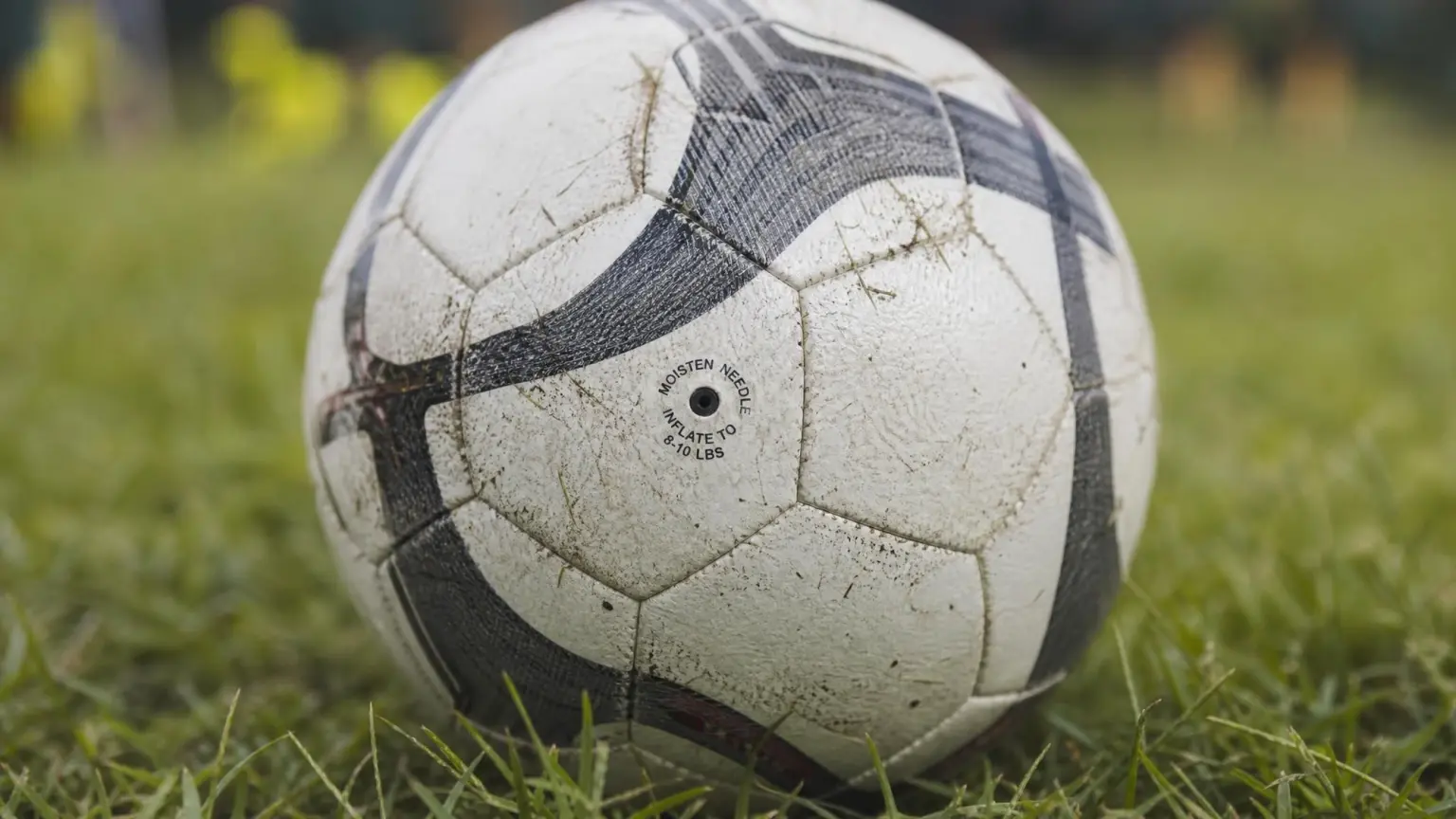
Law 2 puts the legal range at "0.6–1.1 atmosphere (600–1,100 g/cm²) at sea level" — roughly 8.7 to 16 psi. FIFA's own default test pressure for outdoor balls is 0.8 bar, about 11.6 psi. Your ball prints its own range on the sidewall next to the valve; use that, and check it weekly with a hand pump and needle. A cheap pump does more for ball performance than an expensive upgrade in construction.
Are size 4 and size 3 soccer balls FIFA certified?
This is the part that changes what parents should buy, and almost nobody mentions it.
The outdoor requirements cover size 5 and size 4 only. Size 3 does not appear in the table at all. So for a U8-and-under player, whose league uses a size 3, no FIFA mark applies to their ball in the first place.
And size 4 — the ball U9 through U12 players use through the most important technical years of their development — is only certified at two tiers:
| Test (size 4) | FIFA QUALITY | FIFA BASIC |
|---|---|---|
| Circumference | 63.5–66.0 cm | 63.5–66.0 cm |
| Sphericity (max) | 1.8% | 1.8% |
| Rebound at 20°C | 110–160 cm | 110–160 cm |
| Rebound at 5°C | min. 110 cm | min. 110 cm |
| Water absorption (max) | 10% | 10% |
| Weight | 350–390 g | 350–390 g |
| Loss of pressure (max) | 25% | 25% |
| Shape/size retention | not tested | not tested |
There is no FIFA Quality Pro for size 4. The two available tiers have identical published requirements on every test. And the shape and size retention test — the 2,000-shot cannon, the one that proves a ball survives being hit hard for months — is not applied to size 4 at any tier.
Which means a FIFA mark on a youth ball tells you it is round, correctly weighted, bounces predictably and won't waterlog. It tells you nothing about whether it will last a season. If your child is on a size 3 or size 4 and you were about to pay a premium for the badge, don't. Put the difference into getting the size right instead — our soccer ball size guide by age covers which size each age group actually uses, and the youth soccer age groups guide gives you their U-number if you're unsure.
How to judge a soccer ball when the mark doesn't help
With certification off the table for the younger sizes, you're left with construction. Three things determine how a ball is built, and they are usually printed on the box.
How the panels are joined. Machine stitching is the affordable standard and holds up fine for training. Hand stitching produces tight, strong seams and was the traditional match-ball method. Thermal bonding fuses panels with heat instead of thread, which removes the stitch holes water seeps through and gives more consistent shape and flight. Manufacturers broadly agree thermal bonding is the most water-resistant of the three. How many panels there are is a separate question, and a more interesting one than it looks — how many panels a soccer ball has covers why no rule governs the number, and why total seam length rather than panel count decides how a ball flies.
The cover material. PVC is cheap, hard-feeling and tough. TPU sits in the middle: softer touch, still durable. PU is the softest and most responsive, and it is what premium match balls use — it also scuffs fastest on concrete and asphalt.
The bladder inside. Butyl holds air best and lasts longest. Latex gives a livelier bounce but leaks faster and needs pumping more often. Synthetic rubber is the cheapest and the least consistent.
For a child who trains at home most days, the durable combination beats the responsive one every time: machine-stitched or thermally bonded, TPU cover, butyl bladder. Save the soft PU match ball for grass. Indoor and hard-court work is a separate question again — see futsal vs soccer for where a low-bounce futsal ball earns its place.
The ball is also the one piece of kit that shouldn't be an afterthought at signup. Most of the youth soccer equipment checklist gets replaced the moment they outgrow it. The ball is the thing that gets used every day in between, which is the part that actually moves a player forward.
What this means at the store
Ignore the tier, read the row. For a size 5, the only meaningful gaps between Pro, Quality and Basic are roundness, cold-weather bounce, air retention and whether the ball was shot 2,000 times. For a size 4, there are no gaps at all.
Buy a pump with the ball. A certified ball is allowed to lose up to a quarter of its pressure in three days. Weekly inflation does more for touch than any upgrade in construction.
Match the ball to the surface, not the badge. Driveways and concrete destroy soft PU covers. A TPU training ball with a butyl bladder will outlive two match balls, and your child will never notice the difference.
Frequently Asked Questions
What does FIFA Quality Pro mean on a soccer ball?
It means the ball passed FIFA's strictest testing tier, described by FIFA as "the professional standard recommended for all top level matches." For a size 5 ball that requires a circumference of 68.5–69.5 cm, sphericity within 1.5%, a rebound of 135–155 cm from a 2 m drop, a maximum 15% loss of pressure over 72 hours, and surviving 2,000 shots at 50 km/h against a steel plate without seam or valve damage.
Is a FIFA Quality Pro ball worth it for a youth player?
Rarely. FIFA Quality Pro only exists for size 5, so it does not apply to any player below roughly U13. Even at size 5, the gaps between tiers are in roundness, cold-weather rebound and air retention — real differences at professional speeds, marginal for a youth player. A FIFA Quality ball, or a well-built uncertified training ball, is the better buy for daily use.
Are size 3 soccer balls FIFA certified?
No. FIFA's published outdoor requirements cover size 5 and size 4 only; size 3 does not appear in the testing manual's requirements tables. A "FIFA approved" claim on a size 3 ball is not backed by a published outdoor standard for that size, so judge it on construction and brand reputation instead.
What is the best youth soccer ball that lasts more than a season?
Look for a machine-stitched or thermally bonded ball with a TPU cover and a butyl bladder, in the correct size for the age group, and keep it inflated. Butyl holds air far longer than latex, TPU resists scuffing better than soft PU, and thermal bonding removes the stitch holes that let water in. Surface matters more than price: soft match balls fail fast on concrete.
How often should you pump up a soccer ball?
Weekly for a ball in regular use. FIFA's own standard permits a certified ball to lose 15% to 25% of its pressure over just 72 hours depending on its tier, so going soft is normal rather than a sign of damage. Inflate to the range printed on the ball next to the valve — Law 2 allows 0.6 to 1.1 atmosphere at sea level, roughly 8.7 to 16 psi.
The FIFA marks are real engineering, tested by real labs, and they answer a narrower question than the packaging suggests: is this ball round, is it correctly weighted, and does it hold air. For a size 5 played on grass by an older player, the top tier earns some of its premium. For the size 3 or size 4 sitting in your hallway, the badge is close to meaningless — and a pump, the right size and a butyl bladder will do more for your child's touch than any mark on the box.