How Many Panels Does a Soccer Ball Have? Soccer Ball Construction Explained
 Reviewed by Roman PivarnikUEFA Pro Licence · Technical Director, Slovak FA
A traditional soccer ball has 32 panels — 20 hexagons and 12 pentagons, stitched into the shape a mathematician calls a truncated icosahedron. But no rule in soccer requires that, or any other number. Recent World Cup balls have had 14, 8, 6, 20 and 4 panels — and the one that caused the most complaints in the sport's history was not the one with the fewest.
Panel count is the most visible thing about a soccer ball and the most misunderstood. It gets treated as a spec — more panels, more traditional; fewer panels, more advanced. What actually determines how a ball flies is the total length and depth of the seams between those panels, and panel count only tells you that indirectly. A six-panel ball can have rougher seams than a 32-panel one, and in 2014 that was exactly the point.
Here is what a soccer ball is actually built from, why 32 became the number, and what any of it means for the ball sitting in your garage.
How many panels does a soccer ball have?
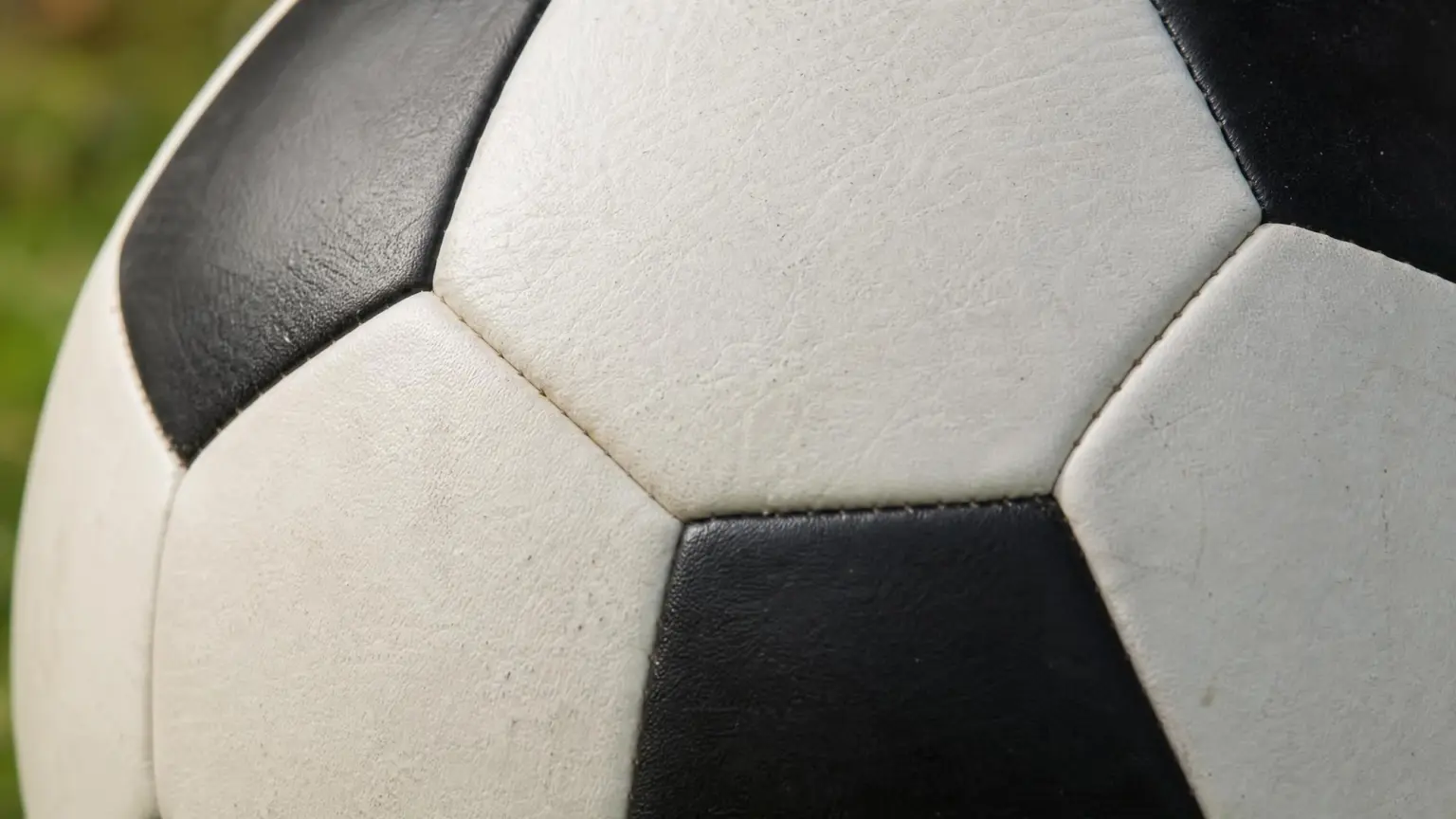
The classic answer is 32: twenty white hexagons and twelve black pentagons, arranged so that every pentagon is surrounded by hexagons and no two pentagons touch.
That arrangement is not arbitrary. It is a real geometric solid — the truncated icosahedron, one of the thirteen Archimedean solids, known to Archimedes and first fully described in the 15th century by Piero della Francesca. You get it by slicing the corners off a twenty-sided icosahedron: the 12 cut vertices become pentagons, the 20 original triangles become hexagons. The result has 32 faces, 90 edges and 60 vertices.
The reason soccer adopted it is a number called sphericity — how closely a solid approximates a true sphere, on a scale where 1.0 is a perfect ball. The truncated icosahedron scores about 0.95, and once you inflate it, the panels bulge under pressure and it rounds out further. For a shape you can cut from flat material and sew by hand, that is close to the best available.
The black-and-white colouring came later and for a plainer reason: contrast on black-and-white television.
Why did 32 panels become the standard?
The 32-panel ball was not a World Cup invention. It was first marketed by Select in Denmark in the 1950s and spread through continental Europe during the 1960s.
What made it universal was the 1970 World Cup in Mexico, where Adidas supplied the Telstar — the first 32-panel black-and-white ball used at a World Cup, and the design that became the default mental image of a soccer ball worldwide. It stayed the World Cup standard until 2006.
Do the rules say how many panels a soccer ball needs?
No. This surprises people, so it is worth being precise about what the rulebook actually controls.
Law 2 of the Laws of the Game requires that all balls are:
| Requirement | Specification |
|---|---|
| Shape | Spherical |
| Material | "Made of suitable material" |
| Circumference | 68 cm to 70 cm (27–28 ins) |
| Weight | 410 g to 450 g (14–16 oz) at the start of the match |
| Pressure | 0.6–1.1 atmosphere at sea level (8.5–15.6 lbs/sq in) |
That is the complete list. Panels are not mentioned. Neither is surface texture, seam depth, stitching method or cover material. As the authors of an aerodynamic analysis of recent World Cup balls put it, FIFA has "relatively tight restrictions" on circumference, mass and pressure, but "there are no such regulations on the surface roughness or material used for the ball's construction."
That gap is the entire reason manufacturers can keep redesigning panels, and the reason the flight characteristics of top-level balls have changed so much since 2006.
How many panels do World Cup balls have?
Once thermal bonding replaced stitching, panel counts stopped being constrained by what a person could sew. They have moved around a great deal since:
| Year | Ball | Panels |
|---|---|---|
| 1970 | Telstar | 32 (20 hexagons, 12 pentagons) |
| 1978 | Tango | 20 |
| 2002 | Fevernova | 32 |
| 2006 | Teamgeist | 14 |
| 2010 | Jabulani | 8 |
| 2014 | Brazuca | 6 |
| 2022 | Al Rihla | 20 |
| 2026 | Trionda | 4 |
Adidas describes this summer's Trionda as "a brand new four-panel ball construction" — the fewest panels of any World Cup ball ever made. Note that the count does not move in one direction. It fell from 32 to 6 across eight years, then jumped back up to 20 for Qatar in 2022 before dropping to 4. Panel count is not a progress bar.
Why fewer panels doesn't mean a smoother ball
This is the part that gets lost, and it is the only part that affects how a ball behaves in the air.
What matters aerodynamically is surface roughness, and for a soccer ball the dominant measures of roughness are the total length of its seams and how deep they are. Panel count influences that, but it does not determine it — a ball with few panels can have long, deep, winding seams, and a ball with many panels can have short, shallow ones.
The measured figures make the point better than any argument:
| Ball | Panels | Total seam length | Seam depth |
|---|---|---|---|
| Conventional 32-panel | 32 | ~400 cm | ~1.08 mm |
| Teamgeist (2006) | 14 | ~345 cm | — |
| Jabulani (2010) | 8 | ~203 cm | ~0.48 mm |
| Brazuca (2014) | 6 | ~327 cm | ~1.56 mm |
Read the bottom two rows. The Brazuca had fewer panels than the Jabulani but 60% more seam length and more than three times the seam depth — the deepest seams of any ball in that comparison, deeper even than a conventional 32-panel ball. Its panels were long and finger-shaped rather than compact, which is how you get more seam out of fewer pieces.
So the Jabulani was the smoothest ball of the group, and that turned out to matter enormously.
What the Jabulani taught everyone about seams
The 2010 ball was the most criticised in World Cup history. Goalkeepers hated it; strikers, less so. The complaint was that it moved unpredictably in flight.
They were right, and the mechanism is well understood. When a ball is kicked with little or no spin, its seams channel air erratically and the trajectory wobbles — the same effect as a knuckleball in baseball. Every ball does this, but only within a particular band of speeds, and the smoother the ball, the higher that band sits.
NASA's Ames Research Center ran the 2014 ball through a wind tunnel and water channel and published what they found. A traditional 32-panel ball knuckles most at around 30 mph. The much smoother Jabulani knuckled most at around 50 mph — and the typical striking speed of a World Cup-caliber player is about 50 to 55 mph. The Jabulani's worst behaviour sat precisely where the ball spent most of its flight.
The Brazuca's added roughness pulled that critical speed back down to roughly 30 mph, well below match striking speeds. "It is more stable in flight and will handle more like a traditional 32-panel ball," said Rabi Mehta, chief of the Experimental Aero-Physics Branch at Ames. Players stopped complaining.
The independent aerodynamic analysis reached the same conclusion from the other direction: the Jabulani's unpredictable region sat at roughly 15–24 metres per second, while the other balls tested had theirs at about 10–17 m/s. A shot slows to somewhere around 15–20 m/s by the time it reaches the goalkeeper. Every ball but the Jabulani arrived stable.
The lesson is not "more panels are better." It is that a smooth ball is an unpredictable ball at the speeds the game is actually played at.
What panel count means for the ball you buy
For a youth player, almost none of this is a buying criterion — but one part of it genuinely is.
Panel count on the box tells you nothing useful. A 32-panel machine-stitched training ball and a six-panel thermally bonded one can both be excellent or both be junk. There is no rule behind the number and no quality implied by it.
Cheap and smooth is the combination to avoid. The one real takeaway from the Jabulani is that a very smooth ball flies erratically at low-to-medium speeds — which is the entire speed range of youth soccer. A ball with visible, defined seams and some surface texture will behave more predictably for a 10-year-old than a glossy, seamless one from a supermarket bin.
How the panels are joined matters more than how many there are. Stitching versus thermal bonding affects water resistance and shape retention far more than panel count does. Our guide to the FIFA quality marks printed on a soccer ball covers what the lab actually tests — and, importantly, what it does not test at the youth sizes.
Get the size right first. Size outranks every construction detail for a developing player, and it is the one spec with a clear correct answer by age. The soccer ball size guide by age has the chart, and the ball belongs near the top of the youth soccer equipment checklist rather than as an afterthought at signup.
One more practical note, since it follows directly from Law 2: pressure is regulated and panel count isn't, which tells you where to spend your attention. An under-inflated ball ruins touch far more thoroughly than any panel geometry. Check it weekly.
Frequently Asked Questions
How many panels does a soccer ball have?
A traditional soccer ball has 32 panels — 20 hexagons and 12 pentagons — forming a truncated icosahedron with 32 faces, 90 edges and 60 vertices. Modern professional match balls vary widely: recent World Cup balls have had 14, 8, 6, 20 and 4 panels. No rule specifies a panel count.
How many hexagons and pentagons are on a soccer ball?
Twenty hexagons and twelve pentagons on the classic 32-panel design. The pentagons are traditionally black and the hexagons white, arranged so that each pentagon is surrounded entirely by hexagons and no two pentagons share an edge.
What is a soccer ball made of?
A modern ball has three parts: an outer cover of synthetic material (commonly PVC, TPU or polyurethane), a lining layer, and an inflatable bladder inside — usually butyl, which holds air longest, or latex, which gives a livelier bounce but leaks faster. Law 2 only requires that the ball be spherical and "made of suitable material," so cover and bladder choices are left entirely to manufacturers.
Why do modern soccer balls have fewer panels?
Thermal bonding replaced hand stitching, which removed the need for panels small enough to sew and eliminated the stitch holes water seeps through. Fewer, larger panels also let designers shape seams deliberately to tune how the ball flies. It is a design freedom, not an improvement in itself — the 2010 eight-panel Jabulani was widely criticised, while the 2014 six-panel Brazuca was well received.
Does the number of panels affect how a soccer ball flies?
Only indirectly. What affects flight is surface roughness, measured mainly as total seam length and seam depth. A six-panel ball with long, deep seams is aerodynamically rougher — and more stable at match speeds — than an eight-panel ball with short, shallow ones, which is exactly the difference between the Brazuca and the Jabulani.