How Do Youth Soccer Standings Work? Points, Goal Differential and Tiebreakers
 Reviewed by Roman PivarnikUEFA Pro Licence · Technical Director, Slovak FA
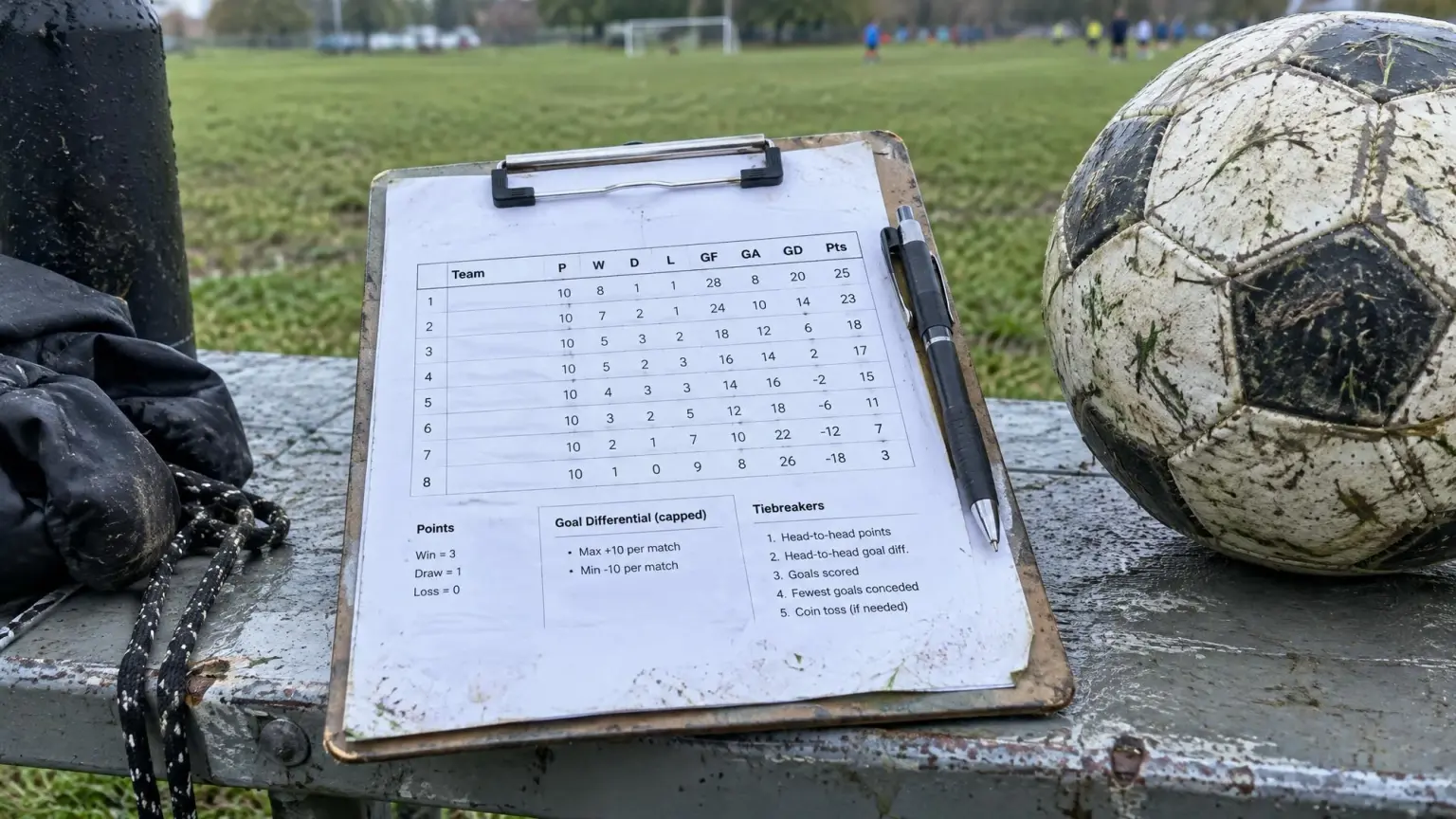
Youth soccer standings are almost always built the same way at the top: three points for a win, one for a tie, zero for a loss, teams ranked by total points. Everything after that is set by your league, not by the Laws of the Game — and the part that confuses parents most, goal differential, is capped at a different number in almost every rulebook. Three goals in one league, four in another, five in a third, seven in a fourth.
That is why a 9–0 win can show up in the table as +3, and why two teams level on points can be separated by fewest red cards, or a coin toss.
Here is what the table is actually counting, where the caps come from, and how a tie for a playoff spot really gets broken.
How do points work in youth soccer standings?
The Laws of the Game are silent on this. Law 10 says only that "the team scoring the greater number of goals is the winner," and that "if both teams score no goals or an equal number of goals, the match is drawn." Tables, points and tiebreakers are competition rules, written by your league.
In practice, nearly every US youth league lands on the same scheme:
- Win — 3 points
- Tie — 1 point
- Loss — 0 points
Illinois Youth Soccer's State Premiership rules award "three (3) points for a win (including forfeits), one (1) point for a tie, zero (0) points for a loss." USL Youth's operations manual uses the same three numbers, and adds −3 points for a forfeit. Utah Youth Soccer goes further still, separating a "minor" forfeit (−1 point) from a "major" forfeit (−3 points, plus the team being dropped a division if it happens twice in a season).
So if the standings look wrong, check first whether a forfeit has been scored against your team. A missed game is not neutral in most rulebooks — it is actively negative.
The other thing worth knowing: in most youth leagues a tie stays a tie. Illinois states it plainly — "if a game is tied at the end of regulation the result will be a tie." There is no regular-season overtime, no shootout, no extra point for anything. High school soccer runs on its own clock, with overtime written into the state association's rules, which is one reason the two tables never look alike.
Why is my child's goal differential wrong?
It almost certainly isn't. It is capped.
Goal differential is goals scored minus goals allowed, but youth leagues cap how much any single result can contribute, so one 11–0 afternoon cannot decide a division. It is the least standardised number in youth soccer:
| League | Goal-differential cap per game | Example |
|---|---|---|
| Rochester District Youth Soccer League (NY) | ±3 | A 6–1 win counts as +3, not +5 |
| Utah Youth Soccer (UYSA) | ±4 | Cumulative differential, max 4 per match |
| Illinois Youth Soccer (State Premiership) | ±5 | "Maximum of five goals per game" |
| USL Youth | ±7 | An 8–0 win is recorded as +7 |
The RDYSL spells the arithmetic out for parents who assume the website is broken: a team scoring 6 against an opponent's 1 gets "+3 (6 − 1 = 5) bounded to 3." USL Youth is more detailed again — a 12–3 win "will be adjusted to 10–3 to reflect the +7 cap," losing teams "will never have goals taken away from them," and players scoring after the seventh goal still get credit in the public stats even though only +7 reaches the table.
Caps exist for the same reason the mercy rule exists: to remove any incentive to pile on goals against an overmatched team. If you have wondered why a coach pulled the handbrake at 5–0, the cap is usually the answer — past it, the scoreline buys the team nothing.
Standings measure the team. Development is individual. A player can have an excellent season on a team that finishes fifth, which is why clubs track individual development separately from results. FlickTec gives each player their own daily home session and progress record, independent of where the team lands in the table. Free 7-day trial.
How are ties in the standings broken?
Every rulebook here starts in the same place — head-to-head — then diverges immediately:
| Step | Illinois (SPD) | Utah (UYSA, two teams) | USL Youth |
|---|---|---|---|
| 1 | Head-to-head (not used if 3+ teams tied) | Head-to-head | Head-to-head record on points |
| 2 | Most games won | Goal differential (max 4) | Total wins |
| 3 | Goal differential (max 5) | Fewest goals allowed | Goal difference |
| 4 | Fewest goals allowed | Most goals scored (max 4) | Goals scored |
| 5 | Fewest red cards received | Shutout wins, excluding forfeits | Points vs top-four finishers |
| 6 | Most shutouts | Coin toss | FIFA Fair Play (fewest disciplinary points) |
| 7 | Kicks from the penalty mark | — | Lottery |
Three things there are worth a parent's attention.
Discipline can decide your season. Illinois separates tied teams by "least red cards received" before it looks at shutouts, and USL Youth uses FIFA Fair Play — fewest disciplinary points — as its last sporting criterion. The RDYSL deducts from the table directly: a red card for a serious foul costs 2 team penalty points, each coaching-staff ejection costs 1, and the first ten player yellow cards in an U11–U16 season cost another. Cards are not just a one-game problem; here they are a standings problem.
Three-way ties break the head-to-head logic. With three teams level, head-to-head often loops — A beat B, B beat C, C beat A. Illinois switches it off entirely: the criterion is "not used if more than two teams are tied." Utah builds a mini-table from only the games the tied teams played against each other, re-scores it 3/1/0, and places teams off that. USL Youth says that "once a 3-way tie is broken, revert to tiebreaker #1."
It can end on luck. Utah's final criterion is a coin toss at the pre-alignment meeting; USL Youth's is a lottery at the league office. Illinois at least keeps it on the field, ending with kicks from the penalty mark.
What if teams have played a different number of games?
This is the most common end-of-season mess, and it has a standard answer: stop ranking on totals and rank on rate.
Illinois uses a percentage: where teams have not played the same number of games, "the Final Standings may be determined by using the percentage of points earned versus the maximum points the team could have earned." Utah's rule is per game — teams "will be ranked by points earned per game played," with goal differential, goals allowed and goals scored recalculated per game too. USL Youth allows points-per-game percentage, and win percentage when tied teams have played each other an unequal number of times.
Note what both Illinois and Utah exclude: games a team refused to play. Forfeits count as completed games, so you cannot improve your points percentage by not showing up.
One more quirk catches people out in multi-group divisions: the group winner advances, not the team with more points. USL Youth's own example is a group winner on 10 points, a second-placed team in that group on 9, and the winner of another group on 8 — and the team on 8 goes through. Points across groups are not comparable, which is the same logic that governs how group play feeds a tournament bracket.
Why are there no standings for U9 and U10?
Because posting them is prohibited at those ages. The RDYSL's answer is direct: "Our parent organizations US Youth Soccer and New York State West Youth Soccer Association have identified these age groups as non-competitive. They prohibit the posting of scores or standings for non-competitive ages."
If you cannot find a table for an 8- or 9-year-old's team, nothing is broken. Scores are often still kept informally at the field; they are simply not published. Standings reappear once the age groups become competitive — the same point at which results start feeding promotion and relegation between flights.
The one thing the table will not tell you
A league table is a ranking of team results with the extremes shaved off. It is a reasonable guide to where a team should be placed next season — mostly what it is used for — and a poor guide to whether a ten-year-old is getting better.
The practical step is narrower than it sounds: find your league's rulebook, search it for "tiebreaker," and read the five lines that follow. You will know before the final weekend whether your team needs a win, a clean sheet, or just to avoid a card.
Frequently Asked Questions
How do points work in soccer standings?
Three points for a win, one for a tie, zero for a loss, with teams ranked on total points. This is the scheme used by Illinois Youth Soccer's State Premiership, Utah Youth Soccer and USL Youth, among many others. Several leagues also subtract points for forfeits — USL Youth and Utah both deduct three for a serious one.
What is goal differential in soccer, and why is mine capped?
Goal differential is goals scored minus goals allowed across the season. Youth leagues cap the amount a single game can contribute so that one lopsided result cannot decide a division. The cap varies by league: ±3 in the RDYSL, ±4 in Utah, ±5 in Illinois, ±7 in USL Youth. A 6–1 win in a ±3 league is recorded as +3.
What is the first tiebreaker in youth soccer standings?
Head-to-head result, in every rulebook reviewed here. If the tied teams split or drew their meetings, leagues move on — some to most wins, some straight to capped goal differential. When three or more teams are tied, head-to-head is often skipped or replaced by a mini-table of just the games between the tied teams.
Can a youth soccer division really be decided by a coin toss?
Yes. Utah Youth Soccer's final tiebreaker for two tied teams is a coin toss at the pre-alignment meeting, and USL Youth's is a lottery at the league office. Illinois instead ends with kicks from the penalty mark. These are last resorts, used only after every sporting criterion is exhausted.
Why aren't there standings for my child's U9 team?
US Youth Soccer treats the youngest age groups as non-competitive, and leagues affiliated with it are prohibited from publishing scores or standings for them. The RDYSL applies this to U9 and U10. Published tables typically begin at U11 or U12, when results start to affect flight placement.