How Do Youth Soccer Tournaments Work? Formats, Points and Tiebreakers
 Reviewed by Roman PivarnikUEFA Pro Licence · Technical Director, Slovak FA
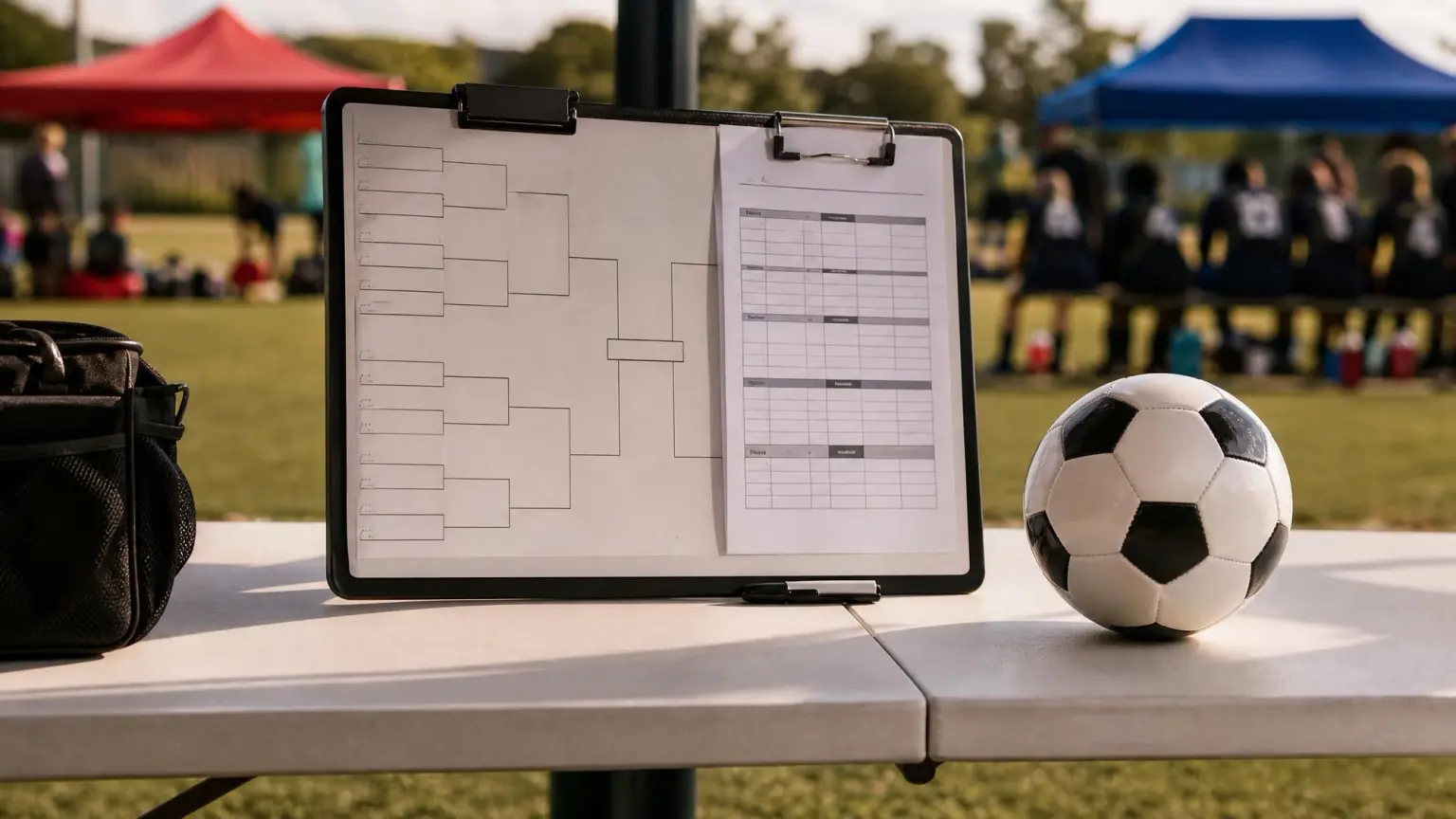
Most youth soccer tournaments work the way the World Cup does: a short group stage where every team plays two to four games, three points for a win and one for a draw, then a knockout bracket for the teams that finish on top. The parts that catch parents out are what happens when two teams finish level on points, and the fact that a tied knockout game at the biggest youth tournament in the country skips extra time entirely and goes straight to penalty kicks.
If you are packing the car for a first tournament weekend, here is how the whole thing is actually scored, straight out of the rulebooks that govern it.
How does a youth soccer tournament work?
Almost every event follows the same two-stage shape.
Stage one is group play. Your child's team is placed in a group (some tournaments call it a bracket, flight or division) with three to five other teams of roughly the same level, and plays each of them once. This is where the "three-game guarantee" on the tournament flyer comes from. Washington Youth Soccer's Founders Cup, a state-level event that draws "over 350 teams from across the state" across U9 through U19, is a straight "single round-robin tournament" — everyone plays everyone in the group, and that is the whole competition until the brackets.
Stage two is the knockout round. Group winners, and often the best runners-up, advance to quarter-finals, semi-finals and a final. One loss and you are done.
Two things follow from that structure. First, the result in game one matters more than it feels like it should, because there are only two or three chances to make it up. Second, the schedule is dense: group games get stacked two to a day so the whole thing fits into a weekend.
How do points work in a soccer tournament?
The scoring is standard almost everywhere. US Youth Soccer's 2025-2026 National Championships and Presidents Cup rules put it in one line: "Points are awarded as follows: 3 for a win, 1 for a tie, 0 for a loss." That rulebook governs the national event at the very top of the US Youth Soccer pathway — if you are wondering how a team actually earns its way there, we cover what State Cup is and how qualifying works.
| Result | Points |
|---|---|
| Win | 3 |
| Draw / tie | 1 |
| Loss | 0 |
| Forfeit | Recorded as a loss, usually 0-1, and often fined |
Forfeits are treated harshly on purpose. At Founders Cup, "All forfeits will be recorded as a 0-1 loss," they carry a $1,000 fine, and a team that forfeits a bracket match "will forfeit all bracket matches and be disqualified from the tournament."
What happens when teams are tied on points?
This is the part worth reading before Sunday morning, because a tiebreaker can send your child home while another team with an identical record plays on.
At the US Youth Soccer National Championships, two teams level on points are separated in this exact order:
- Winner of head-to-head
- Winner of most matches
- Goal difference (maximum +5 per match)
- Fewest goals allowed
- Fair Play — fewest total player and coach dismissals
- Penalty kicks
That third line is the one to understand. The rules cap goal difference so that, in their own example, "a 7-0 win counts as +5 goal difference." The cap removes the incentive to keep hammering an overmatched team late in a game that is already won. Local tournaments set the cap at different levels — Founders Cup uses a wider "max ±10 goals per game" — but nearly all of them have one.
Notice what sits at number five: discipline is a tiebreaker. A red card in game two can quietly cost a team a semi-final place in game three. When three or more teams tie, the sequence gets longer and starts with results among the tied teams only, before widening out to all matches.
What happens if a tournament game ends in a tie?
It depends entirely on which round you are in, and the answer is less consistent than most parents expect.
- Group play: ties normally just stand. Founders Cup states it plainly: "Ties will stand in preliminary rounds." Both teams take their point and move on.
- Knockout rounds at the US Youth Soccer National Championships: no extra time at all. "Knockout Round matches, Semi-Finals, and the Final will proceed directly to Penalty Kicks if tied, with no Extra Time played." Founders Cup does the same: "There is NO overtime period. Straight to FIFA kicks from the marks."
- Knockout rounds under general US Youth Soccer playing rules: overtime first. Rule 303 sets two 10-minute overtime halves at 11U through 14U and two 15-minute halves at 15U through 19U, and only then: "In tournament play, if the game is still tied after overtime periods, FIFA 'Kicks from the Penalty Mark' rules apply to determine the winner."
- 10U and younger: no overtime under any circumstances. The same rulebook is explicit that "ties will stand."
So a tied U13 quarter-final might reach a shootout in ten minutes or ninety, depending on whose rulebook the event runs under. Read the event's rules page rather than assuming — and if it does come down to kicks, our guide to penalty kick rules covers what the referee is actually watching for.
How many games will my child play in a weekend?
Plan on two games on Saturday and one or two on Sunday, at full length. Tournament games are usually not shortened: Founders Cup runs the same 2x25 at 7v7, 2x30 at 9v9, 2x35 at U13-U14 and 2x45 at U17-U19 that those age groups play all season. Our breakdown of how long youth soccer games are by age has the full chart.
What varies wildly is the gap between them. Founders Cup guarantees "a minimum of 6 hours between game start times" when a team plays twice in a day. Plenty of commercial tournaments leave two.
Substitutions usually open up, which helps. Founders Cup allows "unlimited substitutions for all age groups," and the National Presidents Cup does too — looser than the windowed system many leagues use in the regular season, which we cover in youth soccer substitution rules.
Should young kids be playing tournaments at all?
Here is the fact almost no tournament flyer mentions. U.S. Soccer's Player Development Initiatives, the standards document behind small-sided play, says of 4v4 players — U6 through U8 — that "Players should not be participating in events (tournaments, showcases, festivals, etc.)" at all.
For 7v7 and 9v9 it does not ban tournaments, but it reshapes them:
| Standard (U9-U10 / U11-U12) | What the PDI says |
|---|---|
| Games per year | No more than 20 (7v7) / 30 (9v9) |
| Games per day | "no more than one game per day" |
| Events | "should provide a predetermined number of games with no advancement, placement games or champions" |
| Rest | "a minimum of 2 rest days per week during the season" |
| Travel | Under an hour (7v7); day trips with limited overnight allowances (9v9) |
A standard three-games-in-two-days tournament with a trophy at the end conflicts with essentially all of that. That is not a reason to skip your child's first tournament — they are genuinely fun, and the social memory usually outlasts the result. It is a reason to treat them as an occasional highlight rather than a monthly habit at these ages, and to count those games against the annual total.
What to sort out before you leave
- Player passes. No pass, no play. Founders Cup requires passes "surrendered to the referee before each game," and a player without one "must remove their jersey."
- Roster freeze. Most events lock rosters days ahead — Founders Cup at 11:59 p.m. the Wednesday before. Guest players have to be added before then. US Youth Soccer's Rule 205 specifically allows tournaments to accept guest players, unlike league play.
- Weather. Ask what the heat policy is. Washington Youth Soccer follows U.S. Soccer's Recognize to Recover heat and cold guidelines and checks air quality. Late-summer tournaments are exactly when this matters — see our youth soccer heat safety guide.
- Food between games. TrueSport, the U.S. Anti-Doping Agency's education program, recommends leaning on carbohydrates rather than fats, which "digest slowly and do not convert quickly into energy," and reaching for "simple carbs like the ones in fruit" when the gap between games is short. Increase fluids in the days before, not just on the day. And do not debut a new snack at a tournament.
- Downtime. TrueSport also notes that "time between games and events is for mental recovery, too."
The teams that look sharp in game three are rarely the fittest ones. They are the ones who ate, drank and sat down between games — and who arrived with enough touches banked that a tired first touch still behaves. For what to actually do with that window, hour by hour, see our guide to recovery between soccer games. That gap between games is where a season's worth of short sessions at home quietly shows up.
Frequently Asked Questions
How many games are in a youth soccer tournament?
Most tournaments guarantee three games: two or three group-stage games in a round robin against the other teams in your group, plus a knockout game if your team advances. A team that reaches the final can play five or more across a weekend. U.S. Soccer's Player Development Initiatives recommend no more than one game per day for players U12 and younger, so a multi-game tournament day already exceeds the standard for those ages.
How do points work in a soccer tournament?
Three points for a win, one for a tie and zero for a loss, per US Youth Soccer's National Championships rules. Group standings are ordered by total points, and forfeits are recorded as a loss — commonly 0-1 — often with a fine attached.
What are the tiebreakers in a youth soccer tournament?
At the US Youth Soccer National Championships, two tied teams are separated by head-to-head result, then most matches won, then goal difference capped at +5 per match, then fewest goals allowed, then Fair Play based on player and coach dismissals, and finally penalty kicks. Local tournaments use similar sequences with different caps, so always check the specific event's published rules.
What happens if a tournament game is tied?
In group play, ties usually stand and both teams take a point. In knockout rounds it varies: the US Youth Soccer National Championships go straight to penalty kicks with no extra time, while US Youth Soccer's general playing rules add two 10-minute overtime halves at 11U-14U and two 15-minute halves at 15U-19U before kicks. At 10U and younger there is no overtime at all and ties stand.
Should my 8-year-old play in a soccer tournament?
U.S. Soccer's Player Development Initiatives say players at the 4v4 stage — U6 through U8 — "should not be participating in events (tournaments, showcases, festivals, etc.)," and that results and standings should not be recorded at that age. Many clubs still enter U8 teams in local festivals. If yours does, look for an event with a fixed number of short games, no bracket and no champion, and keep the travel minimal.
A tournament weekend is a lot of standing next to a folding chair for what usually amounts to two or three hours of your child's actual playing time. Knowing how the points work turns that standing into something you can follow: which result puts them through, why the coach took the foot off at 5-0, and why the yellow card in game two mattered more than it looked. The trophy gets decided by a table long before it gets decided by a shootout.