Yellow and Red Cards in Soccer: What They Mean and What Happens Next
 Reviewed by Roman PivarnikUEFA Pro Licence · Technical Director, Slovak FA
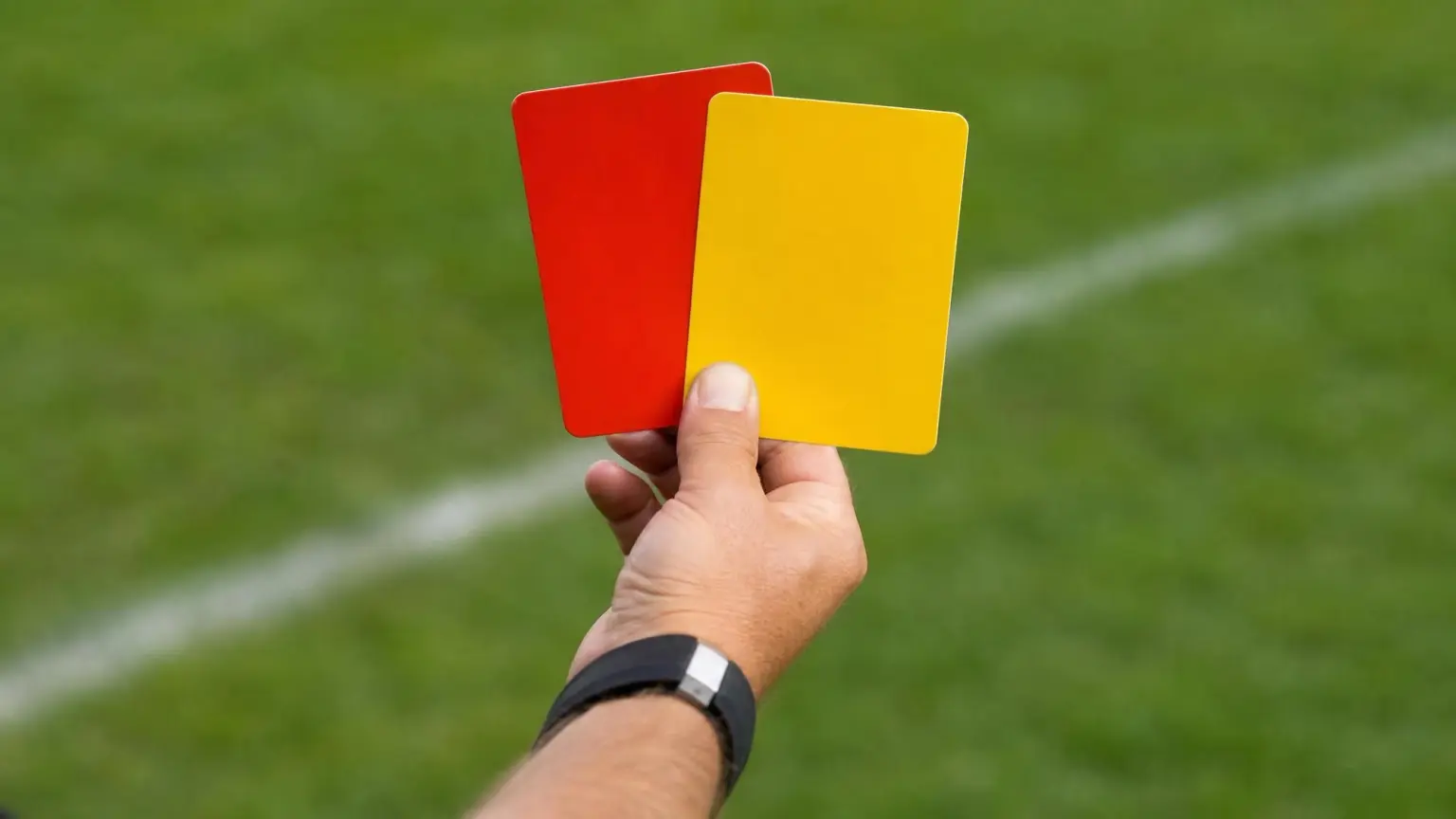
A yellow card is a caution — a formal warning that stays on the record for the rest of the match. A red card is a sending-off: the player leaves immediately, cannot be replaced, and the team plays the rest of the game a player short. Two yellow cards in the same match add up to a red. The referee decides which one to show based on the offence, not on how loud the sideline gets, and a handful of offences that look identical from twenty yards away produce completely different cards.
Every parent watching youth soccer eventually sees the moment: a challenge goes in, the referee reaches for a pocket, and nobody on either sideline is sure what is about to come out. Then a card appears and half the crowd thinks it was harsh while the other half thinks it was overdue.
Here is what each card actually means, which offences produce which one, what happens to the team afterwards, and the youth and high school modifications that change the picture.
What is the difference between a yellow card and a red card in soccer?
Both are how the referee communicates a decision that has already been made. The card itself is a signal, not a punishment.
| Yellow card | Red card | |
|---|---|---|
| Formal name | Caution | Sending-off |
| Player stays on? | Yes | No — leaves immediately |
| Can the team replace them? | Not applicable | No |
| Effect on the team | None | Plays a player short |
| Two in one match | Becomes a red card | Not applicable |
The Laws of the Game are specific about who can receive one: "Only a player, substitute, substituted player or team official may be shown the red or yellow card." That last category matters more than people expect, and it comes up again below.
What gets a player a yellow card?
The Laws list eight cautionable offences for players:
- Unsporting behaviour
- Dissent by word or action
- Persistent offences
- Delaying the restart of play
- Failing to respect the required distance when play is restarted
- Entering, re-entering or deliberately leaving the field of play without the referee's permission
- Entering the referee review area
- Excessively using the "review" (TV screen) signal
The last two only exist where video review is in use, so in youth soccer the working list is six. Unsporting behaviour is the broadest and the one that covers most of what you actually see: a reckless challenge, a shirt pull to stop a break, deliberately handling the ball to stop an attack, faking an injury.
Two on that list surprise people. Persistent offences means a player can be cautioned for an accumulation of small fouls, none of which would earn a card alone — so the yellow that seems to come out of nowhere for a routine trip is often the fifth routine trip. And failing to respect the required distance is why a defender who creeps toward the ball at a free kick gets carded for something that involved no contact at all.
What gets a player a red card?
Also eight offences, and the difference is severity rather than category:
- Serious foul play
- Violent conduct
- Biting or spitting at someone
- Using offensive, insulting or abusive language and/or actions
- Denying a goal or an obvious goal-scoring opportunity by a deliberate handball offence
- Denying a goal or an obvious goal-scoring opportunity by a non-deliberate handball offence outside their own penalty area
- Denying an obvious goal-scoring opportunity to an opponent moving towards goal by an offence punishable by a free kick
- Receiving a second caution in the same match
That last line is the one most people mean when they say "he got two yellows." There is no separate rule for it — a second caution simply is a sending-off offence, and the referee shows the second yellow and then the red so everyone can see why.
The three goal-scoring ones are usually shortened to DOGSO, for "denying an obvious goal-scoring opportunity." Deliberate handball to stop a goal is always a red, wherever it happens; the handball rule explains what counts as deliberate in the first place, which is where most of the disagreement actually sits.
What happens to the team after a red card?
Three consequences follow, and they are worth separating because leagues sometimes muddle them.
The player leaves and stays gone. A sent-off player "must leave the vicinity of the field of play and the technical area" — they cannot sit on the bench.
No replacement. Under Law 3, a player sent off after the kick-off cannot be replaced. The team finishes with fewer players. (A player sent off before kick-off, after being named on the team list, is treated differently: they may be replaced by a named substitute, who then cannot themselves be replaced.)
There is a floor. A match "may not start or continue if either team has fewer than seven players." Multiple red cards can therefore abandon a game — rare in youth soccer, but it is the reason the rule exists.
Playing short changes what a coach can do with the bench for the rest of the game; our guide to youth soccer substitution rules covers how that interacts with re-entry in leagues that allow it.
Does a card carry a suspension into the next game?
Sometimes — and this is set by your competition, not by the Laws of the Game.
A red card almost always carries at least a one-game suspension, and serious offences carry more. Yellow cards typically accumulate: reach a set number across a season and you serve a suspension. But the threshold, whether yellows reset at a certain point in the season, and whether cards carry between competitions all vary by league and state association.
There is no universal number here, and quoting one you heard from another parent is how families end up surprised on a Saturday morning. Check your league's published discipline policy before you need it.
When can the referee show a card, and who can be shown one?
Wider than most spectators assume. The referee's authority runs "from entering the field of play for the pre-match inspection until leaving the field of play after the match ends (including penalties (penalty shoot-out))."
So a card can be shown during the warm-up, at half-time, after the final whistle, and during a shoot-out. If a player commits a sending-off offence before entering the field at the start of the match, the referee can prevent them taking part at all.
Team officials — coaches and bench staff — are also subject to cautions and sending-offs, with their own list of offences. A coach shown a red card leaves the technical area; it does not reduce the number of players on the field.
The penalty-area rule that causes the most sideline arguments
This one is worth knowing cold, because it looks like inconsistency and is not.
When a defender denies an obvious goal-scoring opportunity inside their own penalty area and the referee awards a penalty kick, the card depends entirely on what the defender was trying to do. The Laws put it this way: "the offender is cautioned if the offence was an attempt to play the ball or a challenge for the ball; in all other circumstances (e.g. holding, pulling, pushing, no possibility to play the ball etc.), the offending player must be sent off."
So a mistimed slide tackle that takes the striker down is a penalty and a yellow. A shirt grab on the same striker, in the same spot, is a penalty and a red. The attempt to play the ball is the whole difference — which is why the same-looking foul produces two different cards, and why nobody in the stands can predict it.
Outside the penalty area, denying an obvious goal-scoring opportunity by any offence punishable by a free kick is a straight red.
Are yellow and red cards different in youth soccer?
At the youngest ages, they often do not exist at all. US Youth Soccer's published Under 7 / Under 8 playing recommendations modify Law 12 directly: "no caution or send off shall be issued to players. If a child is being too rambunctious then the game official will ask the coach to make a substitution of that player to give the child a chance to calm down before returning to play."
Above that, the picture is mixed. Older small-sided age groups generally conform to the standard Laws on fouls and misconduct, but individual leagues set their own discipline policies on top.
One modification is worth knowing about because it is spreading: temporary dismissals, or sin bins. The Laws allow them "for all or some cautionable (YC) offences… in youth, veterans, disability and grassroots football competitions," subject to approval from the national association. Instead of a yellow card being purely a warning, the player leaves the field for a set period — "10-15% of the total playing time (e.g. 10 minutes in a 90-minute match; 8 minutes in an 80-minute match)" — beginning when play restarts after they leave. The referee shows the yellow card and then points with both arms to the temporary dismissal area. Many competitions that adopt it use it only for dissent, precisely because it addresses the behaviour a caution alone rarely fixes.
Whether your league uses sin bins is a question to ask before the season, not during a game.
How do cards work in high school soccer?
US high school soccer runs on NFHS rules, not the IFAB Laws, and the differences around cards are real. In the NFHS comparison of the three rule sets, the caution entry reads: "Cautioned player must go off, if subbed for, may return at next opportunity to sub."
That is the big one. A yellow card in high school soccer removes the player from the field, at least temporarily — unlike the standard Laws, where a cautioned player simply carries on. A subsequent caution is an ejection and the player "cannot be replaced," so the team plays short from there.
There is another divergence at the interval: where a player is ejected between periods, NFHS says the "team does not have to remove a player to start the next period," while under the IFAB Laws the "team plays short the rest of the game." If your child plays club in the fall and high school in the spring, the same offence genuinely does produce different outcomes. High school game structure differs in several other ways too.
What this actually looks like from the sideline
Three habits make cards readable in real time.
Watch what the defender's foot was doing, not where the foul happened. In the penalty area, an attempt to play the ball is a yellow and anything else is a red. That single distinction explains most of the calls that feel inconsistent.
Assume the surprising yellow is a persistent-offences yellow. When a card appears for a foul that looks trivial, the referee is usually punishing the pattern, not the incident. Referees often warn a player verbally first — and that warning is not always audible from the sideline.
Find out your league's suspension policy in August, not October. The Laws set the cards. Your league sets what they cost. That gap is where nearly all the confusion lives.
Frequently Asked Questions
What is the difference between a yellow and red card in soccer?
A yellow card is a caution — a formal warning. The player stays on the field and the team is unaffected. A red card is a sending-off: the player must leave the field and the vicinity of the technical area immediately, cannot be replaced by a substitute, and the team plays the remainder of the match a player short.
What happens if you get two yellow cards in one match?
Receiving a second caution in the same match is itself a sending-off offence. The referee shows the second yellow card and then the red card. The player is sent off, cannot be replaced, and the team plays short for the rest of the game — exactly as with a straight red.
Can a team replace a player who has been sent off?
No. Under Law 3, a player sent off after the kick-off cannot be replaced, so the team plays with one fewer player. The only exception is a player sent off before kick-off after being named on the team list, who may be replaced by a named substitute. A match may not start or continue if a team has fewer than seven players.
Do yellow and red cards mean a suspension for the next game?
Usually, but the specifics are set by your league or state association rather than by the Laws of the Game. Red cards almost always carry at least a one-game suspension. Yellow cards typically accumulate toward a suspension across a season, but the threshold and reset rules vary widely. Check your competition's published discipline policy.
Are cards used in youth soccer?
Not at the youngest ages. US Youth Soccer's Under 7 / Under 8 playing recommendations state that no caution or send-off is issued to players, with the referee instead asking the coach to substitute a player who needs to calm down. Older age groups generally follow the standard Laws, and some youth competitions use temporary dismissals (sin bins) in place of, or alongside, ordinary cautions.
Cards look arbitrary until you know that the referee is answering two separate questions: how serious was it, and was the player genuinely trying to play the ball. Once you can hear those questions being asked, the yellow that seemed harsh and the red that seemed lenient usually turn out to be the same rule, applied consistently.