Soccer Training for 12 Year Olds: What Changes at U12
 Reviewed by Roman PivarnikUEFA Pro Licence · Technical Director, Slovak FA
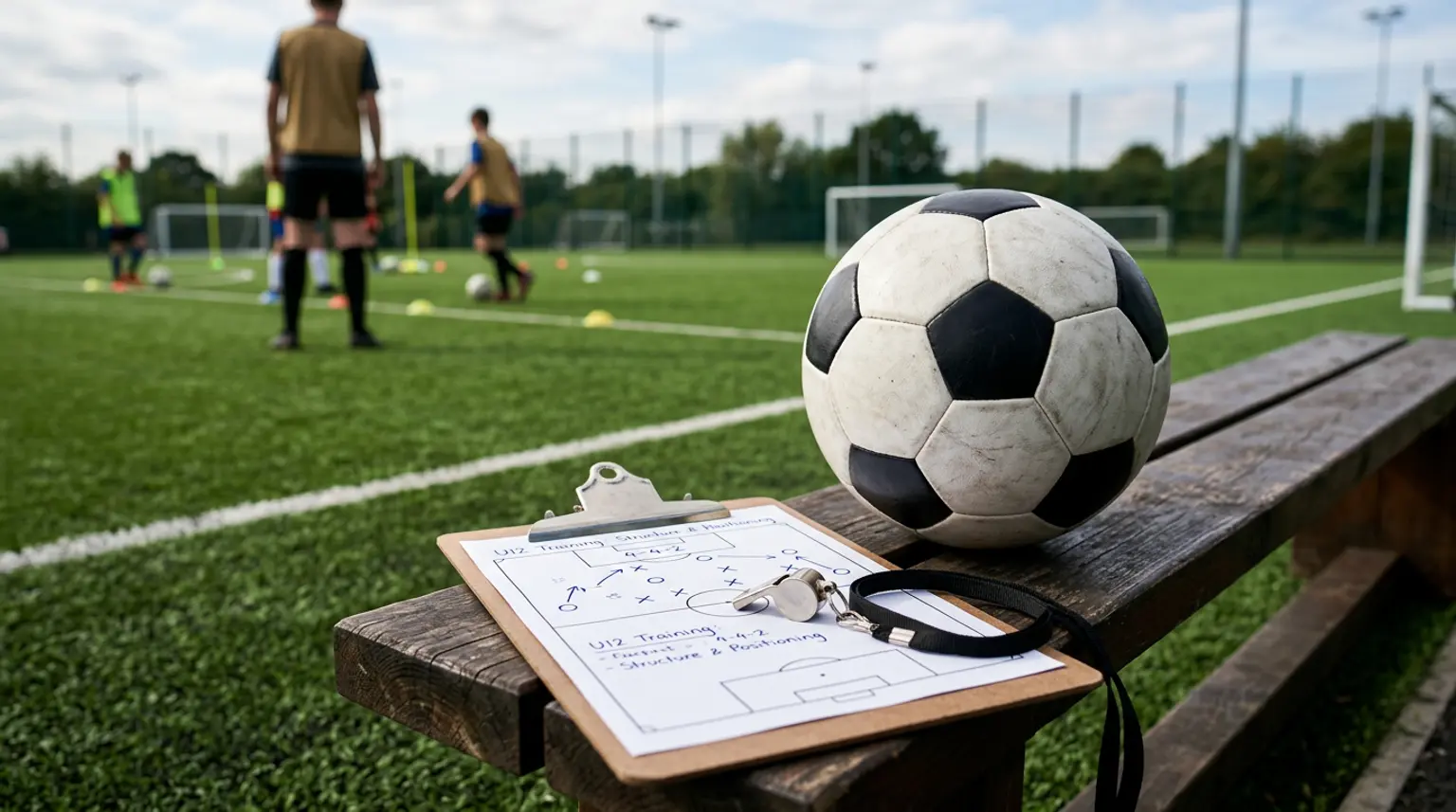
Soccer training for 12 year olds marks the shift from pure skill development to a combination of technical refinement, tactical understanding, and the beginning of position-specific work. At U12, players move from small-sided formats (7v7 or 9v9) to 11v11, which changes the physical demands, the tactical complexity, and the expectations coaches place on individual players. Sessions should last 60 to 75 minutes, happen 3 to 4 times per week, and balance continued technical development with introduction to team shape and game management.
This is a pivotal year. The technical foundation built at U8 and U10 either shows up now or it does not. Players who invested in ball mastery and first touch during the golden learning window (ages 9 to 12) enter U12 with confidence. Players who skipped that work often start to struggle as the game gets faster, the field gets bigger, and the margin for technical errors shrinks.
What changes at U12 compared to younger age groups?
The field and format change
The shift from 9v9 to 11v11 is significant. The field nearly doubles in size compared to 7v7. This means more running, longer passes, and the need to understand positional responsibilities. Players can no longer rely on being close to the ball at all times. They need to learn when to press and when to hold position, when to go forward and when to stay back.
US Soccer's development framework transitions players to 11v11 at U13, but many clubs begin the transition at U12 with larger field formats and more complex tactical environments. Either way, this age is when the "full game" starts to feel real.
Physical development varies wildly
At 12, the range of physical maturation within a single team can be enormous. Some players have entered puberty and look like teenagers. Others still look and move like 10 year olds. This disparity affects speed, strength, and endurance, and it creates challenges for both coaches and players.
What parents need to understand: A physically late-developing player who has strong technical skills will often catch up and surpass early developers by age 15 or 16. Research on the relative age effect in youth soccer consistently shows that many players who dominate at U12 due to physical advantages plateau later, while technically skilled late developers often emerge as the stronger players in the long run. Do not panic if your 12 year old is smaller or slower than teammates. Focus on technical development, which is under the player's control.
The mental game begins to matter
At U12, players start to experience real competitive pressure. Tryouts become more selective. Playing time is no longer guaranteed. Team results start to feel important. Some players thrive in this environment. Others withdraw or develop anxiety.
Building mental resilience through consistent training helps. A player who knows they have put in the work feels more confident under pressure than one who has not. This is one of the practical benefits of daily home training: it creates an internal sense of preparation that translates to game-day composure.
What skills should 12 year olds prioritize?
Passing under pressure
At U12, the game is fast enough that players cannot take three touches to settle the ball before deciding what to do with it. Quick, accurate passing with both feet becomes essential. Practice should include two-touch and one-touch passing drills, passing while moving, and passing into space ahead of a moving teammate.
Home drill: Wall passing at increasing speed. Start with two-touch (control, pass), progress to one-touch, then alternate feet. Do 3 sets of 20 with each foot. The wall forces quick reactions and clean technique under time pressure.
Positional awareness and team shape
This is the age to introduce basic concepts of team organization. Players should start to understand their role within a formation, how to maintain width and depth in possession, and how to compress space when defending.
For attacking play: "When we have the ball, spread out. Create triangles. Support the player on the ball by giving them passing options."
For defending: "When we lose the ball, get compact. Press as a unit. Do not let the opponent play through the middle easily."
These are simple principles, but they require repetition across many training sessions and games before they become habits.
Position-specific skills (introduction)
By U12, most players have a preferred position or two. While they should still be exposed to multiple positions, this is an appropriate time to add light position-specific work. Position-specific training should make up about 20 to 30 percent of individual practice time. The rest stays general.
Attackers: Finishing drills, movement in the box, receiving with back to goal. Midfielders: Two-foot passing range, receiving on the turn, scanning before receiving. Defenders: 1v1 defending technique, distribution from the back, aerial timing (where heading guidelines permit).
Continued ball mastery at speed
Ball mastery does not stop at U12. It evolves. The exercises learned at U8 and U10 (toe taps, sole rolls, inside-outside, Cruyff turns) should now be performed at game speed and chained into fluid sequences. A 12 year old who can execute a pull-back, inside-outside shift, and acceleration in one smooth motion has the close control to operate in tight midfield spaces during 11v11 play.
Strength and conditioning (age-appropriate)
At U12, bodyweight strength work becomes appropriate and beneficial. Exercises like squats, lunges, planks, push-ups, and single-leg balance work strengthen the stabilizer muscles around the knees, hips, and ankles. This both improves performance and reduces injury risk.
No external weights. The focus is on movement quality, control, and body awareness. Formal weight training should wait until age 14 to 15 at the earliest and should be supervised by a qualified professional.
FlickTec includes strength and conditioning, plyometrics, and recovery exercises in its training library of 500+ video exercises, designed by Coach Roman Pivarnik (UEFA Pro Licence, 25+ years of professional coaching including the UEFA Champions League level). For U12 players, the app adapts session intensity and focus areas to match the player's development stage.
What does a good training week look like for a U12 player?
Monday: Team practice (75 min) Tuesday: Home training, passing and first touch focus (25 min) Wednesday: Team practice (75 min) Thursday: Home training, ball mastery at speed + weak foot (25 min) Friday: Home training, light session or position-specific work (20 min) Saturday: Game day Sunday: Rest day or active recovery (light jog, stretching)
Total structured training: approximately 5 to 6 hours per week including games. Home training adds about 70 minutes across three sessions. This falls within the guideline that weekly training hours should not exceed the player's age (12 hours maximum for a 12 year old, across all organized sport).
What mistakes should parents and coaches avoid at U12?
Over-specializing too early. A 12 year old labeled as "the defensive midfielder" and never asked to play anywhere else is having their development narrowed prematurely. Continue rotating positions, even if one position is clearly the best fit right now.
Prioritizing winning over development. U12 is still a development stage. Clubs that select based on physical maturity, play the same starting lineup every game, and avoid risk in favor of results are optimizing for trophies at the expense of long-term player growth.
Comparing to early developers. The 12 year old who is 5'6" and fast will look better than the 12 year old who is 4'11" and technical. By U16, those roles often reverse. Physical development is not within the player's control. Technical development is.
Dropping multi-sport participation too soon. The American Academy of Pediatrics and US Soccer both recommend that youth athletes play multiple sports until at least age 12 to 13. Single-sport specialization before this age increases injury risk and burnout without improving long-term outcomes.
Frequently Asked Questions
Is U12 too early for position-specific training?
Light introduction to position-specific work is appropriate at U12, but it should not dominate training. About 20 to 30 percent of individual practice time can be position-focused. The majority should still develop all-around technical skills that apply across all positions.
How many days per week should a 12 year old train?
Three to four team sessions per week plus 3 to 4 home training sessions of 20 to 25 minutes each is a strong range. Include at least one full rest day per week. Total weekly training hours should stay below 12.
My child is physically smaller than teammates. Should I be worried?
No. Physical maturation varies enormously at this age. Research consistently shows that late developers who maintain their technical training often surpass early developers by mid-teens. Focus on what is controllable: technique, game intelligence, and effort.
Should 12 year olds start strength training?
Bodyweight strength exercises (squats, lunges, planks, push-ups) are appropriate and beneficial at this age. They build injury-preventing stabilizer muscles and improve athletic performance. Avoid external weights until age 14 to 15 and only under qualified supervision.
How does the move to 11v11 affect my child's development?
The larger field demands better fitness, longer passing range, and clearer positional understanding. Players who relied on speed or dribbling in smaller formats may need to develop their passing game through transitioning from small-sided to 11v11 soccer. Most players take a few months to adjust.
U12 is where childhood soccer starts to resemble the real game. The technical habits built in earlier years now get tested in a faster, bigger, more tactical environment. Players who continue to train daily, refine their technique, and develop their understanding of the game will navigate this transition successfully.
For personalized daily training that adapts to a U12 player's skill level and position, explore FlickTec's youth training platform with 500+ guided video exercises for youth players aged 7 and up. As players move into competitive play, understanding how to improve soccer speed and agility becomes increasingly important for staying competitive at the next level.