Soccer Equipment Rules: What Players Can and Can't Wear in a Game
 Reviewed by Roman PivarnikUEFA Pro Licence · Technical Director, Slovak FA
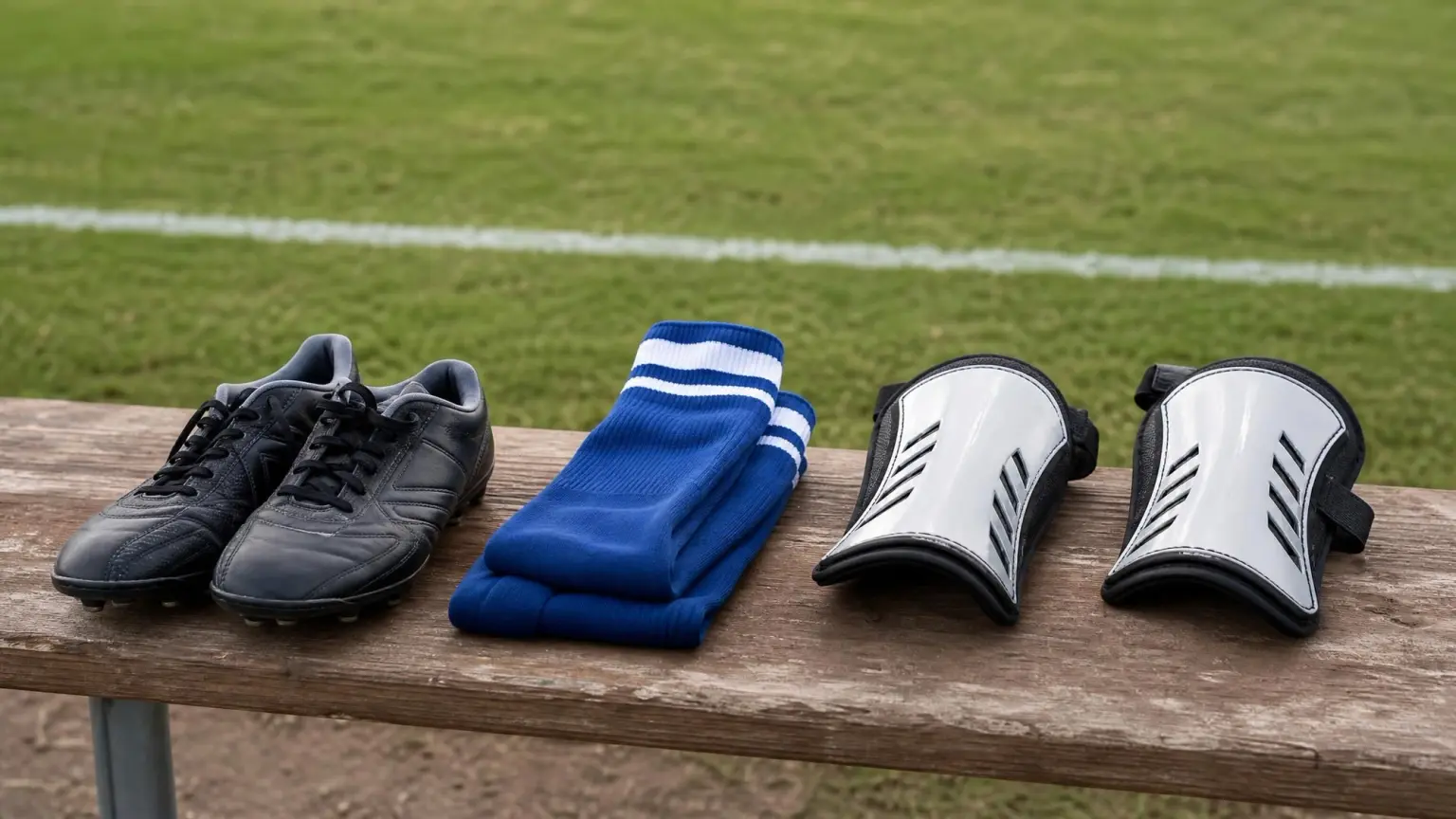
Soccer's rulebook requires exactly five things: a shirt with sleeves, shorts, socks, shin guards covered by the socks, and footwear. Everything else a player might turn up in — earrings, a cast, glasses, leggings, a hat, a smartwatch — is judged against one sentence: "A player must not use equipment or wear anything that is dangerous." Jewelry is the one category the Law names and bans outright, and taping over it does not make it legal.
That last point is the one that ends up in a parking-lot argument roughly once a season. A player shows up with studs that "only went in last week", someone produces a roll of tape, and the referee still won't let them on the field. The referee is right, and the reason is written down.
Here is what the soccer equipment rules actually require, what changes for high school soccer in the US, what your club almost certainly adds on top, and what happens when a referee spots something during the pregame check.
What are the basic soccer equipment rules?
Law 4 of the Laws of the Game lists the compulsory equipment as five separate items:
a shirt with sleeves
shorts
socks – tape or any material applied or worn externally must be the same colour as that part of the sock it is applied to or covers
shinguards – these must be made of a suitable material and be of an appropriate size to provide reasonable protection and be covered by the socks. Players are responsible for the size and suitability of their shinguards
footwear
Two details in there get missed constantly.
Shin guards go under the socks, not over them — which is why game socks are tall, and why this is the single most common thing a referee sends a player away to fix. The Law also puts responsibility for the size and suitability of the guard on the player: the referee checks that guards are worn and covered, not whether they are the right size.
Tape on the socks has to match the socks. A strip of tape holding a guard or a stay in place must be the same color as the part of the sock it covers. Black tape over white socks is not legal.
Notice what is not on the list: a mouthguard, gloves, a base layer, anything else. Those are all optional, and our youth soccer equipment checklist covers what is worth buying once you get past the required five.
Why is jewelry banned in soccer — and why doesn't taping it work?
Law 4 opens with safety, and jewelry is the one thing it names by category:
All items of jewellery (necklaces, rings, bracelets, earrings, leather bands, rubber bands, etc.) are forbidden and must be removed. Using tape to cover jewellery is not permitted. Accessories are permitted as long as they are not dangerous and are safely and securely covered. Dangerous items must be removed and not taped or covered.
US youth soccer applies this without softening it. US Soccer's guidance for new referees, published by US Youth Soccer, tells officials at check-in to "make sure that all jewelry, earrings, watches, etc. are removed," and spells the consequence out in parentheses: "Earrings must be removed. Covering them with tape does not make them legal."
AYSO goes further and names the things parents do not think of as jewelry at all. Its published player equipment policy forbids "necklaces, rings, bracelets, earrings, piercings, leather bands, rubber bands, etc." and adds that this "includes, but is not limited to, bobby pins, hair beads, hair clips". Friendship bracelets, sweat bands and wrist bands are out too unless taped close to the skin.
One wrinkle explains why you will find contradictory answers online: IFAB's own published FAQ for Law 4 answers the small-earrings question by saying the player must "have the earrings removed or safely and securely covered" — softer than the Law text above it. Whatever the international position, the US youth bodies have closed that door. At your child's game, the answer is remove it.
Two carve-outs hold up everywhere:
- Medical ID. US Soccer's referee guidance says it "must be taped to the player's chest or taped to the wrist with the info showing." AYSO adds the reasoning — tape it close to the skin "so other players cannot get a finger stuck underneath it" — and notes a sweat band over it is not acceptable.
- Newly pierced ears. AYSO allows that, subject to the referee's approval, "various soft, flexible materials that do not present a danger" may be used to keep recent piercings open during games. That means a soft retainer, not a taped-over stud. Plan the piercing around the season if you can.
Can a player wear a cast or a splint?
This is where the three rulebooks your child might play under genuinely disagree, and where guessing costs someone a game.
Law 4 never mentions casts. They fall under the referee's general judgement about dangerous equipment. The NFHS's own comparative study of NCAA, NFHS and IFAB rules records the three positions side by side:
| Rulebook | Position on casts and splints |
|---|---|
| IFAB / FIFA (club and league soccer) | "Referee's discretion – check for safety and require padding if cast is hard or dangerous" |
| NFHS (US high school) | "Hard casts or splints must be padded with closed cell foam at least 1/2" thick" |
| NCAA (college) | "Casts permitted if covered and not considered dangerous by referee" |
And then your club may override all of it. AYSO's National Rules and Regulations, quoted in its published equipment policy, are absolute: "Players shall not be allowed to practice or participate in any game with any type of rigid cast or splint." It closes the obvious loophole in the next line — "Removal of any type of cast or splint at the field or surrounding area in order to participate shall disqualify the player from practice or in any game."
Braces are treated differently from casts, and the distinction is worth understanding. AYSO's knee brace policy permits braces "provided that the knee brace is adequately covered and padded in the judgment of the referee." Its reasoning: a cast or splint restricts movement while an injury heals, whereas a brace supports an otherwise functioning joint. The same logic extends to a prosthesis, a hearing aid or an insulin pump — permitted, if padded enough not to hurt anyone else. For high school, NFHS adds that metal ankle braces must be worn inside the socks, while non-metal ones may be worn outside.
Can kids wear glasses, hearing aids or a mouthguard?
Yes to all three, with one caveat on glasses.
Law 4 explicitly permits "sports spectacles" among the allowed non-dangerous protective equipment, alongside gloves, headgear, facemasks, and knee and arm protectors "made of soft, lightweight padded material." AYSO is more permissive than most parents expect: "Glasses may be worn with or without a band to hold them on the player's head (although it is highly recommended). Glasses do not have to be prescription."
The caveat: the referee still judges whether a specific pair is dangerous, and rigid everyday frames with glass lenses are a different proposition from sports goggles with a strap. If your child needs correction on the field, sports frames remove the argument.
Hearing aids are legal — NFHS states it outright and AYSO permits them. Mouthguards are optional rather than required in soccer, and NFHS specifically allows colored mouth protectors.
What can players wear under the uniform when it gets cold?
This is the question that arrives every fall, and the answer depends on which rulebook your child is playing under — which catches out families whose kids play club and high school in the same season.
Under Law 4, the colors are prescribed:
Undershirts must be: a single colour which is the same colour as the main colour of the shirt sleeve, or a pattern/colours which exactly replicate(s) the shirt sleeve
Undershorts/tights must be the same colour as the main colour of the shorts or the lowest part of the shorts – players of the same team must wear the same colour.
So under club rules, a black base layer under a red sleeve is not legal, however cold it is.
NFHS takes a different approach. Per the same comparative guide, visible apparel worn under the shorts or jersey "must be solid like color for team and similar length for individual" and — the key difference — "can differ from uniform color." High school teams need everyone in the same color, not in the uniform's color.
Either way, the team-wide part is what trips people up: one player in navy tights and one in black is a problem under both codes. If cold-weather games are on your horizon, what actually gets a youth game cancelled for rain, cold and lightning covers the thresholds behind that decision.
Goalkeepers get an explicit exemption in Law 4: they "may wear tracksuit bottoms." A field player may not. More of the goalkeeper's separate rulebook is in our guide to goalkeeper rules.
What about hats, headbands and smartwatches?
Head covers are permitted under Law 4, with conditions: black or the same main color as the shirt, the same color across the team, not attached to the shirt, no opening or closing mechanism around the neck, and nothing protruding from the surface. For high school, NFHS allows soft-padded headgear and a soft-billed cap or visor for the goalkeeper, and states that religious head coverings are allowed without state association approval provided they are not abrasive or hard and fit securely. Medical or cosmetic head coverings do need that approval.
Smartwatches and fitness trackers are not allowed. Law 4 is blunt: players "are not permitted to wear or use any form of electronic or communication equipment" except approved player-tracking systems. NFHS is slightly more permissive, allowing wearable tracking technology if it is secured, creates no safety hazard, and is worn on the shoes or under the uniform. A smartwatch on the wrist fails everywhere.
Cleats are less restricted than the rumor suggests. Nothing in Law 4 bans metal studs. AYSO addresses the myth directly: "It has been perpetuated that toe cleats or metal cleats are illegal in soccer," when in fact the referee inspects footwear "to ensure that there are no burrs or sharp edges." The condition of the studs matters, not the material — and our guide to how soccer cleats should fit covers the stud types that suit the surfaces kids actually play on.
One high-school-only requirement is worth knowing if your child moves up: NFHS and NCAA both require shin guards meeting the NOCSAE standard, with the seal permanently marked on the guard. The Laws of the Game require no certification at all — only "suitable material" and "reasonable protection." A perfectly legal club shin guard can be illegal for a high school game.
What happens when the referee finds something?
Not what most sidelines expect. Play does not stop.
Law 4 sets out the sequence: the player "is instructed by the referee to leave the field of play to correct the equipment" and "leaves when play stops, unless the equipment has already been corrected." To come back on, the player must have the equipment checked by a match official and wait for the referee's permission, which can be given while play continues.
Re-entering without that permission is where it turns expensive. A player who does so "must be cautioned" — a yellow card — and if play was stopped to issue it, the opponents get an indirect free kick, or a direct free kick or penalty kick if there was interference.
One related detail surprises people: if a player accidentally loses a shoe or a shin guard, they must replace it as soon as possible and no later than the next time the ball goes out of play — but if they score in the meantime, "the goal is awarded." Losing a boot does not void a goal.
What this looks like from the sideline
Three habits prevent almost every equipment argument.
Do the check in the car, not at the field. Earrings out, hair clips out, watch off, guards under socks. Each is a two-minute fix at home and a missed kickoff at the field.
For anything medical, read your league's rules, not the Laws. Casts, braces, glasses and piercing retainers are exactly where local rules override the international ones, and they do not agree with each other. AYSO's blanket cast ban is stricter than IFAB, NFHS and NCAA all three.
Expect club and high school to differ. Base-layer colors, shin guard certification and wearable tech all change between the two, and a player in both formats meets both sets of rules within weeks.
The pregame inspection is not an obstacle course. It exists because a stud, a bracelet or a hard cast meets someone else's face at speed a few times a season, and after that nobody argues about the rule.
Frequently Asked Questions
Can you wear earrings in soccer?
No. Law 4 lists earrings among the items of jewelry that "are forbidden and must be removed," and explicitly states that "using tape to cover jewellery is not permitted." US Soccer's referee guidance repeats it for youth games: earrings must be removed, and covering them with tape does not make them legal. A newly pierced ear may be kept open with a soft flexible retainer, subject to the referee's approval.
Can you play soccer with a cast?
It depends entirely on who you play for. The Laws of the Game leave it to the referee's judgement of whether the cast is dangerous. NFHS requires hard casts or splints to be padded with closed-cell foam at least half an inch thick for high school games. AYSO bans them outright — no player may practice or play "with any type of rigid cast or splint," and taking a removable cast off at the field disqualifies the player. Check your league's published rules before you travel.
Can kids wear glasses playing soccer?
Yes. Law 4 lists sports spectacles among the permitted items, and AYSO allows glasses with or without a retaining band and does not require them to be prescription. The referee still judges whether a specific pair is dangerous, so sports frames with a strap are the safest choice for a child who needs them on the field.
What can you wear under a soccer uniform in cold weather?
Under the Laws of the Game, an undershirt must be the same color as the main color of the shirt sleeve, and tights or undershorts must match the main color of the shorts — with everyone on the team in the same color. NFHS high school rules are looser on the color but not the consistency: base layers must be a solid color, the same across the team, and of similar length on an individual, but they may differ from the uniform color.
Do soccer players have to tuck their shirts in?
Not under the Laws of the Game, which say nothing about it. It is a competition-level expectation rather than a requirement of Law 4 — US Soccer's youth referee guidance lists "player's shirts are to be tucked in" among the check-in items, so expect to be asked at a youth game regardless.
Almost every equipment dispute in youth soccer comes from assuming one rulebook applies everywhere. The five compulsory items never change. Everything after that — the cast, the base layer, the shin guard certification, the hair clip — depends on whether your child is playing club, high school or college that afternoon. Read the one that applies, do the check before you leave the house, and the referee's inspection becomes the ten seconds it is supposed to be.