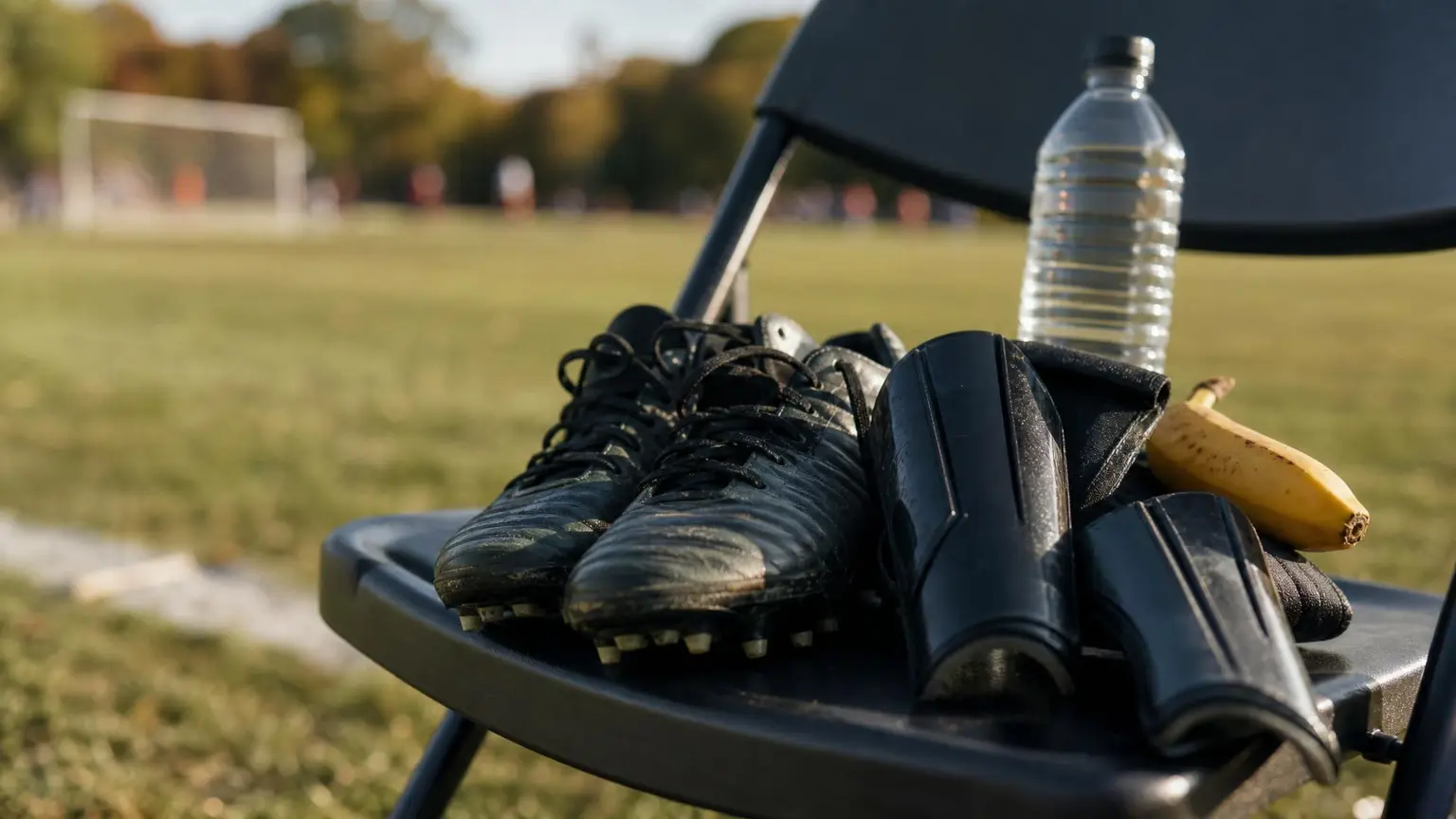
Two Games in One Day: Recovery Between Soccer Games at a Tournament
 Reviewed by Roman PivarnikUEFA Pro Licence · Technical Director, Slovak FA
A youth player cannot fully recover between two games on the same day — the gap is almost never long enough. Muscle glycogen, the fuel that high-intensity running burns through, rebuilds at only about 5% per hour. So a two-hour window between kickoffs restores roughly a tenth of what the first game emptied. That is not a reason to panic. It is a reason to change the goal: recovery between soccer games on a tournament day is about limiting the damage, not erasing it.
Which gives the hour after the final whistle a narrow job: fluid and fast carbohydrate in, legs off the feet, body kept warm. Everything else is optional. Here is what the research on young players actually shows, and what to do with the 45 minutes, two hours or overnight gap your schedule hands you.
How much recovery between soccer games is actually possible?
Less than most schedules assume. In a review of carbohydrate availability and performance published in Nutrients, the authors note that when little recovery time is available between two sessions or competitions on the same day, the constraint is simply biological: "the rate of glycogen re-synthesis is only about 5% per hour". The same review points out that getting carbohydrate in within the first two hours matters much more when the next game is close than it does when there is a full day in between — with 24 hours to play with, total intake matters more than timing.
The sports-medicine literature on youth tournaments reaches the same conclusion from the other direction. In a Sports Medicine review of recovery and scheduling for youth tournament play (Bergeron, 2009), Michael Bergeron writes that "incurred water and other nutrient deficits are often too great to offset during short recovery periods between competition bouts, and the athletes are sometimes 'forced' to compete again not sufficiently replenished." He also notes that prior same-day exercise "has been shown to increase cardiovascular and thermal strain and perception of effort in subsequent activity bouts" — the second game feels harder at the same workload, before any score is involved.
His conclusion is more optimistic than the warning suggests: youth athletes "are capable of tolerating the heat and performing reasonably well and safely in a range of hot environments if they prepare well, manage hydration sufficiently, and are provided the opportunity to recover adequately between contests."
What happens to young players across a tournament day?
Something more specific than "they get tired." A pilot study in the Journal of Strength and Conditioning Research put GPS units on ten U12 players (average age 10.3) and compared four 7v7 tournament games played in under 24 hours against two league games played with 24 hours of rest.
The headline result is counterintuitive. The players' distance per minute held up almost perfectly — about 86–87 metres per minute in both conditions, and stable across all four tournament games. What dropped was the top end: maximum velocity fell from 23.0 km/h in league games to 21.3 km/h in tournament games. And by the final game of the tournament, a bigger share of their running was at walking and jogging pace (37.7% of distance at 3.1–8.0 km/h, versus 32.4% in the earlier games), with slightly less at high speed (2.5% versus 3.3%).
Translated for the sideline: a tired 11-year-old does not stop running. They keep covering ground, but the sprints go first. The explosive recovery run to track a winger, the burst onto a through ball — that is what a compressed schedule takes away.
Two honest caveats. This is a pilot study of ten boys, so treat it as a signal rather than a settled fact. And the players averaged only 15.1 minutes per tournament match against 31.8 in league games — the tournament rotated them heavily, which likely protected the distance numbers.
Does a younger child recover faster than a teenager?
Probably yes, and this is one of the more useful things a parent can know. Reviewing Aspire Academy's data on post-game recovery in youth football, Martin Buchheit and colleagues compared two consecutive matches 48 hours apart in players classified by maturation — before or after peak height velocity, the fastest point of the adolescent growth spurt.
Players past peak height velocity showed residual fatigue 48 hours later: less very-high-intensity running and fewer repeated sprints. Players before it showed no impairment at all — their match running performance actually improved in the second game. The authors' conclusion: "the implementation of post-match recovery strategies may only be necessary in mature players."
The likely reason is less muscle mass, lower force production and therefore less match-induced muscle damage. Practically: the U10 bouncing around the hotel corridor is not faking it, and the 15-year-old who can barely get off the sofa is not soft. For the broader picture of that phase, see growth spurts and soccer performance.
Note the limit, though — this is about games 48 hours apart, not two games before lunch. Nobody has shown a pre-pubertal player is immune to a three-game Saturday.
What should a player eat and drink between games?
Carbohydrate first, and sooner than feels natural. The shorter the gap, the simpler the carbohydrate should be — TrueSport's guidance on tournament recovery is to lean on simple carbs like those in fruit when time is tight, rather than heavier whole grains and pastas that digest slowly. Fat is the thing to skip between games: it does important work in the body but converts to usable energy too slowly to help in the next 90 minutes.
Adult sports-nutrition research puts the useful target at roughly 1–1.2 g of carbohydrate per kilogram of body weight per hour in the hours after exercise, ideally from higher-glycaemic sources and paired with some protein. Those figures come from studies on adult athletes, so treat them as a direction of travel rather than a prescription to weigh out for a ten-year-old. In practice it means a banana and a sports drink beat a chicken wrap, and a chicken wrap beats nothing.
Three rules that matter more than the macros:
- Familiar food only. A tournament in a new city is the worst possible time to try a new food. Pack what you know works.
- Hydrate across the whole day, not just at the whistle. Fluid deficits accumulate and, as Bergeron notes, are often too large to close in a short break. Our heat safety and hydration guide covers how to judge it, and still applies on a cool autumn morning.
- Eat early. A real breakfast before the first kickoff does more for the third game than anything you can hand over at 2pm. For the fundamentals either side of a session, see what a youth player should eat before and after training.
A between-games plan by gap length
| Gap between games | Priority | What it looks like |
|---|---|---|
| Under 90 minutes | Fluid and fast carbs, stay warm | Drink immediately, fruit or a sports drink, shoes off, legs up, light walk before re-warming. No full meal. |
| 2–3 hours | Refuel properly, get off the feet | Carb-led meal with some protein within the first 30 minutes, then genuine rest in the shade or indoors. Gentle mobility, not a session. |
| 4+ hours | Treat it as a second prep | Full meal early, nap or quiet time, then a complete warm-up as if it were the day's first game. |
| Overnight | Sleep is the intervention | Eat within the hour, then protect bedtime ruthlessly — the single highest-value recovery tool available. |
That last row is not filler. Sleep does more for a young athlete between two days of a tournament than any product sold in the car park.
What helps less than people think
Ice baths. In young footballers, the Aspetar review notes that cold-water immersion — alone or with active recovery — reduced perceptions of general fatigue and leg soreness "but had no impact on physical test performance." Feeling fresher is worth something; just don't expect it to buy back sprint speed, and don't force a shivering 11-year-old into a cold tub for a benefit the evidence files under "perceived."
Long static stretching between games. Light mobility to stay loose is sensible. A 20-minute hold-and-stretch session is neither recovery nor preparation.
Doing nothing. Worse than over-managing the break is a player sitting in wet kit on cold concrete eating concession-stand candy, then jogging out cold for game two.
Is three games in one day too many?
It is more than the adult game asks of professionals, which is the honest frame. Bergeron's review is direct about where responsibility sits: tournament directors "frequently provide athletes with only the minimum allowable time between same-day matches," and governing bodies "need to address this issue and provide more specific, appropriate and evidence-based guidelines for minimum rest periods between same-day contests for all levels of tournament play in the heat."
Nobody can rewrite a bracket on the morning of the event, but three things stay controllable: minutes played, whether the gaps are used well, and how many of these weekends land on the calendar in a season. The American Academy of Pediatrics, in its clinical report Overuse Injuries, Overtraining, and Burnout in Young Athletes, defines overtraining as a decrease in performance driven by an imbalance between training and recovery — persistent fatigue, disrupted sleep, changes in mood — and names overscheduling as a burnout risk factor in its own right. Growing bones, it notes, tolerate repetitive stress less well than adult bones.
One heavy tournament weekend is a normal part of a season. A run of them back to back, with no lighter weeks between, is the pattern worth questioning. If the format is new to you, our guide to how youth soccer tournaments work explains the brackets, points and tiebreakers behind the schedule you were handed.
What a gap between games cannot fix is a base that was never built. Consistent touches through the week — FlickTec's guided daily sessions need only a ball and a small space — are what let a player still look like themselves in game three.
Frequently Asked Questions
How long does it take to recover between soccer games?
Longer than a tournament schedule allows. Muscle glycogen rebuilds at only about 5% per hour, so a two-hour gap replaces a small fraction of what the first game used. Full recovery of high-intensity running capacity can take more than 48 hours in post-growth-spurt players. The realistic goal between same-day games is to limit the deficit — fluid, fast carbohydrate, rest off the feet — not to reach full recovery.
What should my child eat between two soccer games?
Carbohydrate-led, familiar, and as soon after the whistle as possible. With under 90 minutes, keep it simple and fast-digesting — fruit, a sports drink, a plain carb snack — and avoid fat, which digests too slowly to help. With two or more hours, a proper carb-based meal with some protein within the first half hour works better. Never experiment with new food on a tournament day.
Do younger kids recover faster than teenagers between games?
The evidence suggests they do. Comparing consecutive matches 48 hours apart, researchers at Aspire Academy found that players past peak height velocity showed reduced very-high-intensity running and fewer repeated sprints, while players before it showed no decline and even improved. The likely reason is less muscle mass and less match-induced muscle damage. This does not mean a young child is immune to a three-game day.
Are ice baths good for youth soccer players at tournaments?
They make players feel better without reliably making them perform better. Studies in young footballers found cold-water immersion reduced perceived fatigue and leg soreness but did not improve physical test performance. If a player likes it and tolerates it, it is harmless. It is not worth forcing, and it is no substitute for fluid, food and rest.
How many games in one day is too many for a youth soccer player?
There is no agreed standard — which is itself the problem researchers have flagged, calling on governing bodies to set evidence-based minimum rest periods between same-day contests. Practically, watch the total: minutes played per game, the length of the gaps, and how many of these weekends appear in a season. GPS data on U12 players showed top speed dropping across a compressed tournament even while total running held up, so fatigue can be present before it is visible.
Fluid and fast carbs in the first 20 minutes, shoes off and legs up for the middle of the gap, a real warm-up before the next whistle. That is the whole protocol, and it beats anything you can buy at the tournament tent.