Futsal Rules Explained: How the Game Differs From Soccer
 Reviewed by Roman PivarnikUEFA Pro Licence · Technical Director, Slovak FA
Futsal is five-a-side soccer played on a hard court with a smaller, low-bounce ball, and the futsal rules that differ from the outdoor game are mostly about the clock and the restarts. Two 20-minute halves with a stopped clock. Kick-ins instead of throw-ins. Four seconds to restart play, every time. No offside. Unlimited substitutions, on the fly. And a team-foul count that hands the other side a free shot from 10 metres once you reach six fouls in a half.
That last one is the rule nobody explains to parents, and it is the one that decides tight games. It is also why a futsal coach spends the first week of the season teaching kids not to dive in.
Here is every futsal rule that actually differs from the outdoor game, taken from FIFA's Futsal Laws of the Game 2025-26, plus the handful your local winter league almost certainly changes on top.
What are the basic rules of futsal?
Futsal has its own Laws of the Game — seventeen of them, numbered the same way as the outdoor Laws and published separately by FIFA. The playing principles carry over. The game management does not.
| Futsal | Outdoor soccer | |
|---|---|---|
| Players | 5 (4 outfield + goalkeeper) | 11 |
| Match length | 2 × 20 min, clock stopped | 2 × 45 min, clock running |
| Substitutions | Unlimited, no stoppage needed | Limited, at stoppages |
| Ball out over the touchline | Kick-in | Throw-in |
| Ball out over the end line | Goal clearance (keeper throws) | Goal kick |
| Offside | None | Yes |
| Restart time limit | 4 seconds | None |
| Team fouls | Counted; 6th = free shot from 10m | Not counted |
| Timeouts | One per team, per half | None |
| Red card | Team plays 2 minutes short | Team plays short all game |
The most useful thing to grasp before a first game: the clock stops. Every time the ball leaves the court or the referee blows the whistle, a dedicated timekeeper stops it. Forty minutes of futsal is forty actual minutes of play, which is why a game that should take 50 minutes can run past an hour — and why the pace is relentless.
How long is a futsal game?
Law 7 is short and specific: "The match lasts for two equal periods of 20 minutes of playing time, which may only be reduced if permitted by competition rules."
The timekeeper signals the end of each period with an acoustic signal deliberately different from the referee's whistle, and the period ends when that signal sounds whether or not the referees whistle. Two more clock rules worth knowing from the sideline:
- Each team gets one timeout per half, lasting one minute, and can only request it when the ball is out of play and their own team has the restart. An unused first-half timeout does not carry over, and there are none in extra time.
- Half-time cannot exceed 15 minutes. The competition rules set the actual length.
Youth leagues shorten the halves constantly — FIFA explicitly permits national associations to modify "the duration of the two (equal) periods of the game" for youth futsal. Two 15s, two 18s and two 12s are all common in US winter leagues, sometimes with a running clock to fit more games into a gym. Assume nothing; read the schedule.
How many players are on a futsal team?
Five on the court, one of whom must be the goalkeeper. A match cannot start or resume if a team has fewer than three.
Substitutions are where futsal looks least like soccer. There is no limit on how many a team makes, and no stoppage required — a swap can happen while the ball is in play. Official competitions allow up to nine named substitutes. Goalkeepers change on the fly too; the referees do not stop play for it.
There is one hard procedural rule, and it is the most common way youth teams get cautioned: every substitution must happen through that team's own substitution zone, a marked 5-metre stretch of touchline in front of their bench — not at the halfway line. And the substitute may only enter after the player being replaced has fully left. Going early is a yellow card.
Futsal works because of the touch count, not the rulebook. A small court with four outfield players means the ball arrives at a player's feet constantly. FlickTec builds each day's home session around the skills your player's position actually needs. Free 7-day trial.
Why are there no throw-ins in futsal?
Because the ball is restarted with a foot. When the whole of the ball crosses the touchline — on the floor, in the air, or after hitting the ceiling — the opposition gets a kick-in. Per Law 15:
- The ball must be stationary on the touchline, at the point where it left the court.
- All opponents must stand at least 5 metres back from that point.
- The kick must be taken within four seconds.
- A goal cannot be scored directly from a kick-in. Straight into the opponents' goal is a goal clearance to them; into the kicker's own goal is a corner.
Miss the four seconds and the kick-in simply goes to the other team. If your child is used to the slower, more forgiving mechanics of a throw-in in outdoor soccer, the adjustment is real: there is no time to look up twice.
Goal kicks disappear too. When the attacking team puts the ball over the end line, the defending goalkeeper restarts with a goal clearance — thrown or released by hand from anywhere inside the penalty area, within four seconds, with opponents outside the area until the ball is in play. No goal can be scored directly from that either.
What is the four-second rule in futsal?
It is the rule that shows up in four different places, and the biggest behavioural change for a player arriving from the outdoor game. Four seconds applies to:
- Kick-ins — from the moment the team is ready, or the referee signals.
- Corner kicks — ball in the corner arc, four seconds to kick it.
- Goal clearances — the goalkeeper has four seconds to release.
- The goalkeeper in their own half — Law 12 awards an indirect free kick if a goalkeeper "controls the ball with the hands, arms or feet in their own half of the pitch for more than four seconds."
Point four catches everyone. The futsal keeper's limit covers the ball at their feet, not just in their hands, and applies anywhere in their own half rather than just the penalty area. The outdoor game's version of this — the eight-second limit now in the goalkeeper rules — only counts hand control inside the area. Futsal adds one more trap: after playing the ball in controlled possession, a goalkeeper cannot touch it again in their own half following a deliberate pass from a team-mate unless an opponent has touched it in between.
The practical effect is that futsal keepers must be comfortable passers under pressure, which is exactly why clubs like putting outfield players in goal for a futsal season.
What are accumulated fouls in futsal?
This is the rule with no outdoor equivalent, and the one most worth explaining before a first match.
Every foul punished with a direct free kick is recorded as an accumulated foul against that team, with the running total kept on the scoresheet and usually on the scoreboard. From a team's sixth accumulated foul in a half, and for every foul after it, the opposition gets what the Laws call a DFKSAF — a direct free kick beginning with the sixth accumulated foul. In plain terms:
- Taken from the 10-metre mark, or from where the foul happened if that was closer to goal.
- The defending team may not form a wall.
- The goalkeeper must stay at least 5 metres from the ball until it is kicked.
- The kicker must be clearly identified, and must try to score.
It is close to a second penalty. The count resets at half-time, so a team that commits five fouls before the break starts the second half clean — then carries the second-half total into extra time if extra time is played. Fouls waved on as advantage still count, which is why referees signal with both arms when a direct-free-kick foul has occurred even as play continues.
That consequence shapes how futsal is coached. A team sitting on five fouls has to defend the rest of the half without conceding another, so coaches drill standing, patient, feet-first defending. Sliding is not banned by the Futsal Laws — the word "slide" never appears in them, and a tackle is judged by the same careless, reckless or excessive-force test as outdoors. But on a hard court a sliding challenge that catches a player is almost always at least careless, and every one of those is another number on the board. Many US youth futsal leagues ban sliding outright for exactly that reason.
One more disciplinary difference: a red card in futsal costs the team two minutes of playing time a player down, not the rest of the match. A substitute comes on once those two minutes elapse — or sooner if the opposition scores during them.
Is there offside in futsal?
No. Law 11 of the Futsal Laws of the Game is one sentence long: "There is no offside in futsal." That is the entire law, and it is part of why futsal rewards a goalkeeper who can throw accurately down the court.
What ball does futsal use?
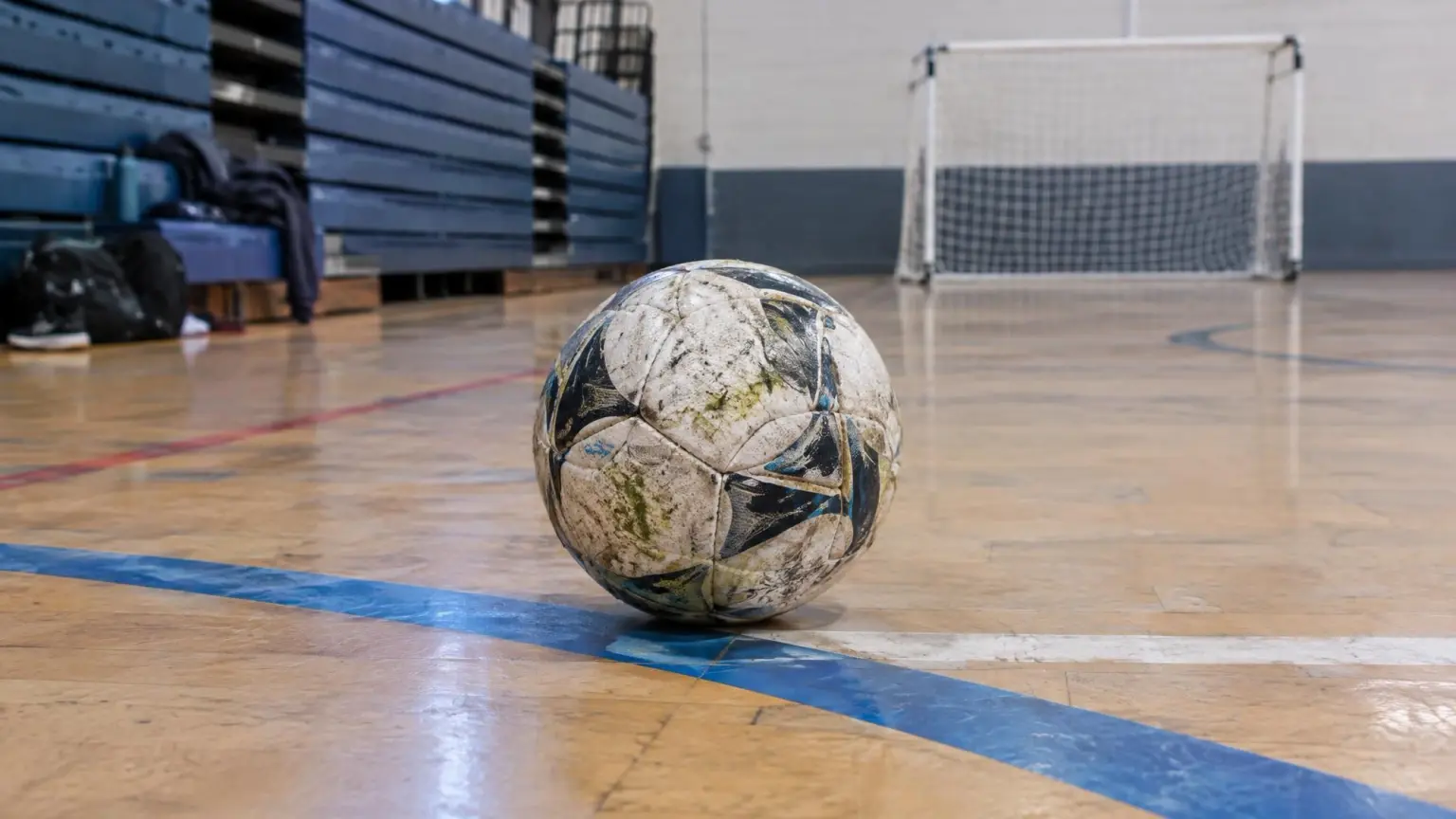
A futsal ball is smaller and much heavier for its size than a soccer ball, and it is built not to bounce. Law 2 specifies a circumference of 62–64cm and a weight of 400–440g, then adds the test that defines the ball: it "must not bounce lower than 50cm or higher than 65cm on the first rebound when dropped from a height of 2m."
Drop a size 4 soccer ball from head height and it returns to your waist. A futsal ball returns to your shin. That dead bounce keeps the ball on the floor and forces players to control it with the sole and the instep instead of chasing it.
Those are the senior figures. FIFA permits national associations to modify "the size, weight and material of the ball" for youth futsal, and US programmes do — younger divisions commonly use a smaller low-bounce ball, and some recreational leagues simply use a standard outdoor ball. Your league's rulebook is the only reliable source for which ball your age group plays with, and a conventional ball behaves very differently on the same court.
Is futsal the same as indoor soccer?
No, and confusing the two is the most common mistake American parents make, because both happen in a gym in January.
Futsal is played on a flat court with touchlines: the ball goes out of play and comes back with a kick-in. Arena indoor soccer is played inside walls, with the ball kept live off the boards, and usually brings its own additions like three-line violations and blue cards. The rulebooks are genuinely different documents, and our guide to indoor soccer rules covers the walled version in detail. If you are weighing whether a futsal season is worth adding to the outdoor calendar, futsal vs soccer compares what each format develops.
What your league will change
FIFA is explicit about which parts of futsal a national association may modify for youth, veterans', disability and grassroots play: the size of the pitch, the size, weight and material of the ball, the goal width and crossbar height, the duration of the two periods, and limits on the goalkeeper throwing the ball.
For reference, a standard court is 25–42m long and 16–25m wide for non-international matches (38–42m by 20–25m internationally), with goals 3m wide and 2m high — roughly a basketball court with handball-sized goals.
The goalkeeper-throwing limit is the one to watch for, because it changes how a team plays. Some youth competitions outlaw a goal clearance thrown directly over the halfway line; where that applies, doing it hands the opposition an indirect free kick from where the ball crossed. FIFA's stated reason is "to promote creative futsal and encourage technical development" — in other words, to stop teams bypassing the middle of the court.
US Youth Futsal's rules overview is a reasonable starting point for the American youth version, but it says so itself: league rules differ from state, regional and national tournament rules. Find your own competition's document before the first game. Shinguards, incidentally, stay compulsory in futsal, same as outdoors.
Frequently Asked Questions
How is futsal different from soccer?
Futsal is five-a-side on a hard court with a smaller low-bounce ball. The main rule differences: two 20-minute halves with a stopped clock, kick-ins instead of throw-ins, goal clearances thrown by the keeper instead of goal kicks, a four-second limit on restarts, no offside, unlimited on-the-fly substitutions, and a team-foul count that gives the opposition a free shot from 10 metres from the sixth foul in a half.
How long is a futsal game?
Two periods of 20 minutes of playing time, with the clock stopped whenever the ball is out of play, plus a half-time interval of up to 15 minutes. Each team also gets one one-minute timeout per half. Youth leagues are permitted to shorten the periods and often do, so check your competition's rules.
Is there offside in futsal?
No. Law 11 of the Futsal Laws of the Game states simply that there is no offside in futsal.
What size futsal ball should my child use?
FIFA's senior specification is a ball of 62–64cm circumference and 400–440g that bounces no lower than 50cm and no higher than 65cm when dropped from 2m — sold as a size 4 futsal ball. FIFA allows national associations to change the size, weight and material of the ball for youth futsal, so the ball for your child's age group is set by the league rather than by the Laws. Ask before buying.
What happens after six fouls in futsal?
From a team's sixth direct-free-kick foul in a half, the opposition gets a direct free kick from the 10-metre mark — or from the spot of the foul if that is nearer to goal — with no wall allowed, the goalkeeper at least 5 metres away, and the kicker obliged to shoot. The count resets at half-time.
Futsal rewards the parts of the game outdoor soccer can hide: a reliable first touch, a head up before the ball arrives, and the discipline not to lunge. Most of the rulebook exists to force those habits — the four seconds, the dead ball, the foul count. Once you see that, the rules stop looking like trivia and start looking like a coaching method.