Stoppage Time in Soccer: Why the Clock Doesn't Stop (and When It Does)
 Reviewed by Roman PivarnikUEFA Pro Licence · Technical Director, Slovak FA
In soccer, the clock does not stop. It runs continuously from kick-off to the end of each half, and the referee — not the scoreboard — is the official timekeeper. Stoppage time in soccer, also called added time or injury time, is how the referee hands back the playing time lost to substitutions, injuries, goal celebrations and time-wasting. But the rule your child plays under may be none of the above: most US small-sided youth games remove added time entirely, and American high school soccer runs a clock that genuinely does stop.
If you have ever stood on a sideline watching a half run four minutes past where your own phone timer said it should end — or watched the referee blow the whistle while the ball was rolling toward an open net — you have run into the one part of soccer governed by three different rulebooks at once. Here is what each of them says.
Does the clock stop in soccer?
Not under the Laws of the Game. The clock runs from kick-off to the end of the half, through throw-ins, goal kicks, substitutions, shoes being retied and arguments with the referee.
The reason is a single line in Law 5: the referee "acts as timekeeper, keeps a record of the match and provides the appropriate authorities with a match report." The same Law lists a referee's compulsory equipment — whistle, red and yellow cards, notebook, and watch.
That is the whole design. In basketball or American football, an operator at a table controls the official clock. In soccer the scoreboard is a courtesy: the official time is on the referee's wrist, and nobody else can stop it.
What is stoppage time in soccer?
Because the clock never stops, the referee compensates at the end of each half. Law 7 calls this the allowance for time lost, and it is specific. Allowance is made in each half for all playing time lost in that half through:
- substitutions
- assessment and/or removal of injured players
- wasting time
- disciplinary sanctions
- medical stoppages permitted by competition rules, such as drinks breaks (which should not exceed one minute) and cooling breaks (ninety seconds to three minutes)
- delays relating to VAR checks and reviews
- goal celebrations
- any other cause, including any significant delay to a restart
Two things there surprise people. Goal celebrations are on the list — a team that scores three times and celebrates properly has spent real minutes doing it. And time is accounted for per half, which is why a chaotic first half gets its own added time instead of being rolled into the end of the match.
Why is added time always longer than the board says?
This detail explains most touchline arguments, and it is one sentence in Law 7:
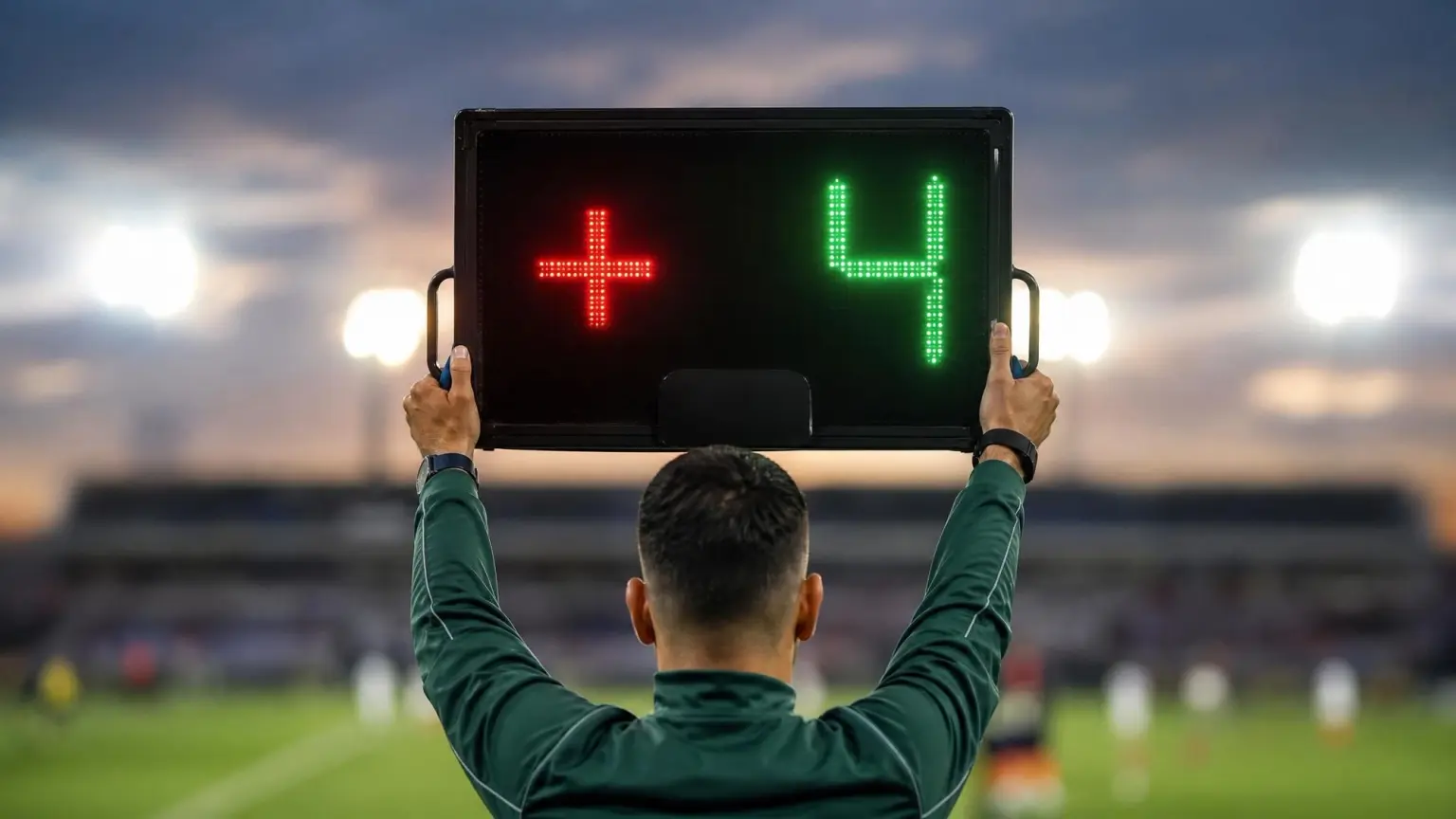
"The fourth official indicates the minimum additional time decided by the referee at the end of the final minute of each half. The additional time may be increased by the referee but not reduced."
Four minutes on the board is a floor, not a promise. The clock keeps running during added time, so a substitution in the 92nd minute, or a goal and its celebration in the 94th, adds more on top. The number can go up and can never come down. Law 7 closes the loophole in the other direction too: "The referee must not compensate for a timekeeping error during the first half by changing the length of the second half."
One rule is genuinely counterintuitive. If a long stoppage happens right at the end of a half, the referee does not add the length of that stoppage. IFAB works the example itself: with three minutes already decided, a five-minute injury stoppage just before that added time begins does not produce eight. "If there is a stoppage towards the end of the game that is longer than the remaining playing time, the 'additional time' played is the remaining playing time, not the length of the stoppage." The original three minutes are shown and played.
Can a half end while the ball is in play?
Yes, and it is the normal case. The whistle goes when time expires regardless of what is happening — a cross in the air, a shot on its way, a striker clean through. Soccer has no final play.
Law 7 allows one exception: "If a penalty kick has to be taken or retaken, the half is extended until the penalty kick is completed." The half stretches for that kick and nothing else — no scoring on a rebound. If the ball goes in, IFAB is explicit that the match simply ends, with no kick-off.
Does youth soccer have stoppage time?
Usually not — and this is where parents get tripped up by watching the professional game.
US Youth Soccer's Policy on Players and Playing Rules sets the default in Rule 301: "Except as provided by USYSA or its State Associations, the FIFA 'Laws of the Game' apply." So added time is the technical starting point — but that clause does enormous work, because nearly every competition modifies it.
The clearest example is U.S. Soccer's Player Development Initiatives, the standards governing small-sided play for players 12 and younger. For 7v7 — the format at U9 and U10 — the document's Law 7 section reads, in full: two halves, 25-minute halves, 10-minute halftime, no added time. When the referee's watch reaches 25 minutes, the half is over. The same standards set 4v4 at four 10-minute quarters for U6–U8, and 9v9 at two 30-minute halves at U11–U12.
Tournaments go further. A running clock is the norm when eight fields have to turn over every hour, and tournament rules often say so outright — one indoor tournament's published rules specify a "40 Minute Running Clock" with "Game clock DOES NOT STOP." That is not a referee cutting corners; it is the competition's written rule.
The upshot is what parents actually want to know: a youth game almost always ends within a minute or two of when the schedule says it will. Our breakdown of how long youth soccer games last at each age has the half lengths, halftime and overtime rules side by side.
How does the clock work in high school soccer?
High school soccer is the real outlier, and the reason so many American families find the professional game's timekeeping baffling.
Games run under NFHS rules — two 40-minute halves with a 10-minute intermission — and the clock counts down and stops. Kansas's state association, publishing NFHS Rule 6-2-3a to its officials, puts it plainly: "In NFHS/KSHSAA soccer contests, the clock should stop after every goal scored. Thus, there should be no reason for any player/s to rush the goal and attempt to retrieve the ball."
It stops for injuries too. NFHS's weekly rule interpretations, distributed by Missouri's state association, state that "the clock is to be stopped for an injury as per 7-4-1," and that a referee "has the authority per 5-3-2i to instruct the timer to correct the clock." Time in high school soccer is put back on the clock rather than added at the end — which is why an NFHS game has no stoppage time at all.
One more wrinkle: under NFHS rules the scoreboard clock is the official one, reversing everything above, and states can override even that — Florida's association makes the on-field official's watch official instead. Our guide to high school soccer game length covers the overtime and state-variation side in full.
| Competition | The clock | It stops for | Added time |
|---|---|---|---|
| Laws of the Game (FIFA/IFAB) | Counts up; referee's watch is official | Nothing | Yes — a minimum, may be increased |
| US Youth Soccer default (Rule 301) | Laws of the Game unless modified | Nothing | Yes, unless the competition removes it |
| U.S. Soccer 7v7 (U9–U10) | Two 25-minute halves | Nothing | No added time |
| Most tournaments | Running clock | Nothing | No |
| NFHS high school | Counts down; scoreboard usually official | Goals, injuries, referee's instruction | No — time is restored instead |
What does the clock have to do with time-wasting?
Everything, which is why "wasting time" sits on Law 7's list: a continuous clock rewards a leading team for every second it burns. The most visible recent change is in Law 12, where a goalkeeper who controls the ball with their hands for more than eight seconds now concedes a corner kick, with the referee counting "down the last five seconds with a raised hand." If you see a referee holding an arm up and counting, that is what is happening. Our goalkeeper rules guide covers how this replaced the old six-second rule — which still appears in league handbooks that predate the change.
What this means on a Saturday
- Check which rulebook your league uses, not the one you watched on TV. Club, high school and tournament play answer this question three different ways.
- The referee's watch is the clock in club and rec soccer, so the parent timing the half on a phone will always be a little out.
- Added time is a minimum. A game can run longer than the board says; it can never run shorter.
- Don't expect a final play. If your child's team is attacking as time expires, the whistle can and will go.
- The clock is not where development happens. A U10 sees fifty minutes of match time in a week at most, and half the squad is on the bench for part of it. The minutes that change a player are the ones between games — what FlickTec is built around.
Frequently Asked Questions
What is stoppage time in soccer?
Stoppage time — also called added time or injury time — is extra time the referee plays at the end of each half to make up for playing time lost during that half. Law 7 of the Laws of the Game lists what counts: substitutions, injury assessments, time-wasting, disciplinary sanctions, drinks and cooling breaks, VAR delays, goal celebrations, and any other significant delay to a restart.
Does the clock stop in soccer?
Not under the Laws of the Game. The referee acts as the official timekeeper and the clock runs continuously through throw-ins, substitutions and injuries, with time lost given back as added time at the end of each half. American high school soccer is the major exception: under NFHS rules the clock counts down and genuinely stops, including after every goal and for injuries.
Why is added time longer than the number shown by the fourth official?
Because that number is a minimum, not a target. Law 7 states that the fourth official indicates the minimum additional time and that it "may be increased by the referee but not reduced." The clock keeps running during added time, so a substitution, injury or celebration in those final minutes adds further time on top of what was displayed.
Does youth soccer have stoppage time?
Usually not. US Youth Soccer's Rule 301 makes the FIFA Laws the default, but competitions may modify them and nearly all do. U.S. Soccer's small-sided standards specify "no added time" for 7v7 at U9 and U10, and most tournaments run a straight running clock. Ask your league which standard it follows.
Can a soccer game end while the ball is in play?
Yes. The referee blows the whistle when time expires no matter what is happening — there is no final play in soccer. The only exception is a penalty kick: Law 7 extends the half until an awarded or retaken penalty is completed. If a goal is scored directly from it, the match ends immediately with no kick-off.
Soccer's clock looks like an oversight and is actually a choice. Handing timekeeping to the referee rather than a scoreboard operator keeps the game flowing and puts the judgement about lost time with the person closest to it. What it costs is certainty — nobody knows exactly when the half will end, including the players. American youth organisers traded that away for schedules that work. Both are the real sport; it helps to know which one you are standing at.