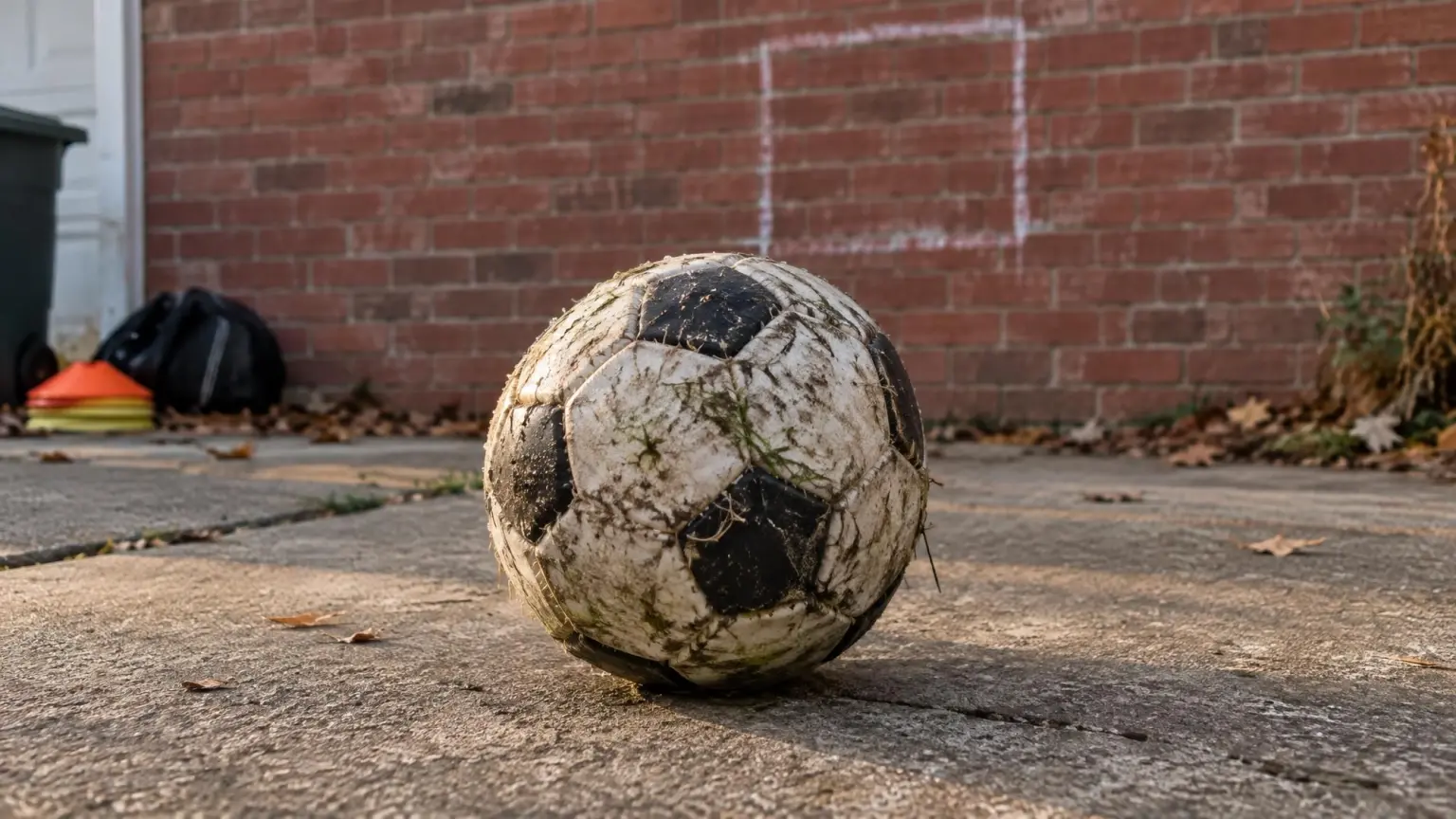
Soccer Wall Drills: 7 Solo Exercises for a Better First Touch
 Reviewed by Roman PivarnikUEFA Pro Licence · Technical Director, Slovak FA
A wall is the most underrated piece of soccer training equipment there is. It returns the ball thousands of times without getting bored, it punishes a sloppy pass immediately, and it costs nothing. Soccer wall drills are the best solo way to build a reliable first touch and accurate passing weight — but they train technique, not decision-making, so they supplement team training rather than replace it.
Your child wants to practise, it is dark at five, the fields are shut for the winter, and there is nobody to pass with. The answer has been sitting in the driveway the whole time. Here is how to use it properly, the seven drills in the order they should be learned, and the honest limit of what a wall can do.
Why is a wall such a good soccer training tool?
Because it gives instant, unforgiving feedback on the two things young players practise least.
Passing weight and first touch are both invisible in most backyard practice. A child can dribble through cones for twenty minutes and never find out whether their pass arrives at the right speed, because there is nobody at the other end to receive it. A wall tells them in half a second: a bad pass comes back wrong, or doesn't come back at all. A heavy first touch bounces away and the rep is over.
It also solves the volume problem. A player gets a limited number of touches in a team session — we work through the arithmetic in how many touches a youth soccer player needs — and a wall is the cheapest way to add a few hundred more without a partner, a coach or daylight.
The skill-acquisition literature splits soccer activities into training form — what one systematic review calls "decontextualized repetitive drills" — and playing form, "game-related, representative situations." Wall work is training form in its purest version, which matters for how you use it. More on that below.
What do you need for soccer wall drills?
Less than you would think, but the details matter more than people expect.
| What | What to look for | Why |
|---|---|---|
| The wall | Flat, solid, no windows, no siding, no garage door | A brick or concrete wall gives a true rebound; thin panels dent and absorb |
| The surface | Flat and consistent — concrete, asphalt, short turf | A sloped or rutted surface makes every rebound a different problem for the wrong reason |
| The ball | Correct size for age; futsal ball on hard surfaces | A futsal ball barely bounces, so it stays on the floor where the practice is |
| Pressure | The low end of legal | A softer ball comes back slower and is easier to control |
| Space | 3–10 yards of run-off | Enough to vary distance; enough that a miss doesn't end up in the road |
Two of those are worth spelling out.
Ball pressure is a dial, not a fixed setting. Under the IFAB Laws of the Game, Law 2 requires a match ball at "0.6 – 1.1 atmosphere (600 – 1,100g/cm2) at sea level (8.5 lbs/sq in – 15.6 lbs/sq in)." That is a wide legal range, and the difference at each end is very noticeable off a wall. A ball near the bottom is slower off the brick and far more forgiving; a rock-hard one fires back before a nine-year-old has reset their feet. Start soft.
On concrete, use a futsal ball. FIFA's Futsal Laws of the Game specify a ball that "may not bounce less than 50 cm or more than 65 cm on the first rebound when dropped from a height of 2 m" — a deliberately dead ball, in a size-4 shell of 62–64 cm circumference. On a hard driveway a normal ball spends half the session in the air; a futsal ball stays on the deck, where first touch actually gets trained. It is the same reason futsal is such good winter work.
The seven wall drills, easiest to hardest
Work down this list. Do not move on until the current one is boringly consistent — that is the signal it has been learned, not a reason to stop.
| # | Drill | What it trains |
|---|---|---|
| 1 | Two-touch, inside foot — control, then pass | Basic receiving and passing accuracy |
| 2 | One-touch pass — return it without controlling | Passing surface and ankle lock under time pressure |
| 3 | Touch out of the feet — first touch sideways, then pass | Opening the body, which is what the game asks for |
| 4 | Weak foot only | The thing nobody practises voluntarily |
| 5 | Driven pass — from 10+ yards, laces | Striking technique and distance control |
| 6 | Volleys and half-volleys — throw it, strike the rebound | Timing and contact on a moving ball |
| 7 | Angled rebound — hit the wall off-centre, react | Receiving a ball you did not expect |
Four coaching points change the quality of all seven:
- Target something. A chalk square, a drain, a brick two courses up. "Pass at the wall" produces lazy reps; "hit that square" produces practice.
- Knee over the ball on the first touch. Leaning back pops the ball up; leaning slightly over it kills it dead.
- Count the good ones, not the total. Ten clean one-touch returns in a row is a real target. Fifty sloppy ones are not.
- Alternate feet from day one — far easier than retrofitting a weak foot at fourteen.
Drill 7 is the bridge to everything else. Striking the wall square returns a predictable ball; striking it at an angle returns one the player has to read. That unpredictability is the point — our first-touch guide goes deeper on body shape, but the short version is that a touch which only works on a perfect pass is not yet a skill.
How long should a wall session be?
Fifteen to twenty minutes, several times a week, beats an hour on Sunday.
This is a technical-repetition activity, so it fatigues attention long before it fatigues legs. When the reps get scruffy, the session is over — continuing past that point is just practising a worse version of the technique. Our guidance on how often young players should train at home applies here unchanged.
A sensible 15-minute shape: three minutes of drill 1 to warm up, six minutes on whichever drill is currently the edge of their ability, three minutes of weak foot, and the rest on something they enjoy and are good at. Ending on competence is not soft — it is why they come back tomorrow.
What can a wall not teach?
This is where most wall-drill articles stop being honest, so here is the real picture.
A wall never makes a player decide. It never shows up in the wrong place, never plays a bad ball, never closes them down, and never gives them a reason to look up before the ball arrives. Everything that involves reading a situation — scanning, choosing a pass, recognising pressure — is absent by design.
The research is appropriately cautious about exactly this gap. A 2021 systematic review in Frontiers in Psychology by Bergmann and colleagues screened 8,295 records and reviewed 35 studies of practice design in soccer. Its summary of repetition-based work is worth quoting precisely:
"The quantitative synthesis of results revealed empirical support for the effectiveness of coaching methodologies aiming at encouraging players' self-exploration within representative scenarios to promote technical and tactical skills. Nevertheless, 'traditional' repetition-based approaches also achieved improvements with respect to players' technical outcomes, yet, their impact on match-play performance remains widely unexplored."
That cuts both ways. Repetition does improve technique — a supported finding, not a consolation prize. But whether those gains show up in a match is, in the authors' own words, "widely unexplored." Anyone who tells you wall reps will make your child a better player is going beyond the evidence; anyone who says they are pointless is too.
The practical conclusion is unglamorous. Wall work makes the first touch available. Games and team training are where a player learns when to use it.
How do you progress wall drills over months?
By making the task less predictable, not by adding more reps.
There is some suggestion that the order matters. A 2026 study in Scientific Reports had 71 inexperienced participants learn the instep kick over 324 trials, comparing blocked practice, random practice, and groups that started blocked and moved to a more random order once they hit an accuracy threshold. The threshold groups came out ahead on retention, and one of them beat every group on transfer. The caveat is real: those were adults aged 18–25 with no experience, not children, so treat it as a hint rather than a prescription.
It points where good coaches already go: get it clean in the simple version, then deliberately mess it up. Narrow the target. Stand closer so there is less time. Hit the wall at an angle. Follow a one-touch return with a sprint to a cone and back. Each keeps the technique and removes the comfort.
What a wall will not give you is a plan — which drill, at what difficulty, this week. That is the gap FlickTec's home sessions fill: structured individual work built by a UEFA Pro Licence coach, so the fifteen minutes in the driveway are aimed at something. Pair it with ball mastery exercises and a few drills that need no equipment at all, and a dark November evening stops being a lost one.
Frequently Asked Questions
Do soccer wall drills actually work?
For technique, yes. A 2021 systematic review of practice design in soccer found that "traditional" repetition-based approaches did achieve improvements in players' technical outcomes — while noting that the effect of such repetition on actual match performance "remains widely unexplored." So wall drills reliably build first touch and passing accuracy, and poorly build decision-making. Use them alongside games, not instead of them.
What size ball should you use for wall drills?
The normal match size for your child's age group, with one exception: on concrete or asphalt, a futsal ball is better. FIFA's Futsal Laws specify a ball that bounces no less than 50 cm and no more than 65 cm on the first rebound from a 2 m drop, so it stays on the ground where first touch is trained instead of bouncing up over the foot.
How long should a kid practise against a wall?
Fifteen to twenty minutes, a few times a week, is plenty. Wall work tires concentration faster than legs, so rep quality falls off well before the child is physically tired. When the touches get sloppy, stop — practising a degraded technique is worse than not practising.
Will kicking a ball against the wall damage it?
It can, which is why the wall matters. Brick, concrete block and poured concrete handle it; vinyl or aluminium siding, garage doors, stucco and anything near a window do not. Letting some air out helps on both counts — the Laws of the Game allow 0.6 to 1.1 atmosphere, and the soft end is gentler on the wall and easier to control.
Can my child really improve at soccer practising alone?
Technique, yes — first touch, both feet, striking, close control all improve alone. Game understanding does not: scanning, decisions under pressure and reading an opponent need other players. That is why the children who get most from solo work are the ones who also play plenty of unstructured games. Solo practice makes the skill available; playing teaches them when to use it.
Step-by-step
- Total time:
- 18m
- You'll need:
- soccer ball (futsal ball on hard surfaces), flat brick or concrete wall, chalk, ball pump
- 1
Two-touch, inside foot
Stand three to four yards from the wall. Pass with the inside of the foot, control the rebound with one touch, then pass again. Aim at a chalk square rather than the wall in general.
3m
- 2
One-touch pass
Return the ball without controlling it first. Lock the ankle and keep the passing surface flat. Count consecutive clean returns rather than total reps.
3m
- 3
Touch out of the feet
Take the first touch sideways rather than straight back, opening the hips, then pass with the other foot. This is the touch the game actually asks for.
3m
- 4
Weak foot only
Repeat drills 1 and 2 using the weak foot exclusively. Expect it to look worse; that is the point.
3m
- 5
Driven pass
Move back to ten yards or more and strike with the laces. Control the distance and keep the ball below head height.
2m
- 6
Volleys and half-volleys
Throw the ball at the wall and strike the rebound out of the air or on the half-volley. Focus on timing and clean contact over power.
2m
- 7
Angled rebound
Strike the wall off-centre so the rebound comes back at an angle the player has not predicted, then control and return it. This is the bridge to a game-realistic first touch.
2m