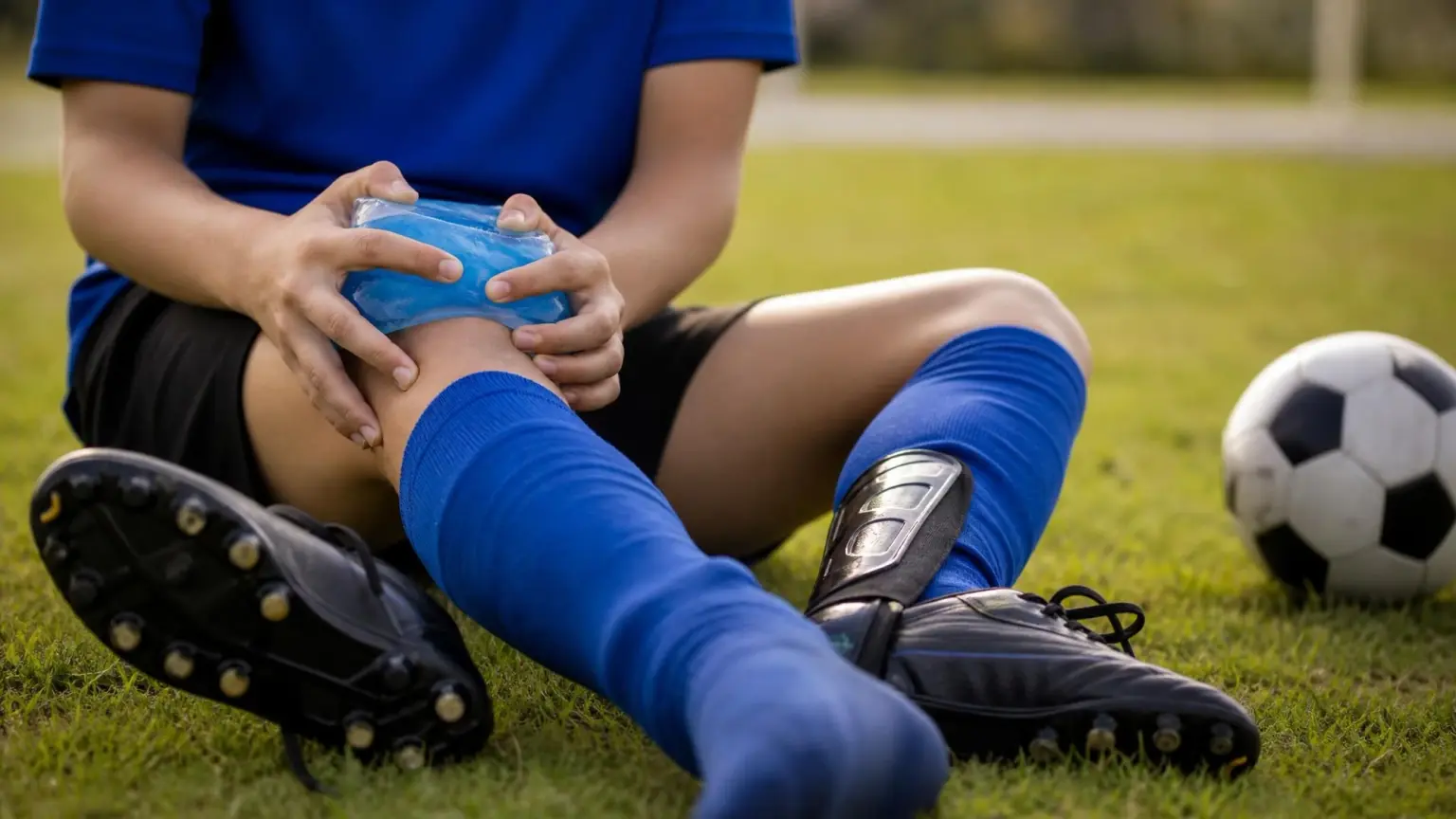
Growing Pains in Youth Soccer: Osgood-Schlatter Disease, Sever's Disease, and When to Worry
 Reviewed by Roman PivarnikUEFA Pro Licence · Technical Director, Slovak FA
Growing pains that show up as a tender, swollen bump just below the kneecap (Osgood-Schlatter disease) or aching heel pain after practice (Sever's disease) are two of the most common reasons active kids age 8 to 15 end up wincing through a soccer season — and neither one usually means stopping soccer, just training around it for a while. Both are overuse injuries at a growth plate, not torn ligaments or fractures, and both are self-limited: with the right adjustments most kids keep training through it, and neither one needs surgery. Sever's can cost a longer stretch of the season than parents expect, so plan around it rather than assuming a quick fix.
That distinction matters, because "growing pains" gets used as a catch-all label parents either over-worry about or wave off completely. Here's what's actually happening at the knee and heel, what genuinely helps, and — just as important — the handful of signs that mean it isn't growing pains at all.
What's Actually Happening in a Growing Knee or Heel?
Osgood-Schlatter disease and Sever's disease are both a type of overuse injury called traction apophysitis — inflammation where a tendon pulls repeatedly on a growth plate (an apophysis) that hasn't finished maturing. Neither is the same category of injury as a sudden ligament tear like the one covered in our guide to ACL injury prevention in youth soccer; there's no single moment to point to, just cumulative strain from running, jumping, and kicking landing on a growth plate that's temporarily a weak link in an otherwise strong young body.
| Osgood-Schlatter disease | Sever's disease | |
|---|---|---|
| Where it hurts | Bony bump just below the kneecap (tibial tuberosity) | Back or underside of the heel |
| What's pulling | Quadriceps, through the patellar tendon | Calf muscles, through the Achilles tendon |
| Typical age | Roughly 10–15 in boys, 8–14 in girls | Roughly 8–15, average around 12 |
| Made worse by | Running, jumping, kneeling, squatting, stairs | Running and jumping, especially on hard or artificial turf |
Osgood-Schlatter Disease: The Painful Bump Below the Kneecap
Osgood-Schlatter disease shows up as pain, swelling, and tenderness right where the patellar tendon attaches to the shin bone, just below the kneecap. In kids who've had it a while, that spot can develop a visible, permanent bump — harmless, but it doesn't fully disappear once the pain does. Multiple orthopedic sources put the typical age range at roughly 10 to 15 in boys and 8 to 14 in girls, with incidence peaking around age 12, which lines up with when the growth plate at the tibial tuberosity is actively maturing.
It's one of the more common causes of knee pain in young athletes generally, and soccer sits squarely in the group of sports — alongside basketball, gymnastics, and volleyball — where repetitive jumping and kicking load the quadriceps and patellar tendon hardest.
Sever's Disease: Why the Heel Hurts After Practice
Sever's disease is the same basic mechanism at a different joint: the calf muscles pull on the heel bone (calcaneus) through the Achilles tendon, at a growth plate that's still developing. It's widely described as the single most common cause of heel pain in this age group, typically affecting kids from about 8 to 15, and one youth soccer academy study put the average age at diagnosis at about 12. It can affect one heel or both. It's reported in boys roughly two to three times as often as girls, though that partly tracks who's playing what — it follows repetitive running and jumping load wherever it lands.
Does It Actually Track a Growth Spurt?
The standard explanation — bone lengthens faster than the muscle-tendon unit can stretch to keep up, so the tendon pulls harder on the growth plate — is intuitive and widely repeated by pediatric orthopedic sources. It's also, worth saying plainly, not settled. A screening study of 119 youth soccer players tested whether Osgood-Schlatter tracked how fast a kid was growing and found no link — and no link to flexibility either. A separate cohort of younger soccer players did find tight quadriceps and calves among the boys who went on to develop it. The research disagrees with itself, and both studies were boys only. A spurt is a plausible trigger, not a proven one.
One genuinely useful finding from that same line of research: having had Sever's disease previously is one of the strongest predictors of later developing Osgood-Schlatter disease — consistent with the idea that some kids are simply more prone to apophysitis in general, wherever the growth plate under the most load happens to be at the time.
How Is It Diagnosed?
Both conditions are diagnosed clinically — a history of activity-related pain plus a physical exam finding tenderness at the specific growth plate (the tibial tuberosity for Osgood-Schlatter, the back of the heel for Sever's) is usually enough. X-rays aren't required to make the diagnosis and mostly get ordered to rule out something else — a stress fracture, a bone cyst, an infection — when the picture doesn't quite fit. That's worth knowing before an ER visit; a pediatrician or sports medicine clinic can usually confirm either condition without any imaging at all.
What Actually Helps
The default instinct — stop soccer entirely until it's gone — usually isn't necessary and rarely realistic mid-season. What consistently comes up across treatment guidance for both conditions:
- Modify load, don't eliminate it. Cut back on the specific movements that flare it up most — for Osgood-Schlatter that's jumping, kneeling, and hard running; for Sever's it's sprinting and jumping, especially on turf. A stretch of reduced-volume weeks is often enough to calm symptoms without a full stop.
- Ice after activity. Applied to the sore spot after training or games. Standard advice for the knee and commonly given for the heel too, though no trial has actually tested it.
- Stretch — and for the heel, wait until the worst has passed. Quadriceps and hamstring stretching is standard advice for Osgood-Schlatter and can be done throughout. For Sever's, stretching into a painful end-range can aggravate it, so start once the pain has eased. Worth knowing that stretching has never been shown to work in a trial for either condition.
- Heel cups or supportive footwear are standard advice for Sever's and take some load off the growth plate. The trials are honest that they don't clearly beat rest or physio, so treat them as comfort, not a cure.
- Expect weeks, not days — but not the whole season either. Guidance across sources describes recovery in terms of a few weeks to a few months with appropriate management, not a fixed number of days. Kids with consistent early management — activity modification plus stretching, done regularly rather than occasionally — tend to land on the faster end of that range.
This is the same principle behind managing training load in youth soccer generally — the goal during a flare-up isn't zero load, it's the right load, adjusted week to week rather than decided once and left alone. A properly structured warm-up routine that includes real stretching and mobility work, done consistently rather than rushed through, is also one of the more practical ways to reduce how often these flare-ups happen in the first place.
When Growing Pains Aren't Growing Pains
Both conditions follow a predictable pattern: pain that shows up during or right after activity, gets better with rest, and doesn't come with other red flags. It's worth a same-week visit to a pediatrician or sports medicine provider — rather than assuming it'll pass on its own — when any of the following show up instead:
- Pain that's present at rest or wakes a child up at night, not just during or after activity
- Swelling, redness, or warmth at the joint itself, not just the growth plate
- Fever alongside the pain
- A child who won't bear weight at all, or is limping consistently rather than just being sore
- Pain that's clearly one-sided with a recent trauma, fall, or collision behind it
- Pain that isn't improving at all after a couple of weeks of the modifications above
None of those describe typical Osgood-Schlatter or Sever's disease — they're the pattern doctors watch for to rule out a stress fracture, an infection, or something needing more than rest and ice. Pain further down the leg follows its own rules: aching that spreads along the inner edge of the shinbone is usually shin splints, where the tell that separates ordinary overuse from a stress fracture is whether the tenderness is diffuse or pinpoint. It's the same "don't wait and see" instinct covered in our broader guide to preventing soccer injuries in youth players: most soreness is normal, but a specific set of warning signs means it's time to stop guessing.
Frequently Asked Questions
Is Osgood-Schlatter disease serious?
No — it's a common, self-limited overuse condition, not a structural injury to the knee joint itself. It can be genuinely painful and can leave a permanent bony bump below the kneecap, and it resolves as the growth plate matures. Most kids come through it fine, though a Danish follow-up of adults treated in hospital for it found many still had knee complaints years later — a good reason to manage it properly rather than wait it out.
Can my child keep playing soccer with Osgood-Schlatter or Sever's disease?
Usually yes, with modifications rather than a full stop. Reducing jumping, hard running, or kneeling during a flare-up, icing after activity, and building in real stretching time typically lets a player keep training at a reduced volume rather than sitting out entirely. A full stop is more often about managing day-to-day pain than a strict medical requirement.
How long does Osgood-Schlatter disease last?
A single flare-up usually settles in a few weeks. The condition itself can come and go for one to two years until the growth plate fuses, and symptoms often return during later growth spurts. Around one in ten still have some pain into adulthood. Sever's is usually quicker, typically a few weeks to months, though it recurs the same way until the heel growth plate closes.
What's the difference between Osgood-Schlatter disease and a torn ACL?
They're unrelated injury types. Osgood-Schlatter disease is a gradual overuse condition at a growth plate below the kneecap, with no single injury moment. An ACL tear is a ligament injury, often from a non-contact landing or cutting motion, that typically involves a pop, immediate swelling, and knee instability — the pattern covered in our guide to ACL injury prevention. If there's a specific moment of injury plus swelling and instability, treat it as the latter, not growing pains.
Does Sever's disease affect both heels or just one?
It can affect either — many kids have pain in one heel, and having it in both is common too, reported in up to 60% of cases across the wider literature. In soccer specifically it's more often just the one heel. One-sided pain on its own isn't a red flag; it only becomes concerning alongside the other warning signs — rest pain, swelling, fever, or a limp that doesn't improve.
Most kids diagnosed with Osgood-Schlatter or Sever's disease finish out a normal soccer career without lasting effects — the job during a flare-up is adjusting load intelligently instead of guessing. FlickTec's training plans let coaches and parents dial individual session volume up or down without losing the rest of a player's development, which is exactly what a growth-plate flare-up calls for.