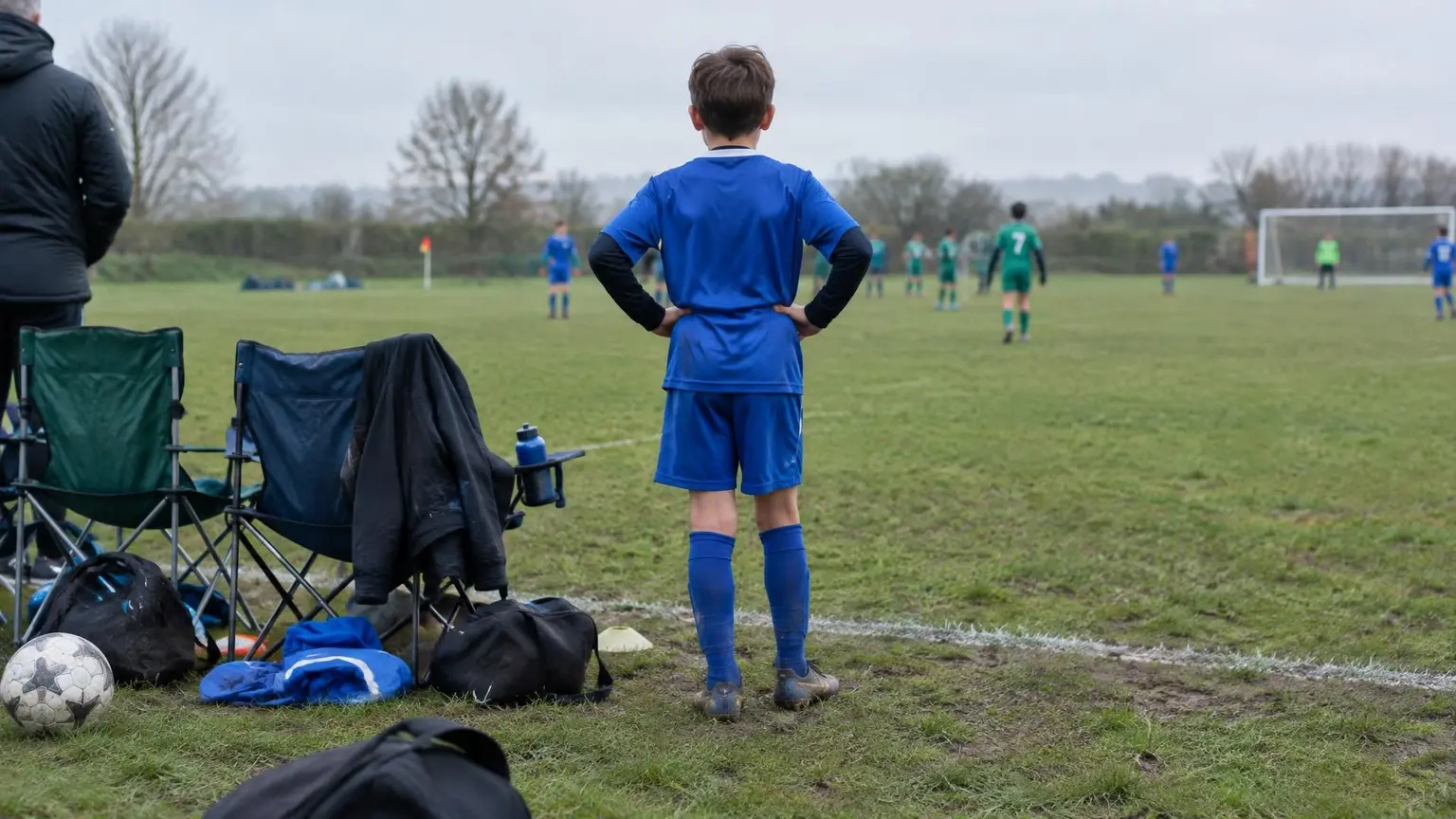
Why Does My Child Play Better in Practice Than in Games?
 Reviewed by Roman PivarnikUEFA Pro Licence · Technical Director, Slovak FA
If your child plays better in practice than in games, the problem is usually not skill — it is that the skill has rarely been asked for under the conditions a game creates. Training is forgiving: no scoreboard, no watching parents, no opponent who refuses to cooperate. A game adds all three at once. A 2025 clinical practice review in Translational Pediatrics puts it in clinical language — performance anxiety "may cause an athlete to perform well below their demonstrated capabilities outside the competitive context."
Which means the Saturday version of your child is not the real one — and neither is the Tuesday version. The useful question is which of two very different things is happening, because they need opposite responses.
Why does my child play better in practice than in games?
Cause one: the skill is there, and pressure interferes with it. The child who executes a turn cleanly in a drill, then plays the safe backward pass all game. Nothing has been lost — it has been locked.
Cause two: the skill was never trained in anything resembling a game. The child who can beat five cones and cannot beat one defender, because cones do not move, close down, or arrive early.
Both produce the same complaint from the sideline, and watching one game closely usually tells you which you have. A pressure problem looks like hesitation and rushed, safe choices on skills your child clearly owns. A context problem looks like decent technique applied at the wrong moment — or the moment never recognised at all.
What does pressure actually do to a skill?
The research answer is counter-intuitive: pressure makes a player think about something they had stopped needing to think about.
In experiments published in the Journal of Experimental Psychology: General, Beilock and Carr found that expert golfers had impoverished memories of individual putts — evidence that a well-learned skill is stored in a form that "supports performance without the need for step-by-step attentional control." Under pressure, performance collapsed in putting but not in a mental-arithmetic task that had never become automatic. Training under distraction did not fix it; training that made players deliberately self-conscious did. Choking in putting "was unchanged by dual-task training but eliminated by self-consciousness training."
Those were adult golfers, and a putt is not a 1v1 on a wet Saturday. But the mechanism travels: a child who had stopped thinking about how to receive the ball starts thinking about it again the moment they hear their own name from the touchline — and the thinking is what makes it worse.
When are nerves normal, and when are they performance anxiety?
Nerves before a game are ordinary, and mostly useful. The Translational Pediatrics review draws the line at distress and function rather than intensity: performance anxiety "differs from normative pre-competition nerves or jitters in the level of distress and/or impairment it can cause."
It also notes that anxiety shows up in three ways — parents tend to watch for only one:
| How it shows up | What you might see |
|---|---|
| Somatic | racing heart, fast breathing, sweating, trembling, nausea |
| Cognitive | worry, dread, confusion, inattention, forgetfulness |
| Behavioural | pacing, fidgeting, going quiet and withdrawn, avoiding |
Two further points are worth holding onto. Children in individual sports are more likely to experience performance anxiety than children in team sports — a quiet argument for team soccer. And the diagnosis parents sometimes reach for, social anxiety disorder of the performance-only subtype, requires symptoms present for at least six months; one rough month mid-season is not that.
For scale, the review cites National Survey of Children's Health data showing 8.6% of US children aged 6–11, and 13.7% of those aged 12–17, have had anxiety problems in their lifetime — while noting that prevalence data for sport-specific anxiety in young athletes "is generally lacking."
Why does training not prepare them for the game?
Here it helps to borrow a framework from elite coaching. Interviewing 11 elite coaches across ten sports, Stoker and colleagues found that pressure is built from two separable ingredients: the demands of a session (the task, the player's physical state, the environment) and its consequences (forfeits, rewards, being judged). A game is loaded with both. A typical youth session has demands and almost no consequences — nothing is at stake, nobody is watching, and the next repetition always comes.
That study also contains a detail which explains a lot about youth soccer. With development-level athletes, the coaches "put more emphasis on creating challenging demands of training, and purposefully neglected consequences." The instinct is right — a nine-year-old does not need forfeits — but it means the only time many young players feel any consequence is 9am on a Saturday, cold, in front of their parents.
Making training resemble a game is the cheapest fix available, and it is structural rather than psychological: teams, a score, a time limit, something to win. Small-sided games do this almost automatically, which is why good coaches lean on them instead of queues behind cones.
Can a child be trained to handle pressure?
Up to a point, and the evidence is real but narrow. Oudejans and Pijpers ran the cleanest test. Seventeen expert basketball players practised free throws over a five-week period, some with anxiety deliberately induced and some without. In the anxious post-test, "only after training with anxiety did performance no longer deteriorate." They repeated the design with seventeen expert dart players throwing from high up a climbing wall, and got the same result.
Adults again, and closed skills again — but the underlying principle holds up across this literature: many small doses of mild pressure spread through training beat one large dose on match day.
For a young player, mild genuinely means mild:
- Make somebody watch. Stopping three teammates to watch one 1v1 changes a repetition completely, and costs nothing.
- Keep score — in rondos, in finishing, in 1v1s. A number on the session makes it matter slightly.
- Add a trivial but real consequence. The losing pair collects the bibs. Not laps.
- Rehearse what they avoid in games. If they never turn into traffic in a match, that is the repetition to put under pressure, not the one they already enjoy.
Two cautions: Stoker's coaches warned that pressure training "had the potential to initially lower confidence," so dosage matters more than enthusiasm, and this is a coach's job far more than a parent's. If your child's sessions are entirely unopposed technical work, that is worth raising with the coach as a question rather than a complaint.
What can parents do before the next game?
Give them a routine, and keep it loose. A study of 100 teenage footballers at sports-profiled secondary schools found pre-match rituals near-universal — and that more ritual went with more somatic and cognitive anxiety, concentration disruption and compulsive behaviour. The author's conclusion: rituals "lead to a reduction of anxiety level but they cannot be inflexible in nature." A dependable warm-up and the same few touches before kick-off help. A superstition that collapses when the lucky socks are in the wash does not.
Trade outcome goals for process goals. The Translational Pediatrics review separates outcome goals (the result), performance goals (your own standard) and process goals (how a skill is executed). "Win" and "score" are outcome goals, and a child controls neither. "First touch forward" and "talk before the pass" are process goals, and they survive a 4–0 defeat intact.
Say less during the game, and after it. Every instruction shouted at a player pulls their attention back onto execution — the exact thing the choking research says degrades a skill they already own. And what you say after a soccer game matters more than anything you say during it.
Do not let them opt out. The review is direct about avoidance: skipping the match relieves the feeling now and "perpetuates feelings of anxiety" later, because the child never finds out they could cope. Ten minutes on the field beats a Saturday in the car.
Keep the reason for playing visible. When Amanda Visek's team at George Washington University mapped what makes sport fun for soccer players aged 8 to 19, they found 81 separate fun-determinants — and 'winning' ranked No. 40, well below trying hard, being a good sport and positive coaching. A child taught that Saturday is about the result has more to lose stepping onto the field than one who hasn't.
Longer term, the only durable protection is having more skill than the moment demands, so pressure has slack to eat into. That is what confidence in young soccer players is made of — repetitions they own, not reassurance. Daily contact with the ball between team sessions is the unglamorous version, and the gap FlickTec's guided sessions, built on Coach Roman Pivarnik's (UEFA Pro Licence) methodology, are designed to fill.
When should you ask for help?
Talk to your paediatrician if the distress is persistent rather than Saturday-shaped: losing sleep over games, stomach aches before every match, asking to stop playing something they used to love. The Translational Pediatrics review notes that cognitive behavioural therapy dominates the literature as a first-line treatment for children and adolescents, with mindfulness-based approaches showing early promise — and that the benefits of sport are lost entirely if anxiety drives a child out of it.
Frequently Asked Questions
Why does my child play well at practice but badly in games?
Usually one of two reasons: the skill is solid and pressure is interfering with it, or the skill was only ever trained without opposition and has never had to be chosen under time pressure. Watching one game closely tells you which — hesitation on skills they clearly own points to pressure, while good technique used at the wrong moment points to missing game context.
Is it normal for kids to get nervous before soccer games?
Yes — and the nerves are often helpful. A 2025 clinical review in Translational Pediatrics draws the line at distress and impairment rather than intensity: performance anxiety differs from normal jitters in how much distress it causes and how much it interferes with functioning. Nerves that fade after kick-off are ordinary; dread that disrupts sleep and willingness to play is worth raising with your paediatrician.
How can I help my child with pre-game nerves?
Give them a dependable but flexible pre-game routine, swap outcome goals ("win," "score") for process goals they control ("first touch forward"), say very little during the game, and don't let them skip matches — avoidance relieves anxiety briefly and reinforces it over time. Ask their coach whether sessions include small-sided games with a score, which is where pressure gets practised.
Should parents shout instructions from the sideline?
It is unlikely to help. Research on choking under pressure shows that directing a skilled performer's attention back onto how they execute a movement degrades skills that have become automatic — and a shouted instruction does exactly that. Encouragement and silence beat live coaching from the touchline.
The Tuesday version of your child is real. The job is not to make them braver on Saturday; it is to make Saturday less unfamiliar.