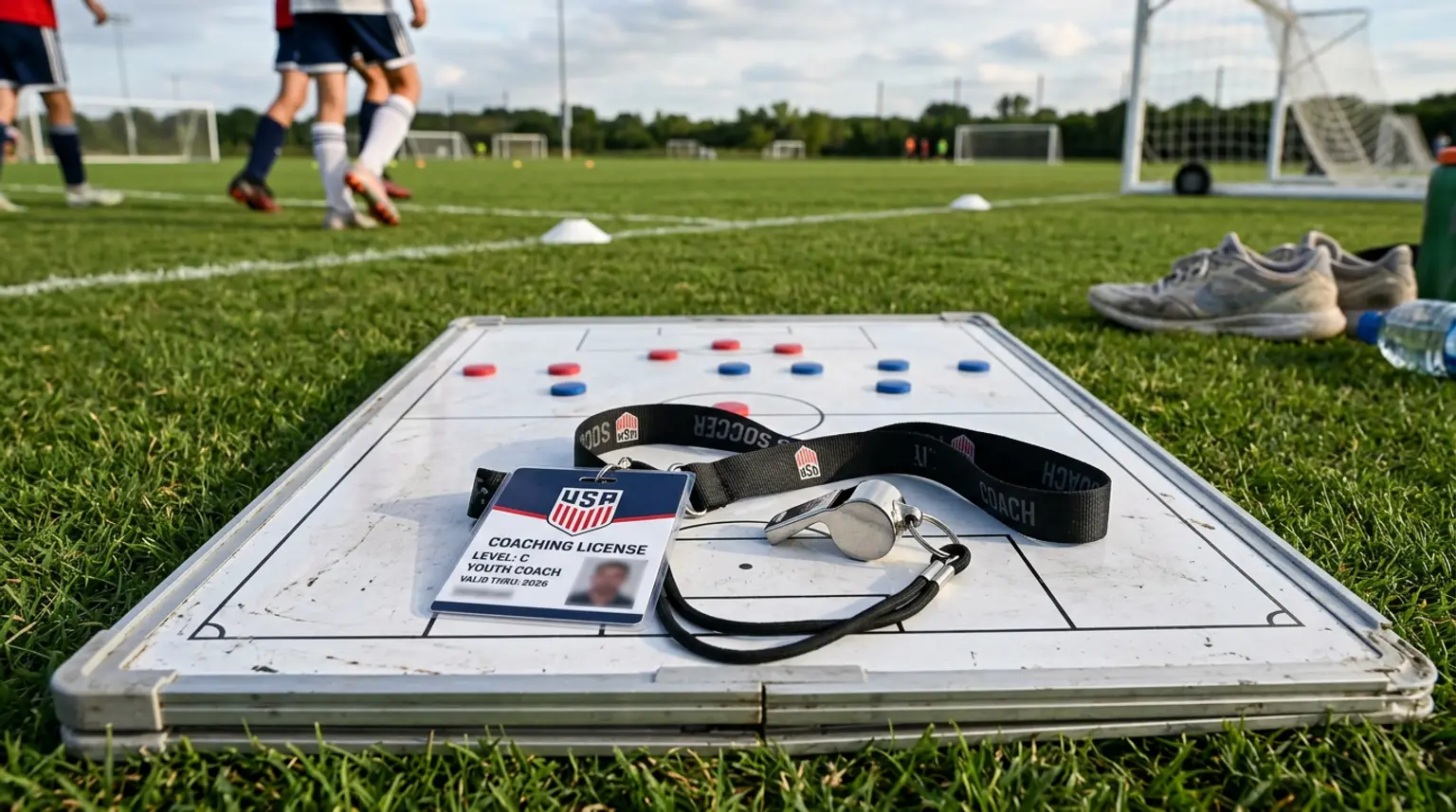
What US Soccer Coaching Licenses Do You Need?
 Reviewed by Roman PivarnikUEFA Pro Licence · Technical Director, Slovak FA
The US Soccer licensing system is designed to ensure that coaches meet minimum standards of competence and safety. But the system is complex, with multiple credential types, state-by-state variation, and outdated rules. Understanding which licenses you need—and which you don't—is the first step to coaching legally and effectively.
The official US Soccer license structure
US Soccer offers four main coaching license levels:
1. National Youth License (NYL)
Formerly called: D License. Duration: 2–3 days of in-person training. Cost: $150–$300. Required for: Coaching recreational youth soccer in many (but not all) states. What you learn: Age-appropriate coaching principles, basic skill development, injury prevention, growth and development, and concussion awareness. Your authority: You can coach youth teams at the recreational level.
2. National "C" License
Duration: 4–5 days of in-person training (usually spread over weekends). Cost: $300–$600. Prerequisite: National Youth License or equivalent experience. Required for: Coaching at higher levels of youth club soccer in many states, and semi-professional teams. What you learn: Technical and tactical development, periodization, advanced session design, assessment and evaluation, sports science fundamentals. Your authority: Coach competitive club teams and tournament play.
3. National "B" License
Duration: 10–14 days of in-person training (often 2 weeks). Cost: $800–$1,500. Prerequisite: National C License and documented coaching experience. Required for: Coaching elite youth club teams and semi-professional play in some states. What you learn: Advanced tactical systems, player assessment, professional-level session design, strength and conditioning integration, managing high-performance environments. Your authority: Coach elite competitive teams. Often required for higher-level club coaching jobs.
4. National "A" License
Duration: 20+ days of in-person training (usually spread over months). Cost: $2,000–$3,000+. Prerequisite: National B License and significant documented experience. Required for: Professional and elite club coaching in rare cases. What you learn: Advanced systems, athlete preparation at the professional level, coaching education and mentorship, research and innovation. Your authority: Coaching at the highest levels of US youth and professional soccer.
Do you actually need a US Soccer license?
The short answer: It depends on your state and the level of play.
When you MUST have a license
- Many state youth soccer associations require the National Youth License or equivalent to coach recreational teams. This is especially true for U6 through U12 programs.
- High-level competitive clubs often require National C or B licenses for their coaching staff.
- High schools have their own certification requirements (usually a state-level credential, often called a "Certified Coaching Course").
- Elite development programs typically require at least a National C license.
- Professional teams require a National A or B license at minimum.
When you may NOT need a license
- Informal, non-competitive play (backyard training, casual pickup games) usually does not require a formal license.
- One-off clinics or camps may not require licensure, depending on your state.
- Private coaching (one-on-one or small group instruction outside a club structure) sometimes operates in a gray area. Check your state.
- Some recreational leagues do not strictly enforce licensing requirements, though it is becoming rarer.
The safest assumption: If you are coaching youth soccer in an organized setting (even casually), check with your state youth soccer association and your club before assuming you do not need a license.
Are US Soccer licenses required for high school coaching?
No. High school soccer is governed by state high school athletic associations (like the California Interscholastic Federation or Texas University Interscholastic League), not US Soccer. Each state has its own coaching certification requirements. Many states require a state-level coaching course (often a basic CPR/First Aid course plus a general coaching education course), but not a US Soccer license specifically.
Check your state's high school association website for requirements.
What about licenses from other organizations?
NSCAA (National Soccer Coaches Association of America): Offers its own coaching licenses (A, B, C, D levels) that are recognized nationally and internationally. These are legitimate alternatives to US Soccer licenses, though less common in youth soccer.
USSF coaching education (Unified Soccer Federation): This is the official body, so US Soccer licenses are the standard.
FIFA coaching licenses: These exist internationally but are not standard in the US youth system.
For youth soccer in the US, a US Soccer license or equivalent is the most recognized credential.
Can you coach without a license?
Legally, in most states, yes—if the setting is not organized or competitive. However:
- Clubs will not hire you without a license, especially for competitive teams.
- Liability insurance may not cover you if you are coaching without a license.
- You may be violating state regulations without knowing it. Check first.
- Parents expect licensed coaches. It signals professional competence and safety.
Even if you are not legally required to be licensed, getting licensed makes you a better coach and protects you professionally.
How long does it take to get a US Soccer license?
National Youth License: 2–3 days (can be done in one weekend). National C: 4–5 days (can be done over 2–3 weekends or a week-long course). National B: 10–14 days (usually 2 full weeks). National A: 20+ days (often stretched over 3–6 months).
Most coaches start with the Youth License and advance to the C License if they move into competitive coaching.
How often do you need to renew?
US Soccer licenses typically last 4 years. To renew, you must complete continuing education credits (usually 20–40 hours over the 4-year period). Options include online courses, clinic attendance, and coaching experience documentation.
What does each license actually teach you?
National Youth License: Age-appropriate development, basic skill progression, fun and engagement, safety, growth and development principles. National C: Technical and tactical systems, session planning, player assessment, strength and conditioning basics, periodization. National B: Advanced tactical systems, high-performance environments, athlete development, coaching education, research-based practice. National A: Professional-level coaching, athlete preparation at the elite level, innovation and leadership.
The progression is designed so that youth recreational coaches do not need advanced tactical knowledge, but competitive club coaches do.
Which license should you get?
If you are coaching U8 or younger recreational soccer: National Youth License. If you are coaching U10+ competitive club soccer: National C License minimum. If you want to move into elite club or professional coaching: National B License. If you are pursuing a professional coaching career: National A License and relevant club experience.
The bottom line
US Soccer licenses exist to maintain coaching standards and player safety. At the youth level, the National Youth License covers recreational coaching, and the National C License is standard for competitive club coaching. Check your state's requirements before assuming you don't need a license. And if you are serious about coaching, get licensed—it improves your competence, signals professionalism to families, and protects you legally.