Turf vs Grass in Soccer: Is Artificial Turf Worse for Young Players?
 Reviewed by Roman PivarnikUEFA Pro Licence · Technical Director, Slovak FA
If your child's club has moved games onto artificial turf, the honest answer to "is it more dangerous?" is: probably slightly, for one specific part of the body — and the number you have seen quoted is the least reliable one in the literature. The most rigorous review finds most modern turf fields carry similar overall injury rates to grass, with foot and ankle injuries as the consistent exception. The bigger and more fixable risk is what your child is wearing on the turf, not the turf itself.
Turf vs grass is not a fair fight on availability: turf drains, survives four games a day, and does not turn into a mud bath in October. Here is what the research supports, what it doesn't, and the one decision worth making differently.
Turf vs grass: does artificial turf cause more injuries?
You will see "58% more likely" quoted a lot. It comes from a real study: a retrospective cohort of 26 high schools published in Current Orthopaedic Practice that identified 953 injuries, 61% on turf and 39% on grass. Athletes were "58% more likely to sustain injuries on artificial turf than natural grass" (relative risk 1.59), with girls' soccer at RR 1.71 and boys' soccer at RR 1.83, both statistically significant.
Hold that number loosely. The authors grade their own work Level IV evidence — the weakest design in this discussion.
Now the counterweight. A 2023 systematic review in The American Journal of Sports Medicine by Gould and colleagues pulled together 53 articles published between 1972 and 2020. Its finding on modern fields is the one to remember: "Most studies on new-generation turf (13/18 articles) found similar overall injury rates between playing surfaces."
Not higher. Similar.
What differed was location. The review found "the greatest proportion of articles reported a higher foot and ankle injury rate on artificial turf compared with natural grass," on both old-generation (3 of 4 articles) and new-generation (9 of 19) turf. Knee and hip rates were similar for soccer players on new-generation turf.
| Injury type | What the systematic review found on modern turf |
|---|---|
| Overall injury rate | Similar to natural grass in most studies (13 of 18 articles) |
| Foot and ankle | Higher on turf in the greatest proportion of studies |
| Knee | Similar for soccer; higher for high-level American football |
| Hip | Similar between surfaces |
One line from that review deserves reading twice: "Only a few articles in the literature reported a higher overall injury rate on natural grass compared with artificial turf, and all of these studies received financial support from the artificial turf industry." When you read a turf-is-safer claim, check who paid.
So foot and ankle is the real signal — and if your child has rolled an ankle before, the surface matters less than the rehab described in our guide to ankle sprains in youth soccer.
What about ACL tears specifically?
This is the fear that drives the question, so it is worth being precise.
Researchers at Nationwide Children's Hospital compared ACL injuries on the two surfaces across twelve years of US high school surveillance data — 1,039 reported ACL injuries, an estimated 389,320 nationally. Among all injuries, ACL tears were more likely on turf in girls' soccer (injury proportion ratio 1.53, 95% CI 1.08–2.16) but not significantly so in boys' soccer (IPR 1.65, 95% CI 0.99–2.75). Among lower-extremity injuries only, both were significant: 1.72 for boys' soccer and 1.61 for girls'.
Two caveats matter. The authors could not calculate injury rates at all: "Data for athletes' exposures by type of playing surface were unavailable." If teams simply spend more hours on turf, more injuries land there. And their own conclusion is deliberately hedged: "ACL injuries were more likely to occur… on artificial turf than natural grass; however, this relationship was not statistically significant for all sports."
What did not change with the surface: in soccer, a noncontact mechanism predominated on both turf (61.5%) and grass (66.4%). These are still the plant-and-turn injuries that ACL injury prevention programmes are built to reduce, and those work on either surface.
Does what's on their feet matter more than what's under them?
Here is the part almost no sideline conversation covers, and the most actionable finding in this area.
A 2025 case-control study in Orthopaedic Journal of Sports Medicine compared 128 female soccer and lacrosse players who had torn an ACL with 128 age- and sport-matched players who never had. Among those who tore an ACL, 75% were wearing cleats. In the matched group, 55.5% were.
The stud shape mattered more than the shoe category:
- Conical studs vs turf shoes: odds of an ACL tear 2.87 times higher (95% CI 1.58–5.23)
- Conical studs vs bladed studs: 2.02 times higher (95% CI 0.97–4.20) — note that this interval crosses 1, so it is not statistically significant
The authors' conclusion: "Wearing turf shoes as opposed to cleats appears to be associated with a reduced risk of ACL tears in high-level female athletes."
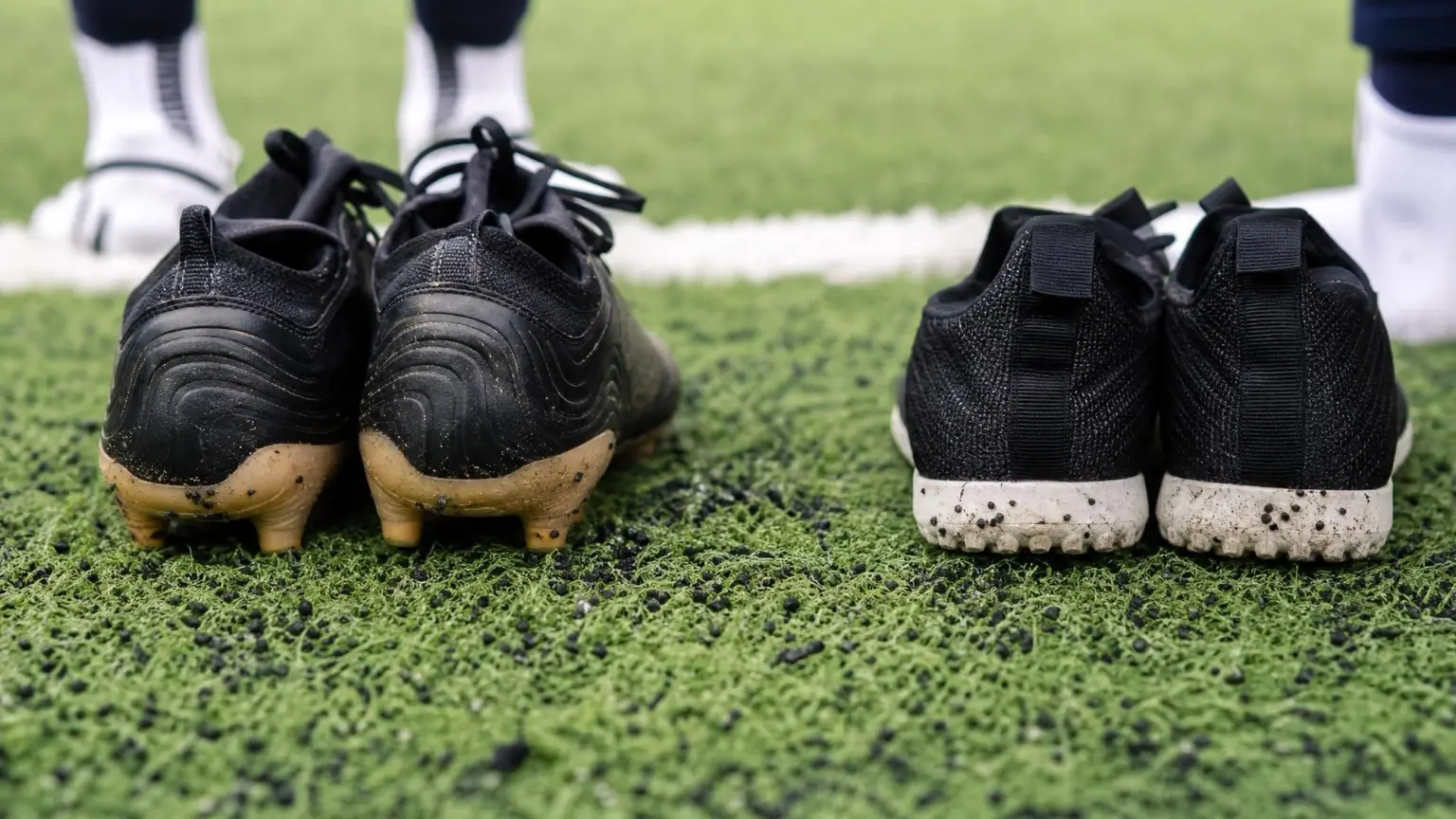
That lines up with older biomechanics work. A systematic review of 23 studies on cleat–surface interaction concluded "the soft ground model provides lower performance especially on artificial grass, while the turf model provides a high protective effect in both fields." Soft-ground boots — the long-studded ones built for wet natural grass — are the wrong tool on turf, and the likeliest to grab when a foot should rotate.
Read the limits honestly: retrospective, high-level female athletes in two sports, recalled footwear, and no isolation of the playing surface. It is not proof that turf shoes prevent ACL tears in a nine-year-old. But the instruction it points to costs nothing: the boots should match the surface the child is actually on, and long soft-ground studs do not belong on artificial turf. Our guide to how soccer cleats should fit covers the sizing side of the same decision.
Is turf actually hotter — and does it matter?
Yes to the first, more complicated on the second.
A 2024 systematic review in the International Journal of Biometeorology pooled 23 studies on the thermal environment around synthetic surfaces. The only two parameters consistently higher on synthetic grass were air temperature (0.5–1.2 °C, roughly 1–2 °F) and surface temperature (9.4–33.7 °C, roughly 17–61 °F). Mean radiant temperature, humidity, wind velocity and wet-bulb-globe temperature "remained similar or required more data."
That last item is the interesting one: WBGT is the index most heat policies are written around, and it was not reliably higher on turf. The review's verdict: "it is uncertain whether the differences are enough to increase an individual's heat stress risk and cause concern for athlete safety."
A companion randomised crossover trial from the same group put 13 trained athletes through 50 minutes of intermittent running on each surface in roughly 32.6 °C (91 °F) air. Calf skin temperature was far higher on synthetic grass — 40.1 °C versus 33.4 °C (104 °F vs 92 °F) — and sweat rate rose from 1.2 to 1.5 L/h. But core body temperature, heart rate, thermal comfort and perceived exertion were unaffected. The surface made their legs hot and made them sweat more; it did not cook them from the inside.
The extra sweat is worth planning for — the practical link to our youth soccer heat safety and hydration guide. But that trial used trained adults, not children, who have a different surface-area-to-mass ratio and less say in whether they stop.
The build matters too: the review found surfaces with styrene butadiene rubber infill or a shock pad ran hotter, while thermoplastic elastomer infill and cool-climate fibres ran cooler. Not every turf field is the same field.
So should I worry if my child's club plays on turf?
Not much, and not about the things the internet worries about:
- Overall injury risk on modern turf is broadly comparable to grass. The scariest number in circulation comes from the weakest study design in the literature.
- Foot and ankle is the exception — the one location where the evidence leans consistently against turf.
- Footwear is the lever you control. No soft-ground boots on turf. Turf shoes are a legitimate option, not a downgrade.
- Heat is a sweat-and-shade problem, not a cancel-the-game problem, on all but genuinely hot days.
- Availability counts on the other side of the ledger. Turf is why a rainy week still holds three sessions rather than one, and consistent volume is itself protective. A structured home routine — from a club programme or an app like FlickTec — fills the gap when neither field is usable.
The plant-and-turn injuries that scare parents most are largely noncontact on both surfaces, and noncontact injuries respond to training. The neuromuscular work is worth more than any surface decision you will make.
Frequently Asked Questions
Is artificial turf worse than grass for youth soccer players?
Mostly not, with one exception. The largest systematic review — 53 articles spanning 1972 to 2020 — found most studies on new-generation turf (13 of 18) reported similar overall injury rates on the two surfaces. Foot and ankle injuries were the consistent exception. The widely quoted claim that athletes are 58% more likely to be injured on turf comes from a single Level IV retrospective cohort of 26 high schools.
Do more ACL injuries happen on turf?
The evidence leans that way but is not conclusive. Across twelve years of US high school data covering 1,039 ACL injuries, tears were significantly more likely on turf in girls' soccer (injury proportion ratio 1.53) but not in boys' soccer (1.65, CI 0.99–2.75). The researchers could not calculate true injury rates, because exposure data by surface was unavailable.
Should my child wear turf shoes or cleats on artificial turf?
Match the shoe to the surface, and avoid soft-ground boots on turf. A 2025 case-control study of 256 female soccer and lacrosse players found the odds of an ACL tear were 2.87 times higher in cleats with conical studs than in turf shoes, and a biomechanics review of 23 studies concluded the soft-ground model performs worst on artificial grass. That isn't strong enough to mandate turf shoes for every child, but long soft-ground studs on turf are the combination to avoid.
Is artificial turf too hot for kids to play on?
The surface gets much hotter; the heat-stress indices mostly don't. A 2024 systematic review of 23 studies found synthetic surfaces ran 9.4–33.7 °C (about 17–61 °F) hotter at the surface, but wet-bulb-globe temperature — the measure most heat policies use — was not reliably higher. In a trial on adults, calf skin temperature reached 40.1 °C on turf versus 33.4 °C on grass, while core temperature and heart rate were unchanged. Plan for extra fluid and shade rather than assuming the game is unsafe.
The short version: turf is not the villain, soft-ground boots on turf are closer to it, and the ankle is the joint worth watching. Get the footwear right, keep the balance and landing work going, bring more water than the grass field needed, and let the rest go. The field your child plays on matters far less than what they do on it twice a week.