Soccer Exercises You Can Do at Home Without Equipment
 Reviewed by Roman PivarnikUEFA Pro Licence · Technical Director, Slovak FA
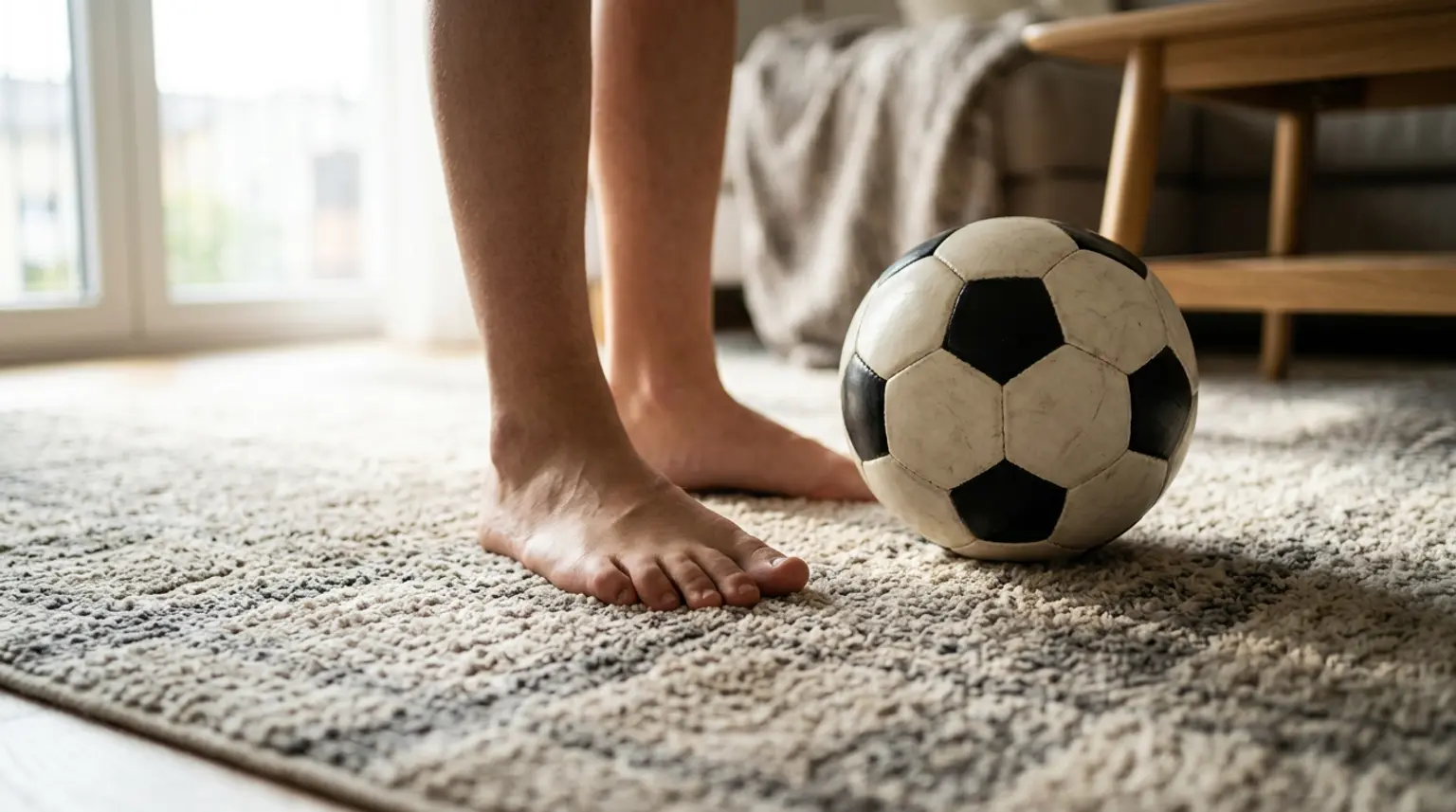
Most soccer exercises can be done at home with nothing more than a ball and a small space, and many effective conditioning and coordination exercises require no equipment at all. You do not need cones, ladders, goals, or a field to get a meaningful soccer training session done. A living room, garage, driveway, or small backyard is enough space, and a soccer ball is the only tool most drills require. Players who train consistently at home with minimal setup improve faster than those who wait for the "perfect" training environment.
The biggest barrier to home training is not equipment. It is the belief that real training requires a full field and a bag of gear. Professional players in academy systems around Europe do significant portions of their technical work in small spaces with nothing but a ball. The exercises that build ball mastery, coordination, strength, and agility are fundamentally simple. What matters is doing them consistently.
What soccer exercises need zero equipment?
These exercises require nothing at all. No ball, no cones, no space beyond what you can find in any room.
Bodyweight strength exercises
Squats. The foundation of lower-body strength for soccer. Feet shoulder-width apart, sit back like sitting in a chair, keep chest up, return to standing. 3 sets of 10 to 15 repetitions. Builds the leg strength that powers sprints, jumps, and changes of direction.
Lunges. Step forward into a lunge, both knees at 90 degrees, push back to standing. Alternate legs. 3 sets of 10 per leg. Develops single-leg stability, which is critical for soccer because you spend most of the game on one foot (running, kicking, turning).
Plank holds. Hold a straight-body plank position on forearms and toes. 3 holds of 20 to 45 seconds (scaled by age). Core strength is the foundation of balance, turning, shielding the ball, and resisting challenges.
Mountain climbers. From a push-up position, drive alternating knees toward the chest at speed. 3 sets of 20 seconds. This is a conditioning exercise disguised as core work, building both stamina and abdominal strength.
Single-leg balance. Stand on one foot for 30 to 60 seconds, then switch. Close your eyes for an added challenge. This develops proprioception (body awareness in space) that directly improves agility and balance on the pitch.
Agility and speed exercises
High knees. Drive knees up to hip height as fast as possible while staying in place. 3 sets of 20 seconds. Builds the hip flexor strength and leg speed that powers sprinting.
Lateral shuffles. Shuffle sideways across a room or driveway, staying low with knees bent. Touch the ground at each end and shuffle back. 3 sets of 30 seconds. This mirrors the defensive movement patterns used in jockeying and closing down.
Burpees. From standing, drop to a push-up, push back up, jump. Repeat. 3 sets of 8 to 12. One of the most time-efficient full-body conditioning exercises. Brutal but effective for building the repeated-effort fitness soccer demands.
Tuck jumps. Jump vertically and bring knees to chest at the top. Land softly. 3 sets of 8. Develops explosive power for aerial duels, sprints off the mark, and plyometric ability.
Carioca steps. Sidestep while alternating crossing one foot in front of and behind the other. Do this across a room or hallway. 3 sets of 30 seconds each direction. Builds hip mobility and the crossover footwork used in defending and changing direction.
What exercises only need a soccer ball?
Add a ball and the training options expand dramatically. These still require minimal space.
Ball mastery (small space, indoors or outdoors)
Toe taps. Alternate tapping the top of the ball with the sole of each foot as fast as possible. 30 seconds on, 10 seconds rest, 4 rounds. The most fundamental ball mastery drill.
Sole rolls. Roll the ball forward, backward, and side to side under one foot. Switch feet. 30 seconds per foot, 3 rounds. Builds the feel for the ball that makes close control instinctive.
Inside-inside passing. Stand still and pass the ball back and forth between the inside of each foot. Keep the ball moving quickly in a tight space. 30 seconds, 4 rounds. Develops quick feet and first-touch precision.
Pull-back turns. Dribble the ball forward 2 to 3 steps, stop it with the sole, pull it back, and turn. Repeat in the opposite direction. 10 per foot, 3 sets. This builds the stop-and-go movement that beats defenders in games.
V-drags. Push the ball forward with the inside of one foot, then drag it back with the sole and push it diagonally with the outside. Repeat. 10 per foot, 3 sets. A core technical move that builds coordination across multiple foot surfaces.
Ball-integrated conditioning
Ball slams. Hold the ball overhead, squat down and touch the ball to the ground, stand up and press it overhead again. 3 sets of 12. Combines core and leg work with ball contact.
Ball squats. Hold the ball in front of your chest while performing squats. The added weight (even a light soccer ball) increases the challenge slightly and keeps the player connected to the ball during strength work.
Seated ball rotations. Sit on the ground with knees bent and feet slightly off the floor. Hold the ball and rotate it from side to side, touching the ground on each side. 3 sets of 20. Builds rotational core strength, which powers turning, shooting, and shielding.
How do you structure a no-equipment session?
A complete home session with minimal or no equipment follows the same structure as any well-designed training:
Warm-up (3 to 5 minutes). High knees, lateral shuffles, arm circles, light jogging in place. If you have a ball, add toe taps and sole rolls at a relaxed pace.
Strength and conditioning block (8 to 10 minutes). Pick 4 to 5 exercises from the bodyweight list above. Perform each for 30 to 45 seconds with 15 seconds rest between. Repeat the circuit twice.
Ball mastery block (5 to 8 minutes). Pick 3 to 4 ball exercises. Perform each for 30 to 60 seconds. Focus on quality touches and using both feet.
Cool-down (3 minutes). Static stretching: hamstrings, quads, hip flexors, calves, and groin. Hold each stretch for 20 to 30 seconds.
Total time: 20 to 25 minutes. This is a complete training session that develops strength, conditioning, technical skill, and flexibility with zero equipment beyond a soccer ball.
How does this compare to training with full equipment?
You are not missing much. The exercises that build the physical foundation for soccer (strength, agility, coordination, endurance) are mostly bodyweight movements. The exercises that build technical skill (ball mastery, close control, footwork) require only a ball.
What full equipment adds is variety (cones create dribbling courses, ladders add footwork patterns, goals enable shooting practice) and sport-specific simulation (small-sided games, crossing and finishing exercises). These are valuable, but they are not essential for daily home training.
A player who does 20 minutes of bodyweight conditioning and ball mastery at home 4 times a week will outperform a player who only trains when they have access to a full field and equipment. Consistency with minimal setup beats occasional sessions with perfect setup every time.
FlickTec's 500+ exercises, designed by Coach Roman Pivarnik (UEFA Pro Licence, former UEFA Champions League coach), include a large number of drills that require only a ball and a small space. The app generates sessions tailored to the player's age, position, and training load, prioritizing exercises that can be done at home with minimal equipment.
What about recovery exercises with no equipment?
Recovery is part of training, and it requires zero equipment.
Static stretching. 5 to 10 minutes of stretching major muscle groups after training helps with flexibility and injury prevention. Hamstrings, quads, hip flexors, calves, and groin are the priority areas for soccer players.
Foam rolling. If you have a foam roller, it is excellent for recovery. If not, a tennis ball or even a water bottle can substitute for targeted pressure on sore muscles.
Breathing and relaxation. 2 to 3 minutes of slow, deep breathing after training helps the nervous system transition from training mode to recovery mode. This is an underappreciated habit, especially for competitive youth players who carry stress from games and performance pressure.
Frequently Asked Questions
Can my child get a real workout without any equipment?
Yes. Bodyweight exercises like squats, lunges, planks, burpees, and high knees develop the strength, power, and endurance soccer players need. Combined with ball mastery drills that only require a soccer ball, a home session can be as effective as a gym workout for youth players.
What size soccer ball should my child use for home training?
Size 3 for players under 8. Size 4 for players aged 8 to 12. Size 5 for players 13 and up. Using the correct size ball matters for developing proper technique and touch.
How much space do I need for home soccer training?
Most ball mastery and bodyweight exercises can be done in a space as small as 6 feet by 6 feet. A living room, garage, driveway, or small backyard is usually sufficient. You do not need a full field for effective individual training.
Is home training without equipment as good as training with a coach?
It serves a different purpose. Home training builds the individual physical foundation and technical ball skill that complement what coaches teach in team sessions. It cannot replace the tactical instruction, real-time feedback, and team dynamics of coached sessions. Think of it as the daily practice that makes team training more productive.
How do I know which exercises are right for my child's age?
Age-appropriate intensity matters. Younger players (under 10) should focus on coordination, ball mastery, and short movement activities. Older players (12+) can add more conditioning intensity and position-specific work. Training apps like FlickTec automatically adjust exercise complexity and physical intensity based on the player's age.
The barrier to getting better at soccer is not equipment, space, or access to a coach. It is consistency. Twenty minutes a day with a ball and a small patch of floor builds the skills and fitness that separate developing players from stagnating ones. Stop waiting for the perfect setup. Start with what you have.
FlickTec delivers daily training sessions designed for minimal equipment and small spaces. Start training at flicktec.io/players.