Soccer Dribbling Drills for Kids: Build Ball Comfort at Every Age
 Reviewed by Roman PivarnikUEFA Pro Licence · Technical Director, Slovak FA
The best soccer dribbling drills for kids are simple, fun activities that build ball comfort and close control through repetition in small spaces. Dribbling is the skill that gives young players the confidence to take on the game. A child who feels comfortable running with the ball at their feet plays with more courage, more creativity, and more joy. That comfort is built at home through short, daily practice, not through complex technical instruction.
For kids under 12, dribbling development should prioritize comfort over technique. A child who happily dribbles a ball around the backyard for 15 minutes every day is building the neural pathways that make dribbling automatic. The specific technical details (which surface of the foot to use, how to feint, when to accelerate) develop naturally through repetition and guided exercises.
What dribbling skills should kids develop first?
Running with the ball. Before any moves or tricks, a child needs to be comfortable simply running with the ball at their feet. Push the ball forward gently with the inside of the foot, jog to it, push again. Then progress to using the outside of the foot, the laces, and the sole. The goal is moving confidently with the ball without losing it.
Close control at walking speed. Dribble in a small space (6 by 6 feet) using only small touches. The ball should never go more than 1 to 2 feet from the foot. This trains the tight control needed to dribble in traffic during games.
Change of direction. Simple turns: stop the ball with the sole and go the other direction. Cut the ball with the inside of the foot. Hook the ball with the outside of the foot. These are the building blocks of beating defenders.
Both-foot comfort. From the very first session, every dribbling exercise should involve both feet. A 7 year old who practices with both feet develops natural two-footedness. A 12 year old trying to learn their weak foot is fighting years of one-sided habit.
What are the best dribbling drills for kids at home?
Cone slalom
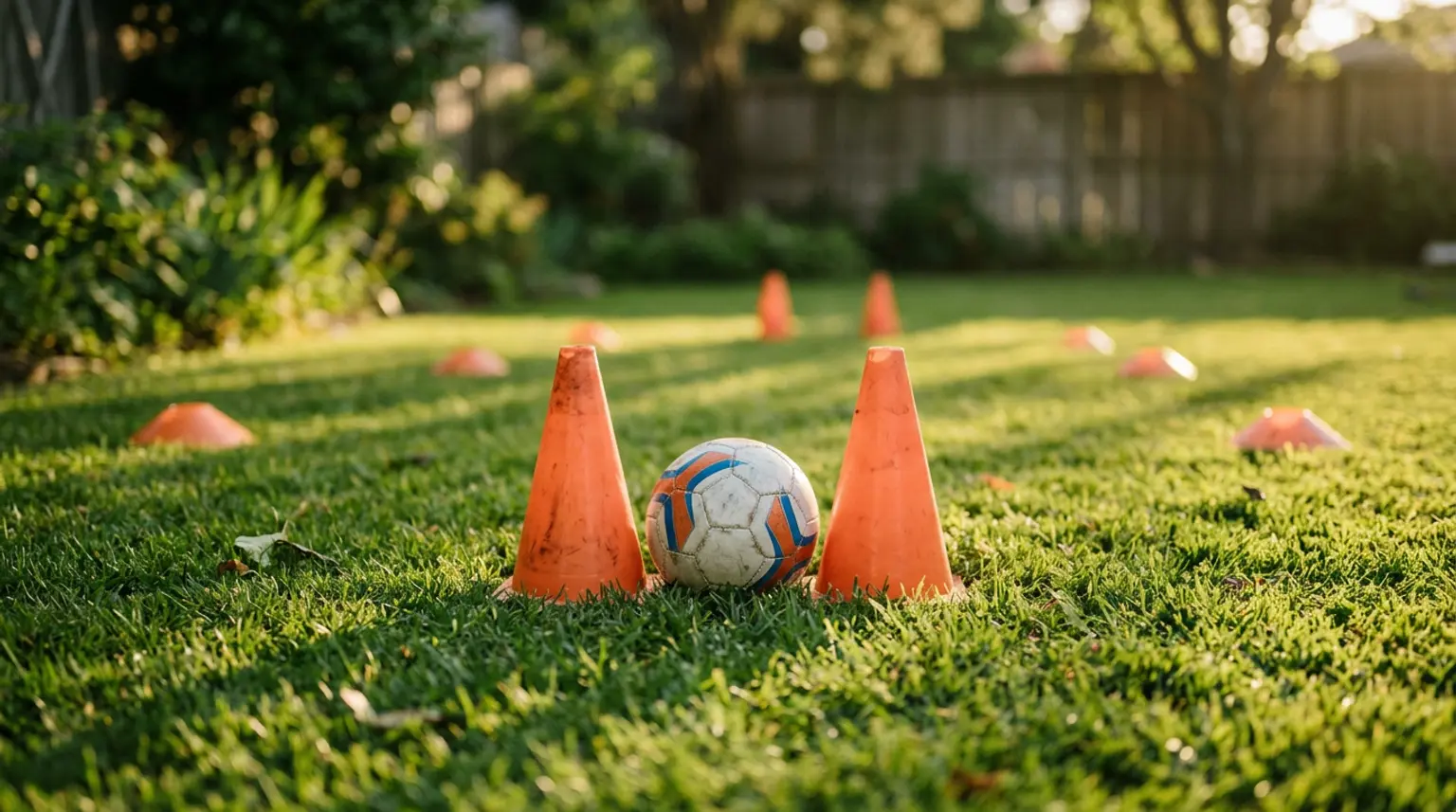
Set up 5 to 6 cones (or water bottles) in a straight line, about 2 to 3 feet apart. Dribble through them using close touches. Go through and back. Time each run if the child is competitive.
Progression by age: U7 to U8: walk through, focusing on control. U8 to U10: jog through, use both feet. U10 to U12: sprint through, timed runs, use only the outside of the foot or only the weaker foot.
Free dribble
No cones, no course. Just dribble around a small area (a driveway, backyard, or room) using different parts of the foot. Change direction randomly. Change speed. Experiment with moves. This is the most underrated dribbling drill because it mimics the unstructured dribbling that happens in a real game.
For younger kids (U6 to U8), this should be the primary dribbling activity. Let them explore. Let them lose the ball. Let them figure out how to keep it close. Over-structuring dribbling practice at this age reduces creativity.
Dribble and freeze
Dribble freely in a small area. When a parent calls "freeze," the child stops the ball dead under their sole as quickly as possible. This trains the stop-start control that is essential for beating defenders: accelerate to draw them in, stop suddenly to wrong-foot them.
Square dribbling
Mark out a 5 by 5 foot square with cones. Dribble around the perimeter using inside touches, then outside touches, then sole rolls along each edge, then pull-back turns at each corner. One full circuit per technique. This develops control with every surface of the foot in a game-realistic small space.
Shadow dribbling
The child follows a parent or sibling who moves around a space, matching their direction changes, stops, and accelerations while maintaining control of the ball. This builds reactive dribbling: the ability to adjust to what is happening around them rather than following a set pattern.
How should dribbling drills progress by age?
U6 to U7: Free dribble and simple cone courses at walking or jogging pace. Emphasize fun and comfort. 5 to 10 minutes, 3 times per week.
U7 to U9: Add cone slaloms, square dribbling, and dribble-and-freeze. Introduce both-foot requirements. Start timing cone courses for friendly competition. 10 to 15 minutes, 3 to 4 times per week.
U9 to U11: Increase speed. Add 1v1 moves (inside cut, outside hook, step-over). Introduce ball mastery combinations that lead into dribbling acceleration. Dedicated weak-foot sessions. 15 to 20 minutes, 3 to 4 times per week.
U11 to U12: Game-speed dribbling through courses. Multiple-move sequences. Dribbling under fatigue. Competitive timed challenges. Transition toward the more advanced dribbling drills used by U12+ players.
How do you keep dribbling practice fun for kids?
Make it a competition. Time the cone slalom and try to beat yesterday's score. Count how many direction changes in 30 seconds without losing the ball. Any measurable challenge turns practice into a game.
Use gamification. Training apps with points and streaks tap into kids' natural desire to earn and achieve. FlickTec uses FlickPoints and weekly leaderboards so players see their progress and compete with teammates. The 500+ exercises designed by Coach Roman Pivarnik (UEFA Pro Licence, 25+ years at the highest European levels) include age-appropriate dribbling content that keeps young players engaged.
Add variety. Do not repeat the same 3 drills every session. Rotate through different exercises so each session feels fresh. A training app handles this automatically by generating varied sessions daily.
Train with someone. Shadow dribbling with a parent, racing through a cone course against a sibling, or playing soccer games that involve dribbling make practice social and fun.
End on a high. Finish each session with the child's favorite exercise or a free dribbling period. Ending while they are still engaged and happy means they look forward to the next session.
Frequently Asked Questions
How young can kids start dribbling practice?
From age 4 to 5, kids can begin simply kicking and chasing a ball. Structured dribbling drills (cone courses, ball mastery) become appropriate from age 6 to 7 when children can follow guided instructions.
Does my child need special equipment for dribbling drills?
A soccer ball and a small space are all that is required. Cones are useful but water bottles, shoes, or any small objects work as substitutes. No special equipment is needed.
How long before my child's dribbling improves?
With 3 to 4 sessions per week of 10 to 15 minutes, most parents notice improved ball comfort within 2 to 3 weeks. The child will show more willingness to dribble in games and fewer lost balls during close control.
Should dribbling drills be done indoors or outdoors?
Both work. Indoor dribbling (on carpet or hard floor with a smaller ball) develops very close control. Outdoor dribbling on grass is more game-realistic. Alternating between both environments is ideal.
Is dribbling more important than passing for kids?
At young ages (under 10), dribbling and first touch and ball comfort are the priority because they build the foundational relationship with the ball. Passing becomes equally important from U10 onward. Both should be trained, but dribbling comfort comes first for younger players.
A child who is comfortable dribbling a soccer ball plays the game differently. They look up instead of down. They try moves instead of kicking it away. They enjoy having the ball instead of fearing it. That comfort is built through daily dribbling practice at home, and it does not take long to develop.
FlickTec includes dribbling exercises in every personalized session for young players. Start at flicktec.io/players.