How to Run a Productive Youth Soccer Tryout
 Reviewed by Roman PivarnikUEFA Pro Licence · Technical Director, Slovak FA
A productive youth soccer tryout evaluates four things: technical ability on the ball, game intelligence in small-sided play, attitude and coachability, and effort throughout the session. The most common tryout mistake is over-valuing physical attributes like size and speed, which change dramatically as players mature, while under-valuing technique and decision-making, which are far more predictive of long-term development. A well-designed tryout uses structured drills and game situations to reveal the players who will improve the most, not just the ones who dominate on the day.
Running tryouts is one of the hardest responsibilities a coach or Director of Coaching faces. Families invest emotionally and financially. Players are nervous. The pressure to "get it right" is real. This guide provides a practical framework that makes evaluations more consistent and defensible.
What should tryouts actually evaluate?
Technical skill on the ball
This is the most reliable predictor of future development. A player with a clean first touch, comfortable close control, and accurate passing has invested in individual training. That investment signals both current ability and future trajectory.
What to watch for: Can they receive the ball cleanly? Do they use both feet? Is their passing accurate with appropriate weight? Can they dribble with their head up? Do they look comfortable or panicked when the ball is at their feet?
Game intelligence
Technical skill without decision-making is incomplete. Some players have great touch but always make the wrong choice.
What to watch for: Do they look before they receive? Do they find space when their team has the ball? Do they track back when possession is lost? Do they make simple, effective decisions or do they over-complicate?
How to evaluate it: Small-sided games (4v4 or 5v5) are the best evaluation tool. In 15 minutes of 4v4, every player faces dozens of decisions. The players who read the game show up clearly.
Attitude and coachability
Coaches notice which players listen during instructions, respond positively to feedback, and keep working when things go wrong. A player who makes a mistake and immediately recovers shows different character than one who drops their head.
How to evaluate it: Give one clear coaching point mid-session ("I want everyone to check their shoulder before receiving"). Watch who tries to apply it. This is a direct test of coachability.
Effort and competitive intensity
Tryouts are demanding. Players who maintain effort throughout the full session, sprint to loose balls, and compete in every drill demonstrate the kind of commitment coaches want.
How should a tryout be structured?
A 90-minute tryout session works well. Here is a proven structure:
Phase 1: Dynamic warm-up with the ball (10 minutes). Every player with a ball. Dribbling in space, ball mastery sequences, light passing in pairs. This settles nerves and gives evaluators an immediate look at ball comfort.
Phase 2: Technical circuit (15 to 20 minutes). Three or four stations that evaluate core skills. Passing and receiving in small groups. 1v1 to goal. A dribbling exercise with direction changes. Rotate groups every 4 to 5 minutes.
Phase 3: Small-sided games (40 to 45 minutes). This is the core of the evaluation. Run 4v4 or 5v5 games with mixed teams. Change the team compositions every 10 to 12 minutes so players are seen with different teammates and against different opponents.
Phase 4: Cool-down and dismissal (5 to 10 minutes). Light jog, stretching, and a brief address to the group. Thank them for their effort. Communicate next steps and timelines clearly.
How should evaluators score and track players?
Use a simple rubric. A 1 to 4 scale across 4 to 5 categories is more reliable than precise numerical scores.
| Category | 1 (Below Level) | 2 (Developing) | 3 (At Level) | 4 (Above Level) |
|---|---|---|---|---|
| Technical Skill | Cannot control or pass consistently | Inconsistent technique, some comfort | Clean touch, accurate passing, both feet | Exceptional control, creates with the ball |
| Game Intelligence | Rarely in the right position | Reads some situations, often late | Finds space, makes good decisions | Sees the game ahead, anticipates |
| Attitude | Disengaged or disruptive | Listens but does not apply | Listens and tries to apply coaching | Seeks feedback, leads by example |
| Effort | Low energy, avoids competition | Inconsistent effort | Works hard consistently | Competes for everything, full 90 min |
Use multiple evaluators. If possible, have 2 to 3 evaluators score independently. Comparing scores identifies where evaluators agree and where they disagree.
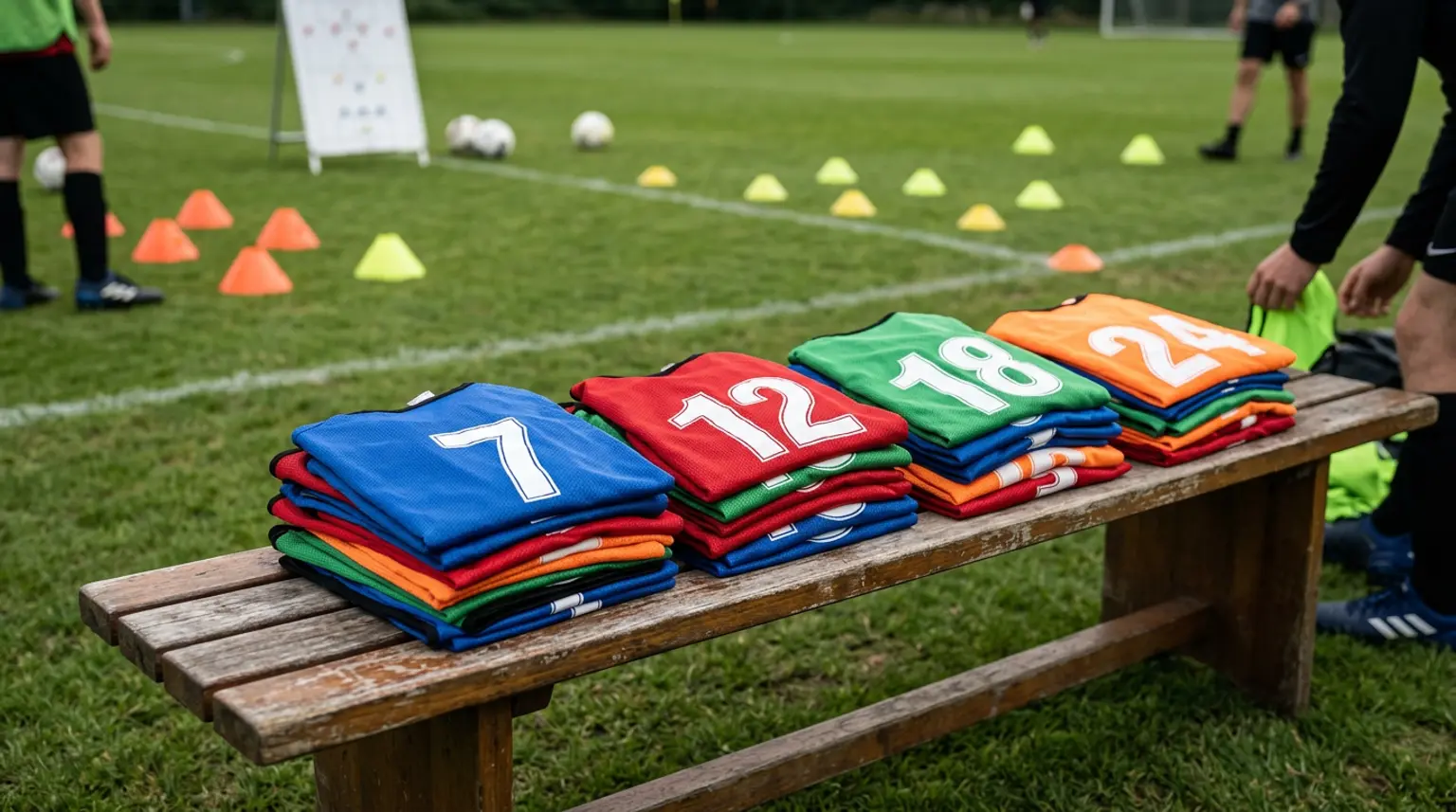
Assign numbered bibs. This allows evaluators to write quick notes by number without losing focus on the field.
What are the biggest tryout mistakes coaches make?
Selecting for size and speed. A physically mature 12-year-old who dominates through power will often plateau by 15 when peers catch up physically. A technically skilled but smaller player often emerges stronger in the long run. Research on the relative age effect consistently shows this pattern.
Over-relying on one session. A single tryout is a snapshot. Some players perform poorly because of nerves. If possible, hold two tryout sessions to give players a more representative opportunity.
Not communicating criteria to families in advance. Parents who understand what evaluators are looking for have more realistic expectations. Publish your evaluation criteria before the tryout. When families understand what skills youth soccer coaches prioritize, they can help their children prepare accordingly.
Ignoring training history. If your club uses a training platform like FlickTec, you may already have data on which players have been training consistently. A player who has completed 60 home training sessions this season and shows steady skill progression is a different proposition than one with the same current skill level but no training habit.
How should coaches communicate results?
Set a clear timeline. Tell families at the tryout when decisions will be communicated and how. Stick to it.
Offer constructive feedback. Players who are not selected deserve to know why and what they can work on. "You were not selected for the top team because your first touch needs more consistency under pressure" is more helpful than "we just didn't have room."
Be honest but kind. Honest feedback, delivered with respect, is what families remember. It also builds the club's reputation as a development organization.
Frequently Asked Questions
How many players should be at each tryout session?
Keep groups to 30 to 40 players per session for practical manageability. With 2 to 3 evaluators, this allows meaningful observation of each player. If you have 80 players trying out, run two sessions and compare scores.
Should tryouts be different for different age groups?
Yes. For U8 to U10, tryouts should feel like a fun training session. Use simple games and observe natural ability, ball comfort, and enthusiasm. Formal evaluation rubrics are more appropriate starting at U11 to U12.
For players preparing ahead of time, how to prepare your child for soccer tryouts is a practical guide.
How do I handle parents who disagree with tryout decisions?
Have a clear, documented evaluation process. Share the criteria in advance. Offer a brief feedback conversation after decisions are made. If a parent remains unhappy, acknowledge their frustration and encourage the player to continue training. A structured home training program like FlickTec gives players a concrete path to improve for next year.
Should fitness testing be part of tryouts?
For U12 and under, no. Fitness differences at this age are primarily driven by physical maturation, not training. For U13+, basic fitness indicators can provide useful data, but they should not outweigh technical and tactical evaluation.
A well-run tryout is fair, transparent, and structured to reveal the players who will develop the most over the coming season. Evaluate what matters: technique, game intelligence, attitude, and effort. Communicate clearly with families.
For tracking player development year-round and giving every player a path to improvement, explore FlickTec for coaches.