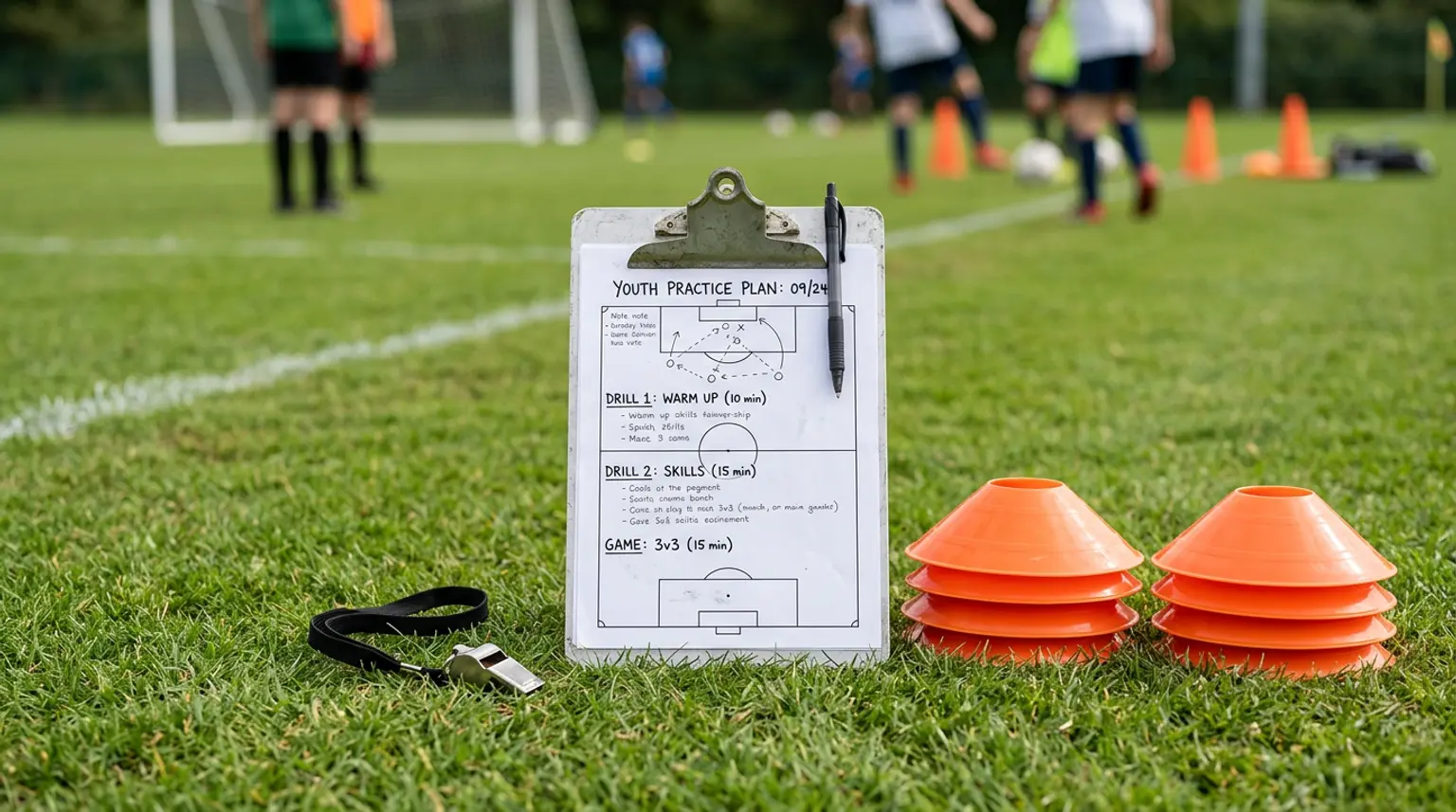
How to Plan a Youth Soccer Practice Session
 Reviewed by Roman PivarnikUEFA Pro Licence · Technical Director, Slovak FA
A well-planned youth soccer practice session follows four phases: a dynamic warm-up (10 to 15 minutes), a technical or tactical training block (15 to 20 minutes), a game-based application block (20 to 25 minutes), and a cool-down (5 minutes). This structure keeps players active, maximizes learning, and ensures that every minute of field time contributes to development. Most youth practices that feel chaotic or unproductive share one root cause: no plan.
Planning does not need to take hours. Once you understand the framework, building a session takes 10 to 15 minutes. The key is knowing what each phase is supposed to accomplish and choosing activities that serve the session's theme.
Why does session structure matter for youth coaches?
A structured session solves three problems at once. First, it keeps all players engaged. Unstructured practices lead to standing in lines, waiting for turns, and losing focus. Second, it creates a learning progression. Players warm up their bodies, practice a skill in isolation, then apply it in a game situation. Third, it makes your limited field time count. Most youth teams get 60 to 90 minutes, two to three times per week. That is not much. Every minute matters.
Research on motor skill learning supports this approach. The Whole-Part-Whole method (sometimes called Play-Practice-Play) is endorsed by US Soccer and coaching organizations worldwide. Players experience the game context first, isolate a specific skill, then return to the game to apply it. The four-phase structure follows this principle.
What does each phase of practice look like?
Phase 1: Dynamic warm-up (10 to 15 minutes)
The warm-up has two jobs: prepare the body for physical activity and get every player touching a ball immediately.
First 5 minutes: movement without the ball. Jogging, high knees, butt kicks, lateral shuffles, leg swings, and walking lunges. These raise heart rate, increase blood flow to muscles, and reduce injury risk. The FIFA 11+ warm-up program has been shown to reduce youth soccer injuries by 30 to 50 percent.
Next 5 to 10 minutes: movement with the ball. Every player gets a ball. Free dribbling in a defined space, ball mastery sequences (toe taps, sole rolls, inside-outside), or partner passing at close range. This activates the technical skills players will need in the main session.
Common mistake: Skipping the warm-up or using it for fitness (laps, sprints). A good warm-up is active, progressive, and ball-involved. Standing in a circle stretching is outdated and does not prepare young players for what comes next.
Phase 2: Technical or tactical training block (15 to 20 minutes)
This is where you teach the session's theme. Pick one skill or concept and build an activity around it.
For younger players (U8 to U10): Keep drills simple, with one or two instructions. Every player should have a ball or be actively involved. Avoid lines. If players are standing still for more than 15 seconds, the activity needs to be redesigned. Good activities for this age include dribbling through gates, 1v1 to mini goals, or passing and receiving in pairs.
For older players (U11 to U14): Activities can include more decision-making. Passing combinations with movement, positional rondos (4v2, 5v2), or directional possession games where players must find a target. The activity should be challenging but achievable for the majority of the group.
Design principle: The technical block should isolate the skill you want players to practice. If today's theme is "playing out from the back," the activity might involve defenders passing through a midfield line under light pressure. The conditions are controlled so players get many repetitions of the target skill.
Phase 3: Game-based application block (20 to 25 minutes)
This is where the session comes alive. Small-sided games (3v3, 4v4, 5v5) or modified scrimmages that naturally create situations where the session's theme appears.
Why small-sided games work: In a 4v4 game, each player touches the ball 3 to 6 times more often than in an 11v11 scrimmage. More touches means more learning. More decisions means faster game intelligence development. US Soccer recommends small-sided games as the primary competition and training format for youth players through U12.
Use conditions to reinforce the theme. If the technical block focused on playing out from the back, the game might award bonus points for building through the thirds. If the theme was 1v1 dribbling, set up a game where players must beat a defender before they can shoot. The conditions guide behavior without over-coaching.
Coach during this phase, not before it. Watch for moments where the session's theme appears naturally. Use brief, specific coaching points: "Good, you checked your shoulder before receiving." "Next time, can you play the first touch forward?" Then let them play. The game is the teacher. You are the guide.
Phase 4: Cool-down (5 minutes)
Light jogging, static stretching, and a brief team huddle. This is the time for two things: physical recovery and a short review.
Ask, do not lecture. "What did we work on today?" "When would you use that in a game?" "What was one thing you did well?" These questions reinforce learning and give players ownership of their development.
How do you choose a theme for each session?
Every session should have one clear theme. Not three. Not "a bit of everything." One theme gives the session focus and ensures players get enough repetition to actually learn something.
Common session themes by category:
Technical: First touch, passing accuracy, dribbling under pressure, crossing, finishing, ball mastery, weak foot development
Tactical: Playing out from the back, pressing as a unit, switching play, creating width, defending 1v1, transition from defense to attack
Position-specific: Striker movement in the box, midfield receiving on the turn, defensive line communication
Choose your theme based on what you observed in the most recent game. If your team struggled to keep the ball under pressure, the next session's theme is possession and composure. If they could not break through a compact defense, work on combination play and movement. Let the game guide the training.
What are the most common practice planning mistakes?
Too many activities. A 60-minute session needs 3 to 4 activities maximum (warm-up, technical block, game, cool-down). Coaches who plan 6 or 7 activities spend more time explaining transitions than actually training.
Activities that do not connect to each other. If the warm-up is dribbling, the technical block is heading, and the game is a regular scrimmage, there is no thread. Every activity should build toward the same theme.
Too much talking. Youth players learn by doing, not by listening. Demonstrations should take 30 seconds, not 3 minutes. Show the activity, say "go," and coach within the activity. A common guideline: for every minute you talk, players should play for five.
No adaptation. If the activity is too easy, players get bored. If it is too hard, they get frustrated. Watch the first 2 minutes and adjust. Make the space smaller or bigger. Add or remove defenders. Change the scoring rules. Good coaching is good adjusting.
How does individual home training complement practice sessions?
Team practice teaches tactics, communication, and game application. What it cannot provide is enough individual ball contacts to build technical skill. In a 60-minute team session, each player gets roughly 80 to 150 individual ball touches. A 15-minute home session with an app like FlickTec produces 500 or more.
Coaches who assign or encourage structured home training see players arrive at practice with better ball comfort, sharper first touch, and more confidence to attempt the skills being taught. The practice session becomes more productive because the technical baseline is higher. FlickTec's 500+ video exercises, designed by Coach Roman Pivarnik (UEFA Pro Licence, 25+ years professional coaching), give coaches a way to extend their methodology beyond field time without adding to their own workload.
Frequently Asked Questions
How long should a youth soccer practice be?
For U8 to U10, 45 to 60 minutes is appropriate. For U11 to U14, 60 to 75 minutes. For U15 and up, 75 to 90 minutes. Younger players lose focus in longer sessions, and extending practice beyond their attention span reduces learning quality.
Should every practice include a scrimmage?
Yes. Game-based play should be part of every session because it is where players apply skills in a realistic context. The scrimmage does not need to be a full-field 11v11. Small-sided games (3v3 to 5v5) with conditions tied to the session theme are more effective for learning.
How far in advance should coaches plan sessions?
Planning a week at a time works well for most coaches. Review the last game, identify a theme for the week, and build 2 to 3 sessions around it. Having a seasonal plan with monthly themes helps ensure you cover all skill areas over the course of the season.
What if I am a volunteer coach with limited soccer knowledge?
Start with the four-phase structure and keep activities simple. Small-sided games with basic rules teach more than complex drills. Use coaching resources like the FlickTec blog for session ideas, and consider taking a US Soccer Grassroots coaching course, which is designed specifically for beginning coaches.
A well-structured practice does not require coaching genius. It requires a plan: warm up, teach a skill, apply it in a game, cool down. Stick to one theme, keep everyone moving, and adjust as you go. The players will do the rest.
For extending your coaching methodology beyond practice with daily guided home training, explore FlickTec for coaches.