How to Assess Player Progress Without Formal Testing
 Reviewed by Roman PivarnikUEFA Pro Licence · Technical Director, Slovak FA
Coaches can assess player progress without formal testing by tracking three things: training consistency (how often and how seriously the player practices), observable game behavior changes (what the player attempts and executes in matches compared to last month), and skill progression data from training platforms. Formal fitness tests and timed drills measure performance on a given day. They do not measure development over time. The most useful assessment methods for youth coaches are the ones embedded in daily coaching, not added on top of it.
Many coaches feel pressure to conduct formal assessments (beep tests, timed sprints, passing accuracy tests) because they seem rigorous and objective. In reality, these tests consume valuable training time, create anxiety in young players, and produce numbers that are difficult to interpret without sport science expertise. There are better ways to track who is improving.
Why are formal tests a poor fit for most youth soccer clubs?
They measure the wrong things at younger ages
A timed sprint tells you how fast a U10 player is today. It does not tell you whether their ball control has improved, whether they are making better decisions in games, or whether they have developed the training habit that drives long-term growth. Physical attributes at U10 are mostly a function of biological maturation, not training quality.
They create anxiety without actionable insight
For many youth players, test days feel like exam days. The pressure to perform can produce results that do not reflect true ability. A nervous player who runs a slow shuttle time is not necessarily unfit. They are nervous. The test told you about their anxiety, not their fitness.
They take time away from actual training
A 90-minute session spent on fitness testing is a 90-minute session where players are not developing technical skills, playing small-sided games, or receiving coaching. For clubs that only have 2 to 3 sessions per week, that trade-off is hard to justify.
What should coaches track instead?
Training consistency and volume
The single most predictive indicator of player development is how consistently they train. A player who practices 4 to 5 times per week (including both team sessions and home training) will improve faster than a player who only trains with the team. This is not a test. It is a fact that coaches can observe.
How to track it: If your club uses a home training platform like FlickTec, training completion data is collected automatically. Coaches can see which players completed sessions, how many days per week they trained, and whether they maintained consistency over weeks and months. This data is more useful than any timed test because it measures the input (training volume) that drives the output (improvement).
If you do not use a platform, even a simple check-in works. A coach who helps players build a soccer training habit creates the consistency that development requires. Ask players at the start of each practice: "How many times did you touch the ball at home this week?" Track the answers. Over a season, the patterns become clear.
Observable game behavior changes
This is the assessment method that experienced coaches use instinctively. You watch a player in September and note what they do. You watch the same player in December and compare. The changes (or lack of changes) tell you everything.
Specific behaviors to observe:
First touch quality. Does the player's first touch settle the ball cleanly, or does it bounce away? Is the first touch directional (moving the ball into space) or static (stopping the ball dead)? Improvement in first touch is one of the earliest visible signs of individual training.
Willingness to use the weak foot. A player who only used their right foot in September but attempts left-foot passes in December has been working on it. This is not something you test. It is something you notice.
Decision-making speed. Does the player make faster, more confident decisions than they did a month ago? Do they scan before receiving? Decision-making improves gradually and is best assessed through repeated game observation, not a one-off test.
Confidence under pressure. A player who cleared the ball every time they were pressed in October but now turns and plays forward in January has grown. Track whether players are attempting more challenging actions and whether their success rate is improving.
Recovery from mistakes. Does the player bounce back after losing the ball? Do they chase, recover, and re-engage? This behavioral change reflects both technical growth and mental development.
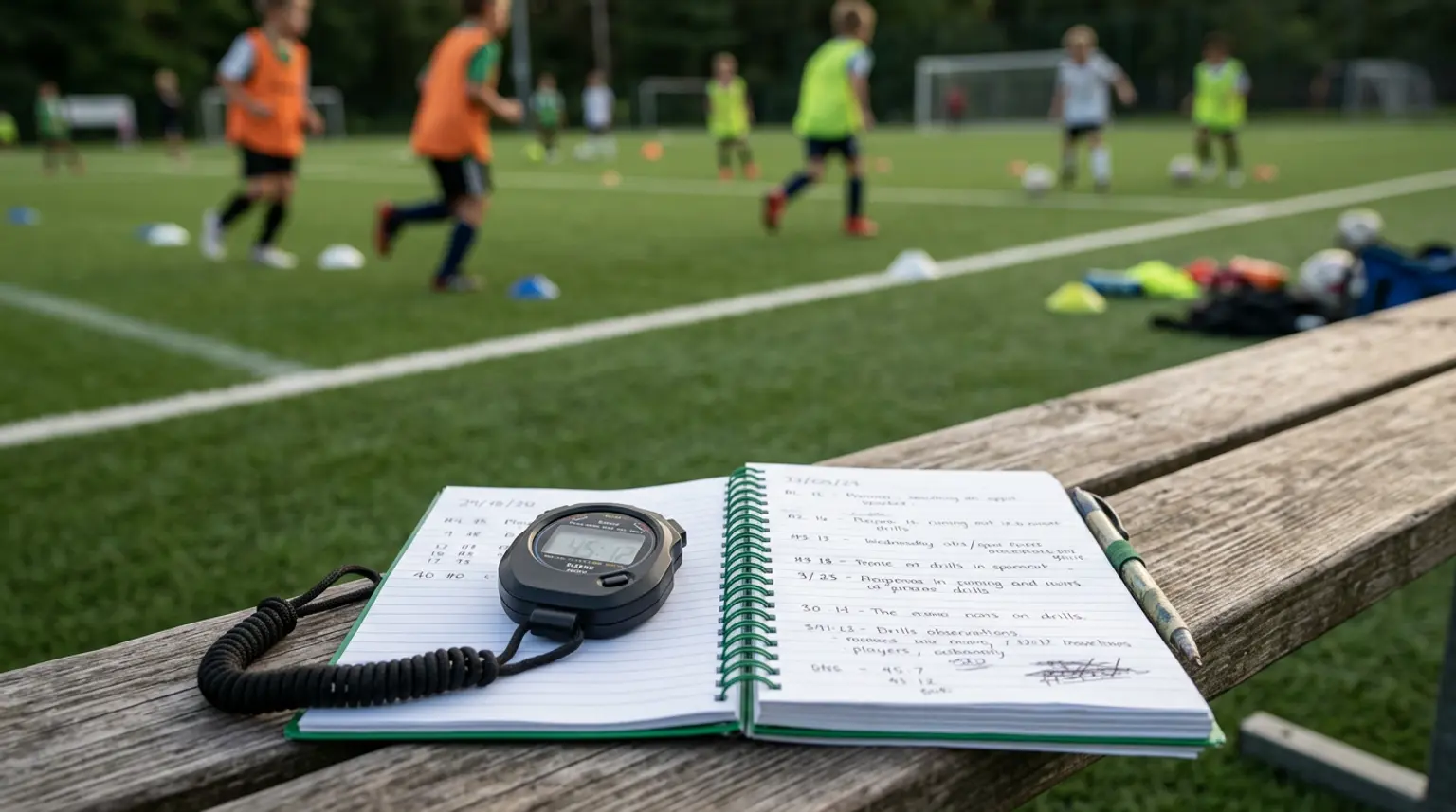
How to track it: Keep brief notes after each game. Not a formal evaluation form. Just 2 to 3 sentences per player on what you noticed. "Player 7: first touch much cleaner this month. Starting to receive on the back foot. Still avoids weak foot in the final third." Over a season, these notes create a rich developmental picture.
Skill progression data from training platforms
Modern training platforms track skill development automatically as players complete sessions. This eliminates the need for coaches to design tests, administer them, and interpret the results.
FlickTec tracks player progress across 8 skill areas (Ball Control, First Touch, Passing, Dribbling, Finishing, Strength, Speed, and Stamina). As players complete guided sessions from the 500+ exercise library designed by Coach Roman Pivarnik (UEFA Pro Licence, 25+ years professional coaching), their skill scores update in real time. Coaches can pull up any player's profile and see their development trajectory without running a single test.
What this looks like in practice: A coach opens the FlickTec dashboard before an IDP review meeting. Player A has trained 4.2 times per week on average, their Ball Control score has risen from 45 to 68 over 3 months, and they have maintained an 18-day training streak. Player B has trained 1.1 times per week, and their scores are flat. No formal test was needed. The data told the story.
Peer and self-assessment (for U11+)
Older players are capable of reflecting on their own development. Giving them a simple framework for self-assessment builds self-awareness and ownership of their improvement.
Simple self-assessment questions (quarterly):
"What is one thing you do better now than 3 months ago?"
"What is one area you want to improve next?"
"How many days per week are you training at home?"
"What skill are you most proud of right now?"
The answers reveal how the player thinks about their own game. A player who says "I improved my weak foot because I practiced wall passing every day" has a growth mindset that predicts future development.
How do you turn these observations into useful assessment data?
Create a simple player development tracker
A shared document with one row per player and columns for:
Training frequency (monthly average). How many sessions per week, including home training?
Key behavior observations (updated monthly). 2 to 3 sentences on what the coach noticed in games.
Skill scores (if using a training platform). Pull directly from the platform dashboard.
Player's self-identified goal. What are they working on?
This takes 5 to 10 minutes per player per month. Over a full season, it produces a far more complete picture of development than any single test day could provide.
Use the data in parent and player conversations
When a parent asks "how is my child doing?", you can answer with specifics. "Your child has trained 3.8 times per week this season. Their first touch has improved noticeably. In the last 3 games, they have started using their left foot for short passes, which they were not doing 2 months ago. The next area to focus on is receiving under pressure."
That answer is more credible, more useful, and more reassuring than any test score could be. It tells the parent that the coach is paying attention, that development is visible, and that there is a clear path forward.
Frequently Asked Questions
Are there any formal tests worth doing for youth soccer players?
Juggling counts and timed dribbling courses can be useful as optional, low-pressure benchmarks that players track against themselves. The key is positioning them as personal challenges ("beat your own record"), not comparative evaluations. Fitness tests like the beep test become more appropriate at U14+ when physical preparation is a genuine part of development.
How do I assess a player I have not coached before?
Tryouts are the one situation where direct observation in a structured setting is necessary. Use small-sided games and basic technical circuits to evaluate technique, game intelligence, attitude, and effort. If possible, also request training history data from the player's previous club or training app.
How often should coaches formally review player progress?
Quarterly reviews (every 3 months) work well for most clubs. Frequent enough to catch trends and adjust goals. Infrequent enough to allow real change to accumulate. Monthly informal observations (game notes) feed into the quarterly reviews.
What if a player is training consistently but not improving visibly?
Check the quality of training, not just the quantity. A player going through the motions for 15 minutes is different from one training with focus and intensity. Also check whether the training content matches the areas that need improvement. If a player needs first touch work but only does ball mastery, the training is consistent but misaligned.
Player assessment does not need to be a separate event. It is something that happens through attentive coaching, consistent tracking, and honest observation. Watch the player. Track the training. Note the changes. The assessment is already happening every time you coach.
For automated skill tracking that gives coaches player development data without manual work, explore FlickTec for coaches.