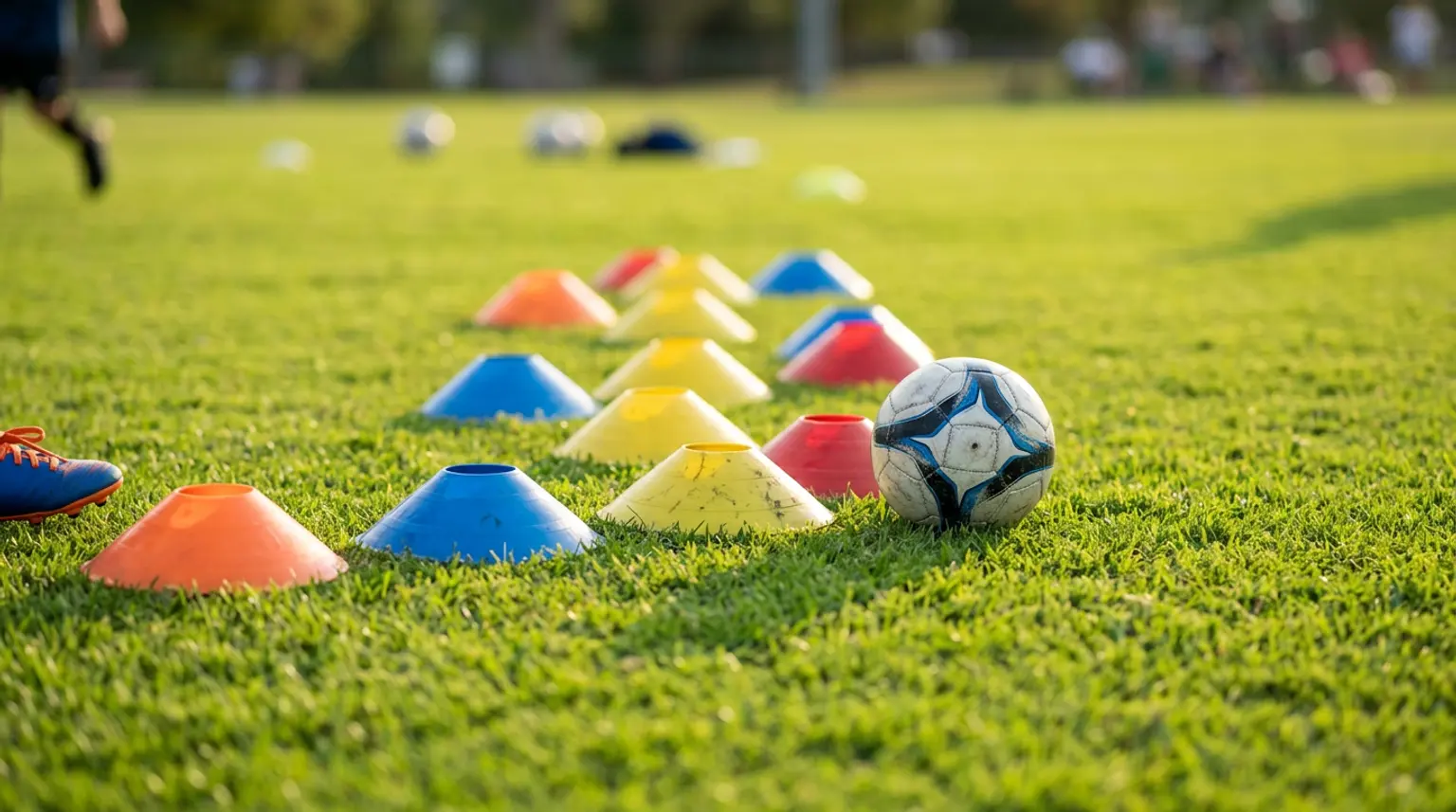
Fun Soccer Drills for Kids Under 10
 Reviewed by Roman PivarnikUEFA Pro Licence · Technical Director, Slovak FA
The best soccer drills for kids under 10 are short, fun activities that build coordination, ball comfort, and a love of the game without feeling like work. At the U6 to U10 age group, the priority is developing a positive relationship with the ball through playful repetition, not running structured tactical sessions. Kids who enjoy training at this age build habits that carry them through years of development. Kids who are bored or overwhelmed quit.
Youth soccer development research consistently shows that players under 10 benefit most from high-touch, low-pressure activities. The focus should be on individual ball contact, basic coordination, and fun challenges rather than team tactics or position-specific work. At this age, every player should be touching the ball as much as possible, with both feet, in activities that feel like games.
What makes a drill "fun" for kids under 10?
Young players are motivated by challenge, variety, and a sense of accomplishment. A drill is fun when it has a clear goal (beat your score, complete the course, keep the streak going), it is short enough to hold attention (30 to 90 seconds per activity), and it changes frequently within a session.
The biggest mistake coaches and parents make is running the same drill for too long. A 7-year-old doing the same cone dribble for 10 straight minutes will disengage. The same 7-year-old doing 6 different activities for 90 seconds each will stay locked in for the entire session.
Gamification helps enormously. Counting touches, timing courses, earning points, and competing against their own previous score gives kids an internal motivator that keeps them practicing without being pushed.
What types of drills work best for this age group?
Ball mastery games
Ball mastery is the single most important skill category for kids under 10. The goal is building comfort and confidence with the ball at the feet through hundreds of touches per session.
Toe taps. Stand over the ball and alternate tapping the top with each foot as fast as possible. Count how many in 30 seconds and try to beat the score next time. This is simple, measurable, and kids love the challenge of improving their number.
Sole rolls. Roll the ball forward and back under one foot, then switch. Progress to rolling side to side. This builds the feel for the ball that makes close control natural later.
Around the world. Move the ball around the body using the inside and outside of both feet in a circle. Reverse direction. This develops comfort using all surfaces of the foot.
Tick-tock. Pass the ball back and forth between the inside of both feet while standing still. Increase speed gradually. This is the foundation of quick feet in tight spaces.
Dribbling challenges
Cone slalom. Set up 5 to 6 cones (or water bottles, shoes, anything) in a line about 3 feet apart. Dribble through them as fast as possible with close control. Time each run. Kids naturally want to beat their time.
Treasure hunt. Scatter 8 to 10 cones around a small area. The player dribbles to each cone, picks it up (while keeping a foot on the ball), and brings it back to a "home base." Race against the clock. This adds decision-making and spatial awareness to basic dribbling.
Freeze dribble. Dribble freely in a small area. When a parent or coach shouts "freeze," the player must stop the ball dead under their sole as fast as possible. This builds the stop-start control that transfers directly to games.
Coordination and movement
Jumping sequences. Two-foot hops, single-leg hops, lateral jumps over a line. These develop the athletic foundation that supports all soccer movement. Keep them short (20 to 30 seconds) and playful.
Shadow moves. The parent or coach performs a movement (jump, shuffle, spin) and the child copies it immediately. This builds reaction time and body awareness in a game-like format.
Ladder patterns (no ladder needed). Use chalk lines, tape, or imaginary squares. Step in and out with quick feet in various patterns. This develops foot speed and coordination that directly improves dribbling.
How long should a session be for kids under 10?
10 to 15 minutes is the sweet spot for U6 to U8 players. 15 to 20 minutes for U8 to U10. These durations match young children's attention spans and leave them wanting more, which is exactly the feeling you want them to have after training.
A well-structured session at this age might look like: 2 minutes of warm-up (light jog, dynamic movements), 8 to 12 minutes of rotating through 4 to 6 activities (60 to 90 seconds each), and 2 minutes of cool-down stretching.
Three to four sessions per week is plenty. The compound effect of consistent short sessions is powerful. A child who does 12 minutes of ball mastery 4 times a week for a month accumulates over 3 hours of pure ball contact, which is more individual touch time than most kids get in 2 months of team practice.
Should kids under 10 do conditioning drills?
Very light conditioning can be woven into the session, but it should never feel like exercise. At this age, conditioning happens naturally through the movement in ball mastery and dribbling drills. A child chasing cones while dribbling is conditioning. A child doing fast toe taps for 30 seconds is conditioning.
Dedicated running, sprints, or formal HIIT training is not necessary or appropriate for most kids under 10. Their bodies are still developing, and the focus should be on coordination, movement quality, and ball skill, not physical output. Conditioning becomes more structured from U11 and up.
Should kids this age use both feet?
Absolutely, and this is the perfect age to develop it. Young children's neural pathways are highly adaptable. If a child practices with both feet from age 6 or 7, using their weaker foot becomes natural rather than forced.
The rule of thumb: every ball mastery drill should be done with both feet. Toe taps alternate naturally. Sole rolls should be done with the left foot and the right foot. Dribbling courses should be completed going both directions. If a child only practices with their dominant foot at this age, the weak-foot gap becomes much harder to close later.
How do you keep kids under 10 coming back to train?
Make it a routine, not a negotiation. "After school, we do 12 minutes of soccer, then you have free time." Attaching it to an existing habit removes the daily decision.
Use a training app with gamification. When a child earns points, sees a streak counter, and can compare with teammates on a leaderboard, the motivation becomes internal. FlickTec uses FlickPoints and weekly streaks that tap into kids' natural competitiveness. The 500+ exercises, designed by Coach Roman Pivarnik (UEFA Pro Licence, 25+ years coaching at the highest European levels), include age-appropriate content for players as young as 8.
Celebrate effort, not perfection. "You beat your toe tap score from yesterday!" matters more than "Your technique needs work." At this age, building the habit of daily practice is more valuable than any single skill. You can help your child build confidence by emphasizing progress and effort.
Train together. Parents, siblings, or friends joining makes it social. A parent doing toe taps alongside their 8-year-old turns training into quality time.
What should you avoid with kids under 10?
Sessions longer than 20 minutes. Younger kids lose focus. Better to end while they are still engaged and wanting more.
Drills that involve long lines or waiting. If a child is standing around waiting for a turn, they are not developing. Every drill should keep every player active.
Too much coaching and correction. Let them explore and make mistakes. A 7-year-old does not need detailed technical feedback on their sole roll. They need repetitions and encouragement.
Competition that discourages. Comparing kids against each other at this age can backfire. Competing against their own previous score is more effective and builds intrinsic motivation.
Skipping the fun. If a child dreads training, no amount of perfect drill selection will help. The number one goal at this age is that the child enjoys training and wants to do it again tomorrow.
Frequently Asked Questions
At what age can kids start structured soccer training at home?
Most children can begin simple, guided home training between ages 6 and 8. Sessions should be 10 to 15 minutes, focused on ball touches and coordination, and supervised by a parent. By age 8 to 9, most kids can follow app-guided sessions with video demonstrations independently.
Do kids under 10 need any equipment for home training?
A soccer ball (size 3 for U6 to U8, size 4 for U8 to U10) and a small space are all that is needed. Cones are helpful but water bottles or shoes work fine as substitutes. No special equipment is required.
How do I know if my child is improving?
At this age, the clearest signs of improvement are increased comfort with the ball (fewer misplaced touches), willingness to try new moves, and growing confidence during games. Formal measurement is less important than consistent practice. Most parents notice visible changes within 2 to 3 weeks of regular home training.
Should kids under 10 specialize in a position?
No. Players under 10 should play multiple positions and focus on general ball skills, coordination, and movement. Position-specific training becomes more relevant from U12 and up. At this age, versatility and broad skill development matter more than role specialization.
Is it normal for young kids to lose interest in training?
Yes. Attention and motivation fluctuate at this age. The solution is not to push harder but to keep sessions short, varied, and fun. If interest drops, try new drills, add a friend, or take a few days off. Forcing training at this age risks creating a negative association with practice that is hard to undo later.
The best thing a parent or coach can do for a soccer player under 10 is make training fun, short, and consistent. Build the habit. Build the ball comfort. Build the love of the game. The technical details and tactical sophistication come later, but only if the child still wants to play.
FlickTec generates age-appropriate daily sessions for young players with gamification that keeps them coming back. Explore training at flicktec.io/players.