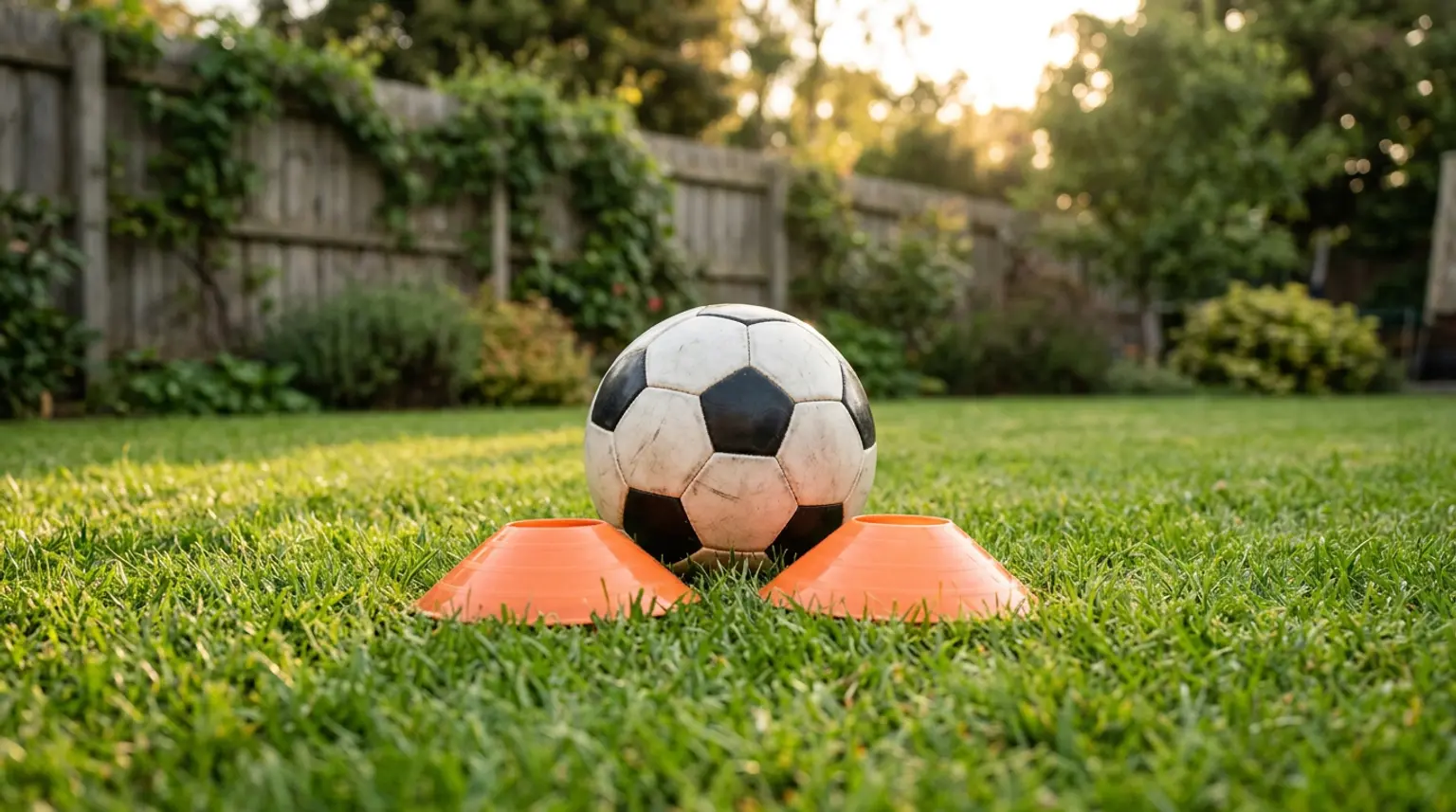
Best Soccer Drills for Kids to Do at Home
 Reviewed by Roman PivarnikUEFA Pro Licence · Technical Director, Slovak FA
Home training is one of the most effective ways for young soccer players to improve. Research shows that consistent practice at home—even 20 to 30 minutes a few times per week—produces measurable technical improvement in 4 to 8 weeks. Yet many kids do not practice at home, either because they lack ideas or because drills feel boring and isolated. Here are drills that kids actually enjoy and that deliver real results.
The fundamentals of effective home training
Before the drills: good home training has three ingredients: Small space (a backyard or park works fine). You do not need a full field. Minimal equipment (soccer ball, some cones or water bottles, maybe a wall). Short sessions (15 to 30 minutes). Kids do not need a two-hour weekend academy.
The goal is consistency, not intensity. Twenty minutes 3 times per week is more valuable than two intense sessions per month.
Best soccer drills for kids to do at home
1. Wall passes (first touch and passing accuracy)
Setup: Stand about 8 to 10 feet from a wall, fence, or rebound board.
Drill: Pass the ball against the wall with your right foot. Receive it (control the first touch with your left foot). Pass it back with your left foot. Receive with your right. Continue alternating.
Progression:
- Start slowly and focus on controlling the first touch.
- Increase speed so the ball returns faster.
- Use only one foot (right foot passes and controls).
- Add a touch between the wall return and your next pass (first touch, one touch away, then pass).
Why it works: Wall passes develop first touch, passing accuracy, and footwork. The ball return is immediate, so your kid stays engaged. This is the single best drill for building technical fundamentals.
Duration: 10–15 minutes.
2. Cone weaving and turns (dribbling and agility)
Setup: Place 4 to 6 cones (or water bottles) in a straight line, about 3 feet apart.
Drill: Dribble the ball through the cones as fast as possible without losing control. Once through, walk back with the ball to the start. Repeat.
Progression:
- Add a figure-eight pattern between two lines of cones.
- Dribble through the cones backward.
- Add a 360-degree turn at the end of the line.
- Place cones tighter (2 feet apart) to increase difficulty.
Why it works: Cone weaving builds foot speed, close control, and edge-of-foot sensitivity. It is fun, measurable (your kid can time themselves), and directly translates to match agility.
Duration: 5–10 minutes.
3. One-touch passes to a wall (ball control and consistency)
Setup: Stand about 12 to 15 feet from a wall with a partner or alone.
Drill (with a partner): Pass the ball to your partner's feet. They receive it and one-touch pass it back to you. You receive it and one-touch pass back. Keep a rhythm.
Drill (alone): Kick the ball against the wall so it returns as a pass. One-touch it back against the wall. Keep a rhythm.
Progression:
- Increase the distance from the wall.
- Increase the pace of the passes.
- Limit your touches to one-touch only (no two-touch control).
- Add directional variety (diagonal passes, wide passes).
Why it works: One-touch passing develops decision-making speed and ball control under pressure. Kids feel a sense of flow and consistency.
Duration: 10–15 minutes.
4. Ball-mastery (feet, thighs, chest, head)
Setup: Just your kid and the ball in an open space (backyard or driveway).
Drill: Perform a sequence of touches to keep the ball in the air or under control:
- Right foot sole taps.
- Left foot sole taps.
- Right knee.
- Left knee.
- Right thigh.
- Left thigh.
- Chest control and drop to feet.
Repeat sequences as many times as possible without the ball dropping.
Progression:
- Increase the pace of touches.
- Increase the number of touches (add head touches).
- Perform sequences while moving in a circle or figure-eight.
- Add a challenge: "Complete 50 consecutive touches without dropping the ball."
Why it works: Ball mastery builds comfort with the ball across all surfaces of the body. It improves coordination, confidence, and touch quality. Kids love the challenge of beating their personal record.
Duration: 5–10 minutes.
5. Short-distance shooting (finishing and accuracy)
Setup: Place a target (a small goal, a cone, a trash can, or a circle drawn on the ground) about 12 to 20 feet away. Use a wall or fence as a backstop.
Drill: Take a few steps and shoot at the target, aiming for accuracy over power. Retrieve the ball and repeat.
Progression:
- Move the target farther away (up to 25–30 feet).
- Add defenders (a friend or family member standing in the way).
- Vary the finish (left foot only, right foot only, instep, outside foot).
- Add pressure: "Five shots in a row, must hit the target at least 3 times."
Why it works: Shooting builds confidence in front of goal. Even young players (U8+) benefit from finishing practice. Short distances keep the success rate high so kids stay motivated.
Duration: 10–15 minutes.
6. In-and-out agility ladder (footwork and quickness)
Setup: Make a simple ladder on the ground using rope and sticks, or draw lines in chalk. Eight to ten squares, each about 18 inches wide.
Drill: Run through the ladder with quick feet:
- Two feet in each square.
- One foot in each square, alternating.
- Lateral movement (side-shuffle through the ladder).
- High knees through the ladder.
Progression:
- Increase speed.
- Add a ball and dribble through the ladder.
- Perform different footwork patterns (crossover steps, backwards, diagonals).
Why it works: Agility ladder drills develop foot speed, coordination, and quickness. They improve on-field agility and are fun because they feel like a game.
Duration: 5–10 minutes.
7. 1v1 in a small space (game awareness and confidence)
Setup: Marks a small space (about 15 x 15 feet or a driveway) with cones or lines.
Drill: You and your kid (or your kid and a friend) play 1v1. Whoever scores the next goal wins.
Progression:
- Play to a certain score (first to 3 goals).
- Vary the rules: "Only use your left foot," or "First touch must be with a specific part of your foot."
- Play with a defender who cannot move more than a few feet (restriction to teach positioning).
Why it works: 1v1 drills are game-realistic and fun. They teach dribbling, defending, and decision-making in high-pressure situations. Kids love competing.
Duration: 10–20 minutes.
8. Passing accuracy course (consistency and decision-making)
Setup: Place cones about 15 feet apart in a line or diamond pattern.
Drill: Move through the course while passing to a partner or wall. At each cone, stop, receive a pass, and pass to the next point.
Progression:
- Increase the distance between cones.
- Increase the pace of play.
- Add defenders who try to intercept (light pressure).
- Vary the type of pass: inside foot, outside foot, sole of foot.
Why it works: Passing courses develop consistency and accuracy under slight fatigue and pressure. They simulate match conditions.
Duration: 10–15 minutes.
How to structure a 30-minute home training session
- 5 minutes: Dynamic warm-up (light jogging, leg swings, activation).
- 10 minutes: Technical work (wall passes or ball mastery exercises).
- 10 minutes: Agility or dribbling (cone weaving or ladder work).
- 5 minutes: Shooting or a fun competitive drill (1v1 or accuracy course).
Switch drills every week so your kid does not get bored.
Making home training fun
- Track progress: Time cone weaving runs or count successful wall passes. Kids love beating their personal best.
- Compete: Make drills competitive (1v1, scoring challenges, "how many in a row").
- Vary the equipment: Use water bottles, cones, chalk, walls, or nets to keep things fresh.
- Play together: Your kid is more motivated if you join in.
- Celebrate improvement: Point out progress (faster feet, better first touch, more accurate passing). Encouragement goes a long way.
The bottom line
Home training does not require expensive equipment, a perfect space, or long sessions. Twenty to thirty minutes of focused, consistent practice 3 times per week produces measurable improvement in first touch, dribbling, passing, and finishing. The drills above are proven, fun, and easy to set up. Start with wall passes and cone weaving—they deliver the most bang for effort—then mix in soccer dribbling drills for kids to keep things fresh. Your kid will see improvement in 4 to 8 weeks, and that improvement fuels motivation to keep training.
Ready to make home training a daily habit? Explore FlickTec's training platform with personalized sessions and progress tracking designed specifically for young players.